

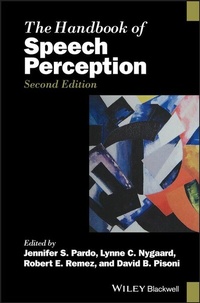
The Handbook of Speech Perception
Description

Speech perception is a dynamic area of study that encompasses a wide variety of disciplines, including cognitive neuroscience, phonetics, linguistics, physiology and biophysics, auditory and speech science, and experimental psychology. The Handbook of Speech Perception, Second Edition, is a comprehensive and up-to-date survey of technical and theoretical developments in perceptual research on human speech. Offering a variety of perspectives on the perception of spoken language, this volume brings together original essays by leading researchers on the major issues and most recent findings in the field.
The second edition features revisions of chapters original to the first edition as well as newly commissioned essays on topics including the relation between speech perception and reading, features in speech perception and lexical access, perceptual identification of individual talkers, and perceptual learning of accented speech. Each chapter provides an informed and critical survey, including a summary of current research and debate, clear examples and research findings, and discussion of anticipated advances and potential research directions.
Offering critical introductions to recent research literature and leading field developments, The Handbook of Speech Perception, Second Edition, provides readers with a clear understanding of the aims, methods, challenges, and prospects for advances in the field. This handbook is ideal for both specialists and non-specialists throughout the research community looking for a comprehensive view of the latest technical and theoretical accomplishments in the field as well as those interested in the development of multidisciplinary research on speech perception.
More details
Other editions
Additional editions
Persons
Jennifer S. Pardo is Professor of Psychology and Director of the Speech Communication Laboratory at Montclair State University, USA. Her research on the production and perception of spoken language in conversational interaction and on understanding variation and convergence in phonetic form has appeared in Journal of Memory and Language, Journal of Phonetics, and Language and Speech.
Lynne C. Nygaard is Professor of Psychology and Director of the Center for Mind, Brain, and Culture, and the Speech and Language Communication Laboratory at Emory University, USA. Her research on the perceptual, cognitive, biological, and social underpinnings of human spoken communication has appeared in many journals, including Psychological Science, Brain and Language, and Cognitive Science.
Robert E. Remez is Professor of Psychology at Barnard College, Columbia University, USA, and Chair of the Columbia University Seminar on Language and Cognition. His research has been published in many scientific and technical journals, including American Psychologist, Developmental Psychology, Ear and Hearing, Experimental Aging Research, Journal of Cognitive Neuroscience, and Journal of Experimental Psychology.
David B. Pisoni is Distinguished Professor of Psychological and Brain Sciences and Chancellor's Professor of Cognitive Science at Indiana University, Bloomington, USA, and Professor in the Department of Otolaryngology at Indiana University School of Medicine, Indianapolis, USA. He has made significant contributions in basic, applied, and clinical research in areas of speech perception, production, synthesis, and spoken language processing.
Content
List of Contributors vii
Foreword to the Second Edition ix
Foreword to the First Edition xi
Preface xiv
Part I Sensing Speech 1
1 Perceptual Organization of Speech 3
Robert E. Remez
2 Primacy of Multimodal Speech Perception for the Brain and Science 28
Lawrence D. Rosenblum and Josh Dorsi
3 How Does the Brain Represent Speech? 58
Oiwi Parker Jones and Jan W. H. Schnupp
4 Perceptual Control of Speech 97
K. G. Munhall, Anja]Xiaoxing Cui, Ellen O'Donoghue, Steven Lamontagne and David Lutes
Part II Perception of Linguistic Properties 123
5 Features in Speech Perception and Lexical Access 125
Sheila E. Blumstein
6 Speaker Normalization in Speech Perception 145
Keith Johnson and Matthias J. Sjerps
7 Clear Speech Perception: Linguistic and Cognitive Benefits 177
Rajka Smiljanic
8 A Comprehensive Approach to Specificity Effects in Spoken]Word Recognition 206
Conor T. McLennan and Sara Incera
9 Word Stress in Speech Perception 239
Anne Cutler and Alexandra Jesse
10 Slips of the Ear 266
Z. S. Bond
11 Phonotactics in Spoken]Word Recognition 286
Michael S. Vitevitch and Faisal M. Aljasser
12 Perception of Formulaic Speech: Structural and Prosodic Characteristics of Formulaic Expressions 309
Diana Van Lancker Sidtis and Seung yun Yang
Part III Perception of Indexical Properties 333
13 Perception of Dialect Variation 335
Cynthia G. Clopper
14 Who We Are: Signaling Personal Identity in Speech 365
Diana Van Lancker Sidtis and Romi Zäske
15 Perceptual Integration of Linguistic and Non]Linguistic Properties of Speech 398
Lynne C. Nygaard and Christina Y. Tzeng
16 Perceptual Learning of Accented Speech 428
Tessa Bent and Melissa Baese]Berk
17 Perception of Indexical Properties of Speech by Children 465
Susannah V. Levi
Part IV Speech Perception by Special Listeners 485
18 Speech Perception by Children: The Structural Refinement and Differentiation Model 487
Susan Nittrouer
19 Santa Claus, the Tooth Fairy, and Auditory]Visual Integration: Three Phenomena in Search of Empirical Support 517
Mitchell S. Sommers
20 Some Neuromyths and Challenging Questions about Cochlear Implants 540
Cynthia R. Hunter and David B. Pisoni
21 Speech Perception Following Focal Brain Injury 570
Emily B. Myers
Part V Theoretical Perspectives 603
22 Acoustic Cues to the Perception of Segmental Phonemes 605
Lawrence J. Raphael
23 On the Relation between Speech Perception and Speech Production 632
Jennifer S. Pardo and Robert E. Remez
24 Speech Perception and Reading Ability: What Has Been Learned from Studies of Categorical Perception, Nonword Repetition, and Speech in Noise? 656
Susan Brady and Axelle Calcus
25 Cognitive Audiology: An Emerging Landscape in Speech Perception 697
David B. Pisoni
Index 733
List of Contributors
Faisal M. Aljasser is an associate Professor of Applied Linguistics in the Department of English language and Translation, College of Arabic Language and Social Studies at Qassim University. He received his Ph.D. in Applied Linguistics from Newcastle University, UK in 2008. His research centers on the production and perception of Arabic as a native language and as a second language.
Melissa Baese-Berk is the David M. and Nancy L. Petrone Faculty Scholar and Associate Professor of Linguistics at the University of Oregon, where she directs the Speech Perception and Production Laboratory. She earned her PhD from Northwestern University in 2010. Her research focuses on speech perception and production, with special attention to speakers and listeners who do not share a native language with their interlocutor. Her work has been supported by grants from the National Science Foundation. Recent publications have appeared in Cognition, Journal of the Acoustical Society of America, Journal of Phonetics, and Attention, Perception, and Psychophysics.
Tessa Bent is Professor of Speech, Language and Hearing Sciences and director of the Speech Perception Laboratory at Indiana University. She received her Ph.D. in Linguistics from Northwestern University in 2005. Her research focuses on children's and adults' perception and representation of variable speech signals, with a focus on regional dialects and non-native accents. This research is currently supported by a grant from the National Science Foundation and has previously been supported by the National Institutes of Health. She is a Fellow of the Acoustical Society of America.
Sheila E. Blumstein is the Albert D. Mead Professor Emerita of Cognitive, Linguistic, and Psychological Sciences at Brown University. She received her Ph.D. in Linguistics from Harvard University in 1970. She spent her entire professional career from 1970 until 2018 at Brown University. Her research focuses on the neural basis of speech and language and the processes and mechanisms underlying speaking and understanding. She received a Claude Pepper Award from the National Institutes of Health and The Silver Medal in Speech Communication from the Acoustical Society of America and was elected Fellow to a number of professional societies.
Z. S. Bond, Professor Emerita, Ohio University, earned a Ph.D. in linguistics, with psychology and hearing and speech sciences as concentrations, from the Ohio State University. She has worked at the University of Alberta, Ohio University, Ohio State University and the Aerospace Medical Research Laboratory at Wright- Patterson Air Force Base. Her research areas include phonetics, psychology of language, speech perception, and language contact. Currently she is analyzing the pronunciation of Latvian in recordings from WW I. She has published papers in various journals including Journal of the Acoustical Society of America, Language and Speech, Perception and Psychophysics, and Journal of Phonetics. She is a member of Acoustical Society of America, Association for the Advancement of Baltic Studies, Linguistic Society of America and a foreign member of Latvian Academy of Science.
Ann R. Bradlow is the Abraham Harris Professor of Linguistics and Associate Dean for Graduate Studies at Northwestern University. She received her PhD in Linguistics from Cornell University in 1993, and then completed postdoctoral fellowships in Psychology at Indiana University (1993-1996) and Hearing Science at Northwestern University (1996-1998). Over the past three decades, Bradlow has pursued an interdisciplinary research program in acoustic phonetics and speech perception with a focus on speech intelligibility under conditions of talker-, listener-, and situation-related variability. Her work has been supported by grants from the National Institutes of Health. Recent publications have appeared in the Journal of the Acoustical Society of America, Journal of the Association for Laboratory Phonology, International Journal of Audiology, Applied Psycholinguistics, Journal of Phonetics, Language & Speech, and Bilingualism, Language, & Cognition.
Susan Brady received her Ph.D. in Cognitive Psychology at the University of Connecticut in 1975 and presently is an Emerita Professor of Psychology at the University of Rhode Island. She has held additional positions at the University of Sussex, St. Andrews University, and Haskins Laboratories. Concentrating on topics in the field of reading, her research has focused primarily on the roles of speech perception and verbal working memory in individual differences in reading ability. Likewise, she has endeavored to translate the implications of the larger body of reading research for practice, and has conducted professional development projects for educators.
Axelle Calcus is an Assistant Professor of Psychology at Université Libre de Bruxelles (Brussels, Belgium). She received her PhD in Psychology in 2015, and worked as a postdoctoral researcher at Boston University (MS, United States), University College London (London, UK) and Ecole Normale Supérieure (Paris, France). Her main research interest focuses on the development of perception of speech in noise in children with and without hearing difficulties. Her work has been supported by awards from H2020 (European Commission). She is a member of the board of the Belgian association for audiology, and of the executive committee of the Belgian association for psychological sciences. Her recent work has been published in Developmental Science and eLife.
Cynthia G. Clopper is Professor of Linguistics at Ohio State University and a Fellow of the Acoustical Society of America. She received her Ph.D. in Linguistics and Cognitive Science from Indiana University and held post-doctoral positions in Psychology at Indiana University and in Linguistics at Northwestern University before joining the faculty at Ohio State. Her major areas of expertise are phonetics, speech perception, sociophonetics, and laboratory phonology. Dr. Clopper's current research projects examine the effects of geographic mobility and linguistic experience on cross-dialect lexical processing, the relationships between linguistic and indexical sources of variation in speech processing, and regional prosodic variation in American English.
Anja-Xiaoxing Cui is a postdoctoral fellow at the University of British Columbia and visiting professor of systematic musicology at Osnabrück University. She studied psychology and piano performance before receiving her Ph.D. in Cognitive Neuroscience from Queen's University in 2019. Her research centers on auditory processing and the interactions of music and learning, and has been supported by NSERC and the Social Sciences and Humanities Research Council of Canada. Anja received additional support through the German Academic Exchange Service and the German Academic Scholarship Foundation.
Anne Cutler is Distinguished Professor at the MARCS Institute, Western Sydney University, Australia. She studied languages and psychology in Melbourne, Berlin and Bonn, took a PhD in psycholinguistics at the University of Texas, held positions at MIT, Sussex University and the MRC Applied Psychology Unit (Cambridge, UK), and then from 1993 to 2013 was Director and Comprehension Group head at the Max Planck Institute for Psycholinguistics in Nijmegen, The Netherlands. Her research concerns listening to spoken language, and in particular how native language experience tailors speech decoding processes. She is an elected member of national academies in Europe, the US and Australia.
Josh Dorsi is a Postdoctoral Scholar in the Neurology Department of the Penn State College of Medicine. He received his Ph.D. in Psychology from the University of California, Riverside in 2019. His research investigates the role of multisensory and lexical information in supporting speech perception, as well as the role of crossmodal correspondences in speech and language pathologies. Some recent publications of this work have appeared in Attention, Perception, & Psychophysics; The Quarterly Journal of Experimental Psychology; and the Journal of Cognitive Psychology.
Cynthia R. Hunter is Assistant Professor of Speech-Language-Hearing and Director of the Speech Perception, Cognition, and Hearing Laboratory at the University of Kansas. She earned her Ph.D. in Psychology from the StateUniversity of New York at Buffalo in 2016, and completed postdoctoral fellowships at Indiana University and the Indiana Clinical and Translational Sciences Institute. Her research centers on the neural and cognitive factors that allow individuals with and without hearing loss to understand speech in adverse listening conditions. Her recent workhas appeared in Ear and Hearing, Journal of Speech, Language, and Hearing Research, Neuropsychologia, and Brain and Language.
Sara Incera is an Assistant Professor of Psychology and Director of the Multilingual Laboratory at Eastern Kentucky University. She received her Ph.D. in Psychology from Cleveland State University in 2016, Conor McLennan was her Ph.D. advisor. Her research interests include foreign accents, bilingualism, and language development across the lifespan. Her most recent work has focused on the relationships between language and emotion. Her articles have been published in Cognition & Emotion, Journal of Psycholinguistic Research,...
