

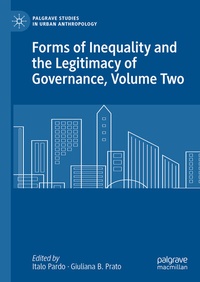
Forms of Inequality and the Legitimacy of Governance, Volume Two
Description

This edited volume uses ethnographic cases to examine social, political, and economic inequality in diverse urban settings. This book is couched in the idea that ethnographically-based analysis helps to bring out the nature and interconnections between different forms of inequality and sheds light on the major forces that combine to create inequalities. Ethnography also helps to identify the dynamics that undergird the principle of freedom of thought and of action - a key principle, that is, of associated life in a democracy - and recognize empirically that these dynamics not only protects difference but increase it, for they underpin the freedom of the individual to use their talents to manage their lives and achieve their goals. This second volume in a two-part series focuses on housing and residential patterns, development and urban regeneration, and education. This book will be of interest to scholars and students in sociocultural anthropology, sociology, politics, socio-legal studies, urban change, education.
More details
Other editions
Additional editions
Persons
Italo Pardo is Honorary Professor of Social Anthropology at the University of Kent, UK. He established and co-edits the journal Urbanities and co-founded and presides over the not-for-profit association, International Urban Symposium-IUS.
Giuliana B. Prato is Honorary Professor of Social Anthropology at the University of Kent, UK. Having chaired the Commission on Urban Anthropology (IUAES) for many years, she co-founded the International Urban Symposium-IUS, of which she is Secretary-Treasurer, and co-founded and serves on the Board of Urbanities .
Content
Chapter 1. Notes on Forms of Inequality: Urban Dynamics and Choice.- Chapter 2. Citizenship as Reward: Migration and the Spatiotemporal Politics of City-Making in Southwest China.- Chapter 3. Mapping Differences and Inequalities on the Urban Residential Patterns.- Chapter 4. Discovering Community in Urban Society: Autoethnography of a Journey.- Chapter 5. Reclaiming the Mediterranean City: Contesting the Legitimacy of Urban Renewal Projects and the Airbnb Economy in Marseille.- Chapter 6. The Other Public Space: Questioned Legitimacies and Highlighted Inequalities Underneath an Overpass.- Chapter 7. Disaster, Risk and Housing Crisis in Istanbul.- Chapter 8. Beyond the Disaster: Vulnerability of Governance in the Turkey-Syria Earthquake.- Chapter 9. Social Moral Dilemmas: A Case Study of Exclusion, Dehumanization and Stigma.- Chapter 10. Language Entanglements and Educational Exclusions: Publicness, Education and the Legitimacy of Governance.- Chapter 11. Class Legitimacy, and Individual Choice: An Ethnographic Study of Indian Urban Middle Class Intimate Relationships.
