

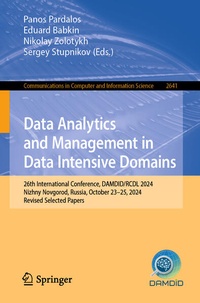
Data Analytics and Management in Data Intensive Domains
Description

This book includes the revised selected papers from the 26th International Conference on Data Analytics and Management in Data Intensive Domains, DAMDID/RCDL 2024, held in Nizhny Novgorod, Russia, during October 22-25, 2024.
The 15 full papers and 5 short papers presented in this volume were carefully reviewed and selected from 71 submissions. They focus on Conceptual Modeling and Ontologies; Generative and Transformer-Based Models; Machine Learning Methods and Applications and Statistical Methods and Applications.
More details
Other editions
Additional editions
Content
.- Conceptual Modeling and Ontologies .
.- An Approach to Information Security Domain Analysis for Building a Research Infrastructure.
.- Approach to Developing a Machine Learning Ontology.
.- Metagraph Operations using Bigraph Representation.
.- Ontology and Knowledge Graph of Mathematical Physics in the Semantic Library MathSemanticLib.
.- Data Quality Assessment in Large Spectral Data Collections. States and Transitions.
.- Generative and Transformer-Based Models .
.- Explaining Transformer-Based Models: a Comparative Study of flan-T5 and BERT Using Post-Hoc Methods.
.- Exploring Fine-Tuned Generative Models for Keyphrase Selection: A Case Study for Russian.
.- Applying Generative Neural Networks to Extract Argument Relations from Scientific Communication Texts.
.- An Experimental Study on Cross-Domain Transformer-Based Term Recognition for Russian.
.- On Open Datasets for LLM Adversarial Testing.
.- An LLM Approach to Fixing Common Code Issues in Machine Learning Projects.
.- Machine Learning Methods and Applications .
.- Verifying Factographic Content in Narrative Texts.
.- Decoding the Past: Building a Comprehensive Glagolitic Dataset for Historical Text Analysis.
.- Real-Bogus Classification for ZTF Data Releases: Two Approaches.
.- Prospects for the Use of Artificial Intelligence for Hydrometeorology.
.- Statistical Methods and Applications .
.- Model for Assessing the Need to Involve Users of Social Networks in a Healthy LifeStyle and Giving up Bad Habits According to the Data of a Social Network.
.- Exploring Patterns of Information Literacy Development in Schools: Application of Multilevel Latent Class Analysis to School Students Survey Data.
.- Development and Implementation of Software Application for Comparative Analysis of the Estimates of the Complexity of Text Data.
.- bXES: a Binary Format for Storing and Transferring Software Event Logs.
