

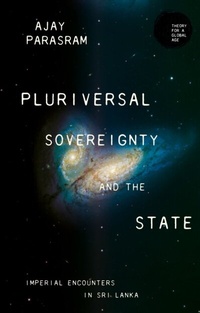
Pluriversal Sovereignty and the State
Imperial Encounters in Sri Lanka
1st Edition
Published on 11. June 2024
208 pages
978-1-5261-4841-4 (ISBN)
Description

This book documents the political and cosmological processes through which the idea of 'total territorial rule' came into being in the context of early- to mid-nineteenth-century Ceylon (Sri Lanka). Analysing ideas at the core of the modern international system, Pluriversal sovereignty and the state develops a decolonial theoretical framework informed by a 'pluriverse' of multiple ontologies of sovereignty to argue that the territorial state itself is an outcome of imperial globalisation.
Anti-colonialism up to the middle of the nineteenth century was grounded in genealogies and practices of sovereignty that developed in many localities. By the second half of the century, however, the global state system and the states within it were forming through colonising and anti-colonising vectors. By focusing on the ontological conflicts that shaped the state and empire, we can rethink the birth of the British Raj and locate it in Ceylon some 50 years earlier than in India. In this way, the book makes a theoretical contribution to postcolonial and decolonial studies in globalisation and international relations by considering the ontological significance of 'total territorial rule' as it emerged historically in Ceylon.
Through emphasising one important manifestation of modernity and coloniality - the territorial state - the book contributes to studies in the politics of ontological pluralism in sovereignty, postcolonial and decolonial international studies, and globalisation through colonial encounters. -- .
Anti-colonialism up to the middle of the nineteenth century was grounded in genealogies and practices of sovereignty that developed in many localities. By the second half of the century, however, the global state system and the states within it were forming through colonising and anti-colonising vectors. By focusing on the ontological conflicts that shaped the state and empire, we can rethink the birth of the British Raj and locate it in Ceylon some 50 years earlier than in India. In this way, the book makes a theoretical contribution to postcolonial and decolonial studies in globalisation and international relations by considering the ontological significance of 'total territorial rule' as it emerged historically in Ceylon.
Through emphasising one important manifestation of modernity and coloniality - the territorial state - the book contributes to studies in the politics of ontological pluralism in sovereignty, postcolonial and decolonial international studies, and globalisation through colonial encounters. -- .
Reviews / Votes
Winner of the 2024 Sussex International Theory PrizeWinner of the 2025 ISA Global Development Studies Book Prize
'Parasram lays out a thought-provoking argument - while European colonialism and European ideas fashioned a territorially grounded account of sovereignty, in that very fashioning we encounter an ontological collision between modernist-liberal accounts of sovereignty and the sovereign traditions of the colonised. When sovereignty is revalued, the consequences are devastating.'
Roshan de Silva-Wijeyeratne, Dundee Law School, University of Dundee
'Parasram's erudite and compelling re-visioning of the colonial encounter via the notion of 'galactic collision' is a joy to read and think with. In reading the ontological foundations of the modern territorial state through what it displaces, the author gives new urgency to the horizons of pluriversal sovereignty for IR. '
Meera Sabaratnam, University of Oxford -- .
More details
Series
Language
English
Place of publication
Manchester
United Kingdom
Target group
College/higher education
Professional and scholarly
Illustrations
3 black & white illustrations
ISBN-13
978-1-5261-4841-4 (9781526148414)
Copyright in bibliographic data and cover images is held by Nielsen Book Services Limited or by the publishers or by their respective licensors: all rights reserved.
Schweitzer Classification
Other editions
Additional editions
Book
11/2023
Manchester University Press
€124.80
Shipment within 15-20 days
Person
Ajay Parasram is an Associate Professor in International Development Studies and History at Dalhousie University in Kjipuktuk, Mi'kma'ki -- .
Content
Introduction: total territorial rule and the universal state
1 Colonial contamination and the postcolonial moment
2 Universal sovereignty: externalizing violence, relational state formation, and empire
3 Universal gaze and pluriversal realities:
4 Ontological collision and the Kandyan Convention 1815
5 The coloniality of the archives
Conclusion: pluriversal sovereignty and research
Index -- .
1 Colonial contamination and the postcolonial moment
2 Universal sovereignty: externalizing violence, relational state formation, and empire
3 Universal gaze and pluriversal realities:
4 Ontological collision and the Kandyan Convention 1815
5 The coloniality of the archives
Conclusion: pluriversal sovereignty and research
Index -- .
