

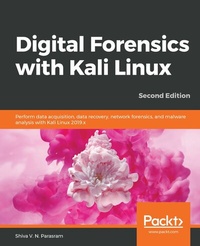
Digital Forensics with Kali Linux
Perform data acquisition, data recovery, network forensics, and malware analysis with Kali Linux 2019.x
2nd Edition
Published on 23. September 2024
334 pages
978-1-83864-410-9 (ISBN)
Description

Take your forensic abilities and investigation skills to the next level using powerful tools that cater to all aspects of digital forensic investigations, right from hashing to reporting
Key Features
Perform evidence acquisition, preservation, and analysis using a variety of Kali Linux tools
Use PcapXray to perform timeline analysis of malware and network activity
Implement the concept of cryptographic hashing and imaging using Kali Linux
Book DescriptionKali Linux is a Linux-based distribution that's widely used for penetration testing and digital forensics. It has a wide range of tools to help for digital forensics investigations and incident response mechanisms. This updated second edition of Digital Forensics with Kali Linux covers the latest version of Kali Linux and The Sleuth Kit. You'll get to grips with modern techniques for analysis, extraction, and reporting using advanced tools such as FTK Imager, hex editor, and Axiom. Updated to cover digital forensics basics and advancements in the world of modern forensics, this book will also delve into the domain of operating systems. Progressing through the chapters, you'll explore various formats for file storage, including secret hiding places unseen by the end user or even the operating system. The book will also show you how to create forensic images of data and maintain integrity using hashing tools. Finally, you'll cover advanced topics such as autopsies and acquiring investigation data from networks, operating system memory, and quantum cryptography. By the end of this book, you'll have gained hands-on experience of implementing all the pillars of digital forensics: acquisition, extraction, analysis, and presentation, all using Kali Linux tools.What you will learn
Get up and running with powerful Kali Linux tools for digital investigation and analysis
Perform internet and memory forensics with Volatility and Xplico
Understand filesystems, storage, and data fundamentals
Become well-versed with incident response procedures and best practices
Perform ransomware analysis using labs involving actual ransomware
Carry out network forensics and analysis using NetworkMiner and other tools
Who this book is forThis Kali Linux book is for forensics and digital investigators, security analysts, or anyone interested in learning digital forensics using Kali Linux. Basic knowledge of Kali Linux will be helpful to gain a better understanding of the concepts covered.
Key Features
Perform evidence acquisition, preservation, and analysis using a variety of Kali Linux tools
Use PcapXray to perform timeline analysis of malware and network activity
Implement the concept of cryptographic hashing and imaging using Kali Linux
Book DescriptionKali Linux is a Linux-based distribution that's widely used for penetration testing and digital forensics. It has a wide range of tools to help for digital forensics investigations and incident response mechanisms. This updated second edition of Digital Forensics with Kali Linux covers the latest version of Kali Linux and The Sleuth Kit. You'll get to grips with modern techniques for analysis, extraction, and reporting using advanced tools such as FTK Imager, hex editor, and Axiom. Updated to cover digital forensics basics and advancements in the world of modern forensics, this book will also delve into the domain of operating systems. Progressing through the chapters, you'll explore various formats for file storage, including secret hiding places unseen by the end user or even the operating system. The book will also show you how to create forensic images of data and maintain integrity using hashing tools. Finally, you'll cover advanced topics such as autopsies and acquiring investigation data from networks, operating system memory, and quantum cryptography. By the end of this book, you'll have gained hands-on experience of implementing all the pillars of digital forensics: acquisition, extraction, analysis, and presentation, all using Kali Linux tools.What you will learn
Get up and running with powerful Kali Linux tools for digital investigation and analysis
Perform internet and memory forensics with Volatility and Xplico
Understand filesystems, storage, and data fundamentals
Become well-versed with incident response procedures and best practices
Perform ransomware analysis using labs involving actual ransomware
Carry out network forensics and analysis using NetworkMiner and other tools
Who this book is forThis Kali Linux book is for forensics and digital investigators, security analysts, or anyone interested in learning digital forensics using Kali Linux. Basic knowledge of Kali Linux will be helpful to gain a better understanding of the concepts covered.
More details
Edition
2nd Revised edition
Language
English
Place of publication
Birmingham
United Kingdom
Target group
Professional and scholarly
US School Grade: College Graduate Student
Edition type
Revised edition
File size
35,52 MB
ISBN-13
978-1-83864-410-9 (9781838644109)
Copyright in bibliographic data and cover images is held by Nielsen Book Services Limited or by the publishers or by their respective licensors: all rights reserved.
Schweitzer Classification
Other editions
New editions
Shiva V. N. Parasram
Digital Forensics with Kali Linux
Enhance your investigation skills by performing network and memory forensics with Kali Linux 2022.x
E-Book
05/2024
3rd Edition
Packt Publishing Limited
from
€32.39
Available for download
Additional editions
Shiva V. N. Parasram | Alex Samm | Dale Joseph
Digital Forensics with Kali Linux
Perform data acquisition, data recovery, network forensics, and malware analysis with Kali Linux 2019.x
Book
04/2020
2nd Edition
Packt Publishing
€68.10
Shipment within 3-4 weeks
Previous edition
Shiva V. N. Parasram
Digital Forensics with Kali Linux
Perform data acquisition, digital investigation, and threat analysis using Kali Linux tools
E-Book
06/2024
1st Edition
Packt Publishing Limited
€33.99
Available for download
Persons
V. N. Parasram Shiva :
Shiva V. N. Parasram is a cybersecurity and risk consultant with over 19 years of experience and is the executive director of the Computer Forensics and Security Institute (CFSI), which specializes in pentesting, Digital Forensics and Incident Response (DFIR), and advanced security training with a global reach. As the only Certified EC-Council Instructor (CEI) in the Caribbean, he has trained thousands and is the founder of the CFSI CyberFence program. Shiva is also the author of three other books from Packt Publishing and has delivered workshops regionally and globally for ISACA, ISC2, universities, and security agencies. He is also a Security Risk Manager Consultant for PTRMS (Canada) positioned within a global financial institution, and a cybersecurity mentor at Springboard (US).
Shiva V. N. Parasram is a cybersecurity and risk consultant with over 19 years of experience and is the executive director of the Computer Forensics and Security Institute (CFSI), which specializes in pentesting, Digital Forensics and Incident Response (DFIR), and advanced security training with a global reach. As the only Certified EC-Council Instructor (CEI) in the Caribbean, he has trained thousands and is the founder of the CFSI CyberFence program. Shiva is also the author of three other books from Packt Publishing and has delivered workshops regionally and globally for ISACA, ISC2, universities, and security agencies. He is also a Security Risk Manager Consultant for PTRMS (Canada) positioned within a global financial institution, and a cybersecurity mentor at Springboard (US).
Content
Table of Contents
Introduction to Digital Forensics
Installing Kali Linux
Understanding Filesystems and Storage Media
Incident Response and Data Acquisition
Evidence Acquisition and Preservation with dc3dd and Guymager
File Recovery and Data Carving with foremost, Scalpel, and bulk_extractor
Memory Forensics with Volatility
Artifact Analysis
Autopsy
Analysis with Xplico
Network Analysis
Introduction to Digital Forensics
Installing Kali Linux
Understanding Filesystems and Storage Media
Incident Response and Data Acquisition
Evidence Acquisition and Preservation with dc3dd and Guymager
File Recovery and Data Carving with foremost, Scalpel, and bulk_extractor
Memory Forensics with Volatility
Artifact Analysis
Autopsy
Analysis with Xplico
Network Analysis
