

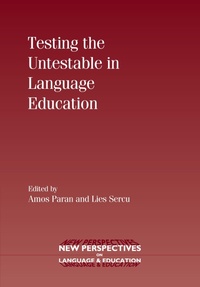
Testing the Untestable in Language Education
Published on 7. June 2010
240 pages
978-1-84769-398-3 (ISBN)
Description

The testing and assessment of language competence continues to be a much debated issue in foreign language teaching and research. This book is the first one to address the testing of four important dimensions of foreign language education which have been left largely unconsidered: learner autonomy, intercultural competence, literature and literary competence, and the integration of content and language learning. Each area is considered through a theoretical framework, followed by two empirical studies, raising questions of importance to all language teachers: How can one test literary competence? Can intercultural competence be measured? What about the integrated assessment of content-and-language in CLIL and teaching? Is progress in autonomous learning skill gaugeable? The book constitutes essential reading for anyone interested in the testing and assessment of seemingly largely untestable aspects of foreign language competence.
Reviews / Votes
The title of this book is well chosen. Despite the apparent oxymoron, this collection of papers succeeds in addressing important issues of educational policy and theory with the precision born of empirical work combined with discussion of principles. This book will open new options for testers, for teachers and for those who make policy decisions. * Michael Byram, School of Education, University of Durham, UK * The book brings together double sets of constructs which represent in their own right whole areas of academic investigation. Each section provides both theoretical underpinning and empirical studies which in turn offer a wide array of pedagogical initiatives and alleyways to explore. As such, it makes a very valuable contribution to the understanding of each dimension while providing pragmatic guidelines for practitioners interested in rising to the challenge of developing meaningful testing procedures. Christine Penman, School of Marketing, Tourism & Languages, Edinburgh Napier University, UK in Language and Intercultural Communication * Vol. 12, No. 4, November 2012, 388-390 *More details
Series
Language
English
Place of publication
Bristol
United Kingdom
Publishing group
Channel View Publications Ltd
Target group
Professional and scholarly
ISBN-13
978-1-84769-398-3 (9781847693983)
Copyright in bibliographic data and cover images is held by Nielsen Book Services Limited or by the publishers or by their respective licensors: all rights reserved.
Schweitzer Classification
Other editions
Additional editions
Amos Paran | Lies Sercu
Testing the Untestable in Language Education
Book
06/2010
Multilingual Matters
€48.10
Shipment within 10-20 days
Persons
Amos Paran is Senior Lecturer at the Institute of Education, University of London, where he is Programme Leader of the MA TESOL. He has a special interest in mastera??s level teaching by distance learning, and has also been involved in testing projects in a variety of different languages. His main research interests are reading in a foreign language, literature in language teaching, and distance education.
Lies Sercu is an Associate Professor of Linguistics at the University of Leuven. Her research interests concern the promotion of intercultural competence through foreign language education as well as SLA vocabulary acquisition from reading and writing texts in a foreign language. She has been involved in the development of language tests and blended learning environments for the professionalisation of language teachers. She has widely published in major international journals on intercultural competence and foreign vocabulary acquisition.
Lies Sercu is an Associate Professor of Linguistics at the University of Leuven. Her research interests concern the promotion of intercultural competence through foreign language education as well as SLA vocabulary acquisition from reading and writing texts in a foreign language. She has been involved in the development of language tests and blended learning environments for the professionalisation of language teachers. She has widely published in major international journals on intercultural competence and foreign vocabulary acquisition.
Content
Chapter 1 More than Language: The Multiple Faces of Testing and Assessment in Language Learning and Teaching - Amos Paran
PART 1 INTERCULTURAL COMPETENCE
Chapter 2 Assessing Intercultural Competence: More Questions than Answers - Lies Sercu
Chapter 3 Interculturally Savvy or Not? Developing and Assessing Intercultural Competence in the Context of Learning for Business - Kaisu Korhonen
Chapter 4 Eliciting The Intercultural in Foreign Language Education at School - Anthony J. Liddicoat and Angela Scarino
PART 2 AUTONOMY
Chapter 5 Measuring Autonomy: Should We Put Our Ability to the Test? - Phil Benson
Chapter 6 Assessment of Autonomy or Assessment for Autonomy? Evaluating Learner Autonomy for Formative Purposes - Terry Lamb
Chapter 7 Learners Reflecting on Learning: Evaluation versus Testing in Autonomous Language Learning - Leni Dam and Lienhard Legenhausen
PART 3 LITERATURE
Chapter 8 Between Scylla and Charybdis: The Dilemmas of Testing Language and Literature - Amos Paran
Chapter 9 Crossing The Bridge from Appreciative Reader to Reflective Writer: The Assessment of Creative Process - Jane Spiro
Chapter 10 The Taming of the Immeasurable: An Empirical Assessment of Language Awareness - Hui-wei Lin
PART 4 LANGUAGE AND CONTENT
Chapter 11 Assessing Language and Content: A Functional Perspective - Bernard Mohan, Constant Leung and Tammy Slater
Chapter 12 Teachers and Texts: Judging What ELLs Know From What They Say - Marylin Low
Chapter 13 Towards Systematic and Sustained Formative Assessment of Causal Explanations in Oral Interactions - Tammy Slater and Bernard Mohan
PART 1 INTERCULTURAL COMPETENCE
Chapter 2 Assessing Intercultural Competence: More Questions than Answers - Lies Sercu
Chapter 3 Interculturally Savvy or Not? Developing and Assessing Intercultural Competence in the Context of Learning for Business - Kaisu Korhonen
Chapter 4 Eliciting The Intercultural in Foreign Language Education at School - Anthony J. Liddicoat and Angela Scarino
PART 2 AUTONOMY
Chapter 5 Measuring Autonomy: Should We Put Our Ability to the Test? - Phil Benson
Chapter 6 Assessment of Autonomy or Assessment for Autonomy? Evaluating Learner Autonomy for Formative Purposes - Terry Lamb
Chapter 7 Learners Reflecting on Learning: Evaluation versus Testing in Autonomous Language Learning - Leni Dam and Lienhard Legenhausen
PART 3 LITERATURE
Chapter 8 Between Scylla and Charybdis: The Dilemmas of Testing Language and Literature - Amos Paran
Chapter 9 Crossing The Bridge from Appreciative Reader to Reflective Writer: The Assessment of Creative Process - Jane Spiro
Chapter 10 The Taming of the Immeasurable: An Empirical Assessment of Language Awareness - Hui-wei Lin
PART 4 LANGUAGE AND CONTENT
Chapter 11 Assessing Language and Content: A Functional Perspective - Bernard Mohan, Constant Leung and Tammy Slater
Chapter 12 Teachers and Texts: Judging What ELLs Know From What They Say - Marylin Low
Chapter 13 Towards Systematic and Sustained Formative Assessment of Causal Explanations in Oral Interactions - Tammy Slater and Bernard Mohan
