

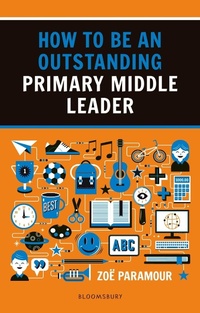
How to be an Outstanding Primary Middle Leader
1st Edition
Published on 1. November 2018
144 pages
978-1-4729-5187-8 (ISBN)
Description

How to be an Outstanding Primary Middle Leader is a compendium of research, advice, anecdotes and practical tips to help middle leaders excel in this complex and demanding role, without compromising their mental or physical health.
Written by Zoe Paramour, experienced middle leader and award-winning blogger of The Girl on the Picadilly Line, this book provides advice and practical solutions to challenges middle leaders are likely to encounter while leading a subject, phase or other whole-school responsibility, from having difficult conversations with colleagues and parents to dealing with an Ofsted inspector and writing a school improvement plan. All advice is drawn from Zoe's own experiences as a middle leader, interviews and conversations with middle and senior leaders, as well as research into leadership.
In Zoe's unique, straight-talking and witty style, this book is an accessible and enjoyable read for both new and experienced primary middle leaders looking to reflect on their practice and maximise their impact.
Written by Zoe Paramour, experienced middle leader and award-winning blogger of The Girl on the Picadilly Line, this book provides advice and practical solutions to challenges middle leaders are likely to encounter while leading a subject, phase or other whole-school responsibility, from having difficult conversations with colleagues and parents to dealing with an Ofsted inspector and writing a school improvement plan. All advice is drawn from Zoe's own experiences as a middle leader, interviews and conversations with middle and senior leaders, as well as research into leadership.
In Zoe's unique, straight-talking and witty style, this book is an accessible and enjoyable read for both new and experienced primary middle leaders looking to reflect on their practice and maximise their impact.
Reviews / Votes
From finding the right role and developing your vision, to owning your weaknesses and genuinely working on them, Zoe Paramour's book is a must-read for any current or aspiring middle leader. It will bring useful insights for those situations you have not yet experienced and smiles for those you recognise. Middle leaders make things happen and this book will empower and support you to do this. A thoroughly fantastic read. * Claire Bracher, Assistant Headteacher, @cjabracher * A perfect manual for those about to dip their toes into primary middle leadership. It marries just the right amount of theory with all the essential practical advice and information needed to be successful in the role. * Aidan Severs, Deputy Headteacher, @thatboycanteach * Zoe Paramour leads us well through the key aspects of middle leadership to ensure positive impact in schools. This book is a perfect dip-in resource enabling readers to find chapters that are most relevant at the time. A must-buy for any aspirant or current middle leader. * Tracey Lawrence, @behaviourteach * Middle leadership roles can include subject leadership, phase leadership or specialised roles - whatever it is, this book gives excellent practical guidance in an easily read enjoyable format with a personal approach that gives confidence that the ideas and suggestions are firmly rooted in practical experience. * Parents in Touch * After reading the book I know it will be a permanent fixture on my desk in my office as I try to be a better middle leader. It provides both a wealth of information and a good supply of tips and anecdotes to support middle leaders in almost any situation they can expect to find themselves in. A very enjoyable and informative read. Zoe has gained herself a new follower! * UKEdChat *More details
Series
Edition
1. Auflage
Language
English
Place of publication
London
United Kingdom
Publishing group
Bloomsbury Publishing PLC (Digital)
Target group
Professional and scholarly
ISBN-13
978-1-4729-5187-8 (9781472951878)
Copyright in bibliographic data and cover images is held by Nielsen Book Services Limited or by the publishers or by their respective licensors: all rights reserved.
Schweitzer Classification
Other editions
Additional editions
Zoe Paramour
How to be an Outstanding Primary Middle Leader
Book
11/2018
Bloomsbury Education
€41.03
Shipment within 10-20 days
Person
Zoe Paramour worked her way up from NQT to Assistant Headteacher in five years and has been a middle teacher for three. She has worked in a number of very different schools and has held a variety of posts. Zoe is currently a middle leader in a primary school in North London. She is also a freelance writer and journalist specialising in education and politics, as well as the founder of the award-winning blog The Girl on the Piccadilly Line. She writes for a number of national publications, including The Independent, The Huffington Post, The IB Times and The New Statesman.
Content
- Cover
- Half Title
- Series
- Title
- Copyright
- Dedication
- Contents
- Acknowledgements
- Introduction: 'The Best Job in the World' - fact
- Confession
- Who am I?
- How to use this book
- What, no teaching and learning?
- Chapter 1 Choosing the right school and role
- What is a middle leader?
- Subject leader
- Phase leader
- Whole-school remit
- The wrong trousers
- What to look for in a school
- The interview
- Interview questions
- The task
- The call
- Chapter 2 You as a leader
- Leadership styles
- The coercive style
- What does it look like?
- What are the pros?
- What are the cons?
- What sort of things might they say?
- Example of a coercive leader
- The authoritative style
- What does it look like?
- What are the pros?
- What are the cons?
- What sort of things might they say?
- Example of an authoritative leader
- The affiliative style
- What does it look like?
- What are the pros?
- What are the cons?
- What sort of things might they say?
- Example of an affiliative leader
- The democratic style
- What does it look like?
- What are the pros?
- What are the cons?
- What sort of things might they say?
- Example of a democratic leader
- The pacesetting style
- What does it look like?
- What are the pros?
- What are the cons?
- What sort of things might they say?
- Example of a pacesetting leader
- The coaching style
- What does it look like?
- What are the pros?
- What are the cons?
- What sort of things might they say?
- Example of the coaching style
- Situational leadership
- Unwilling but able
- Willing but unable
- Willing and able
- Unwilling and unable
- The qualities of an effective leader
- What is your vision?
- Share your vision
- Chapter 3 Policies and plans
- Action plan
- 1. Assess where you are now
- 2. Decide on your priorities
- 3. Turn your priorities into targets
- 4. Working out your next steps
- Set maintenance tasks
- 5. Share your action plan . and not just with your SLT
- 6. Reflect and review
- School policies
- Find out what the current policy is
- Find out what is and isn't working
- Consult others
- Be concise and clear
- Share your policy
- Use your policy
- Monitor and feedback
- Chapter 4 Communicating with your team
- Transactional analysis
- The three ego states
- The parent state
- The child state
- The adult state
- Why is this relevant?
- Finding it difficult to delegate
- Withholding information as a way of asserting authority
- They don't ask - they tell
- They try to make everyone happy
- How to keep relationships adult-to-adult
- The power of words
- Using 'and' not 'but'
- Using 'at the same time'
- The language of change
- Communication
- Managing meetings
- Why are you calling this meeting?
- Create an agenda
- Keep to time
- Make a decision
- Keep minutes
- Keep it positive
- Emails
- Keep it brief
- Highlight the key information
- Think about when you send the email
- Follow up
- Chapter 5 Leading from the middle
- Who are your senior leadership team?
- The bridge
- The governing body
- Reporting to governors
- Link governors
- Dealing with parents
- Parent workshops
- Chapter 6 Monitoring
- When do you carry out monitoring?
- How do you carry out monitoring?
- Observations
- What to look for
- Get involved while you're observing
- Feedback
- Talking to pupils
- How to conduct pupil interviews
- Book scrutiny
- Things to remember when scrutinising books
- Data
- How to collect data
- Data definitions
- Questions to ask about data
- Progress
- Reflect on your monitoring
- Chapter 7 Difficult conversations
- Difficult conversations: general guidance
- Ask for advice
- Plan and practise the conversation
- Power posing
- Be objective
- Listen more than you talk
- Be human but remain in control of your emotions
- Follow up
- Scenarios
- Scenario 1: the bad lesson
- Scenario 2: the luddite
- Scenario 3: the angry parent
- Scenario 4: the flailing teacher
- Scenario 5: the eye-roller
- Chapter 8 Developing others
- INSET
- Planning your INSET
- The countdown to your INSET
- Two weeks before
- One week before
- Three days before
- One day before
- Ten minutes before
- After your INSET
- Developing experienced staff
- Team teaching
- What is team teaching?
- Planning team teaching
- Mentoring experienced staff
- When to stop mentoring
- Developing an NQT
- Mentoring an NQT
- The NQT report
- Chapter 9 An inspector calls
- What to expect when you're expecting . 'The Call'
- When you get 'The Call'
- Things to have to hand
- The interview
- Myths about Ofsted
- Chapter 10 Avoiding burnout
- Two hats
- Managing marking
- Plan your marking
- Verbal feedback
- Live marking
- Peer marking
- Whole-class feedback
- Sharpening the saw
- Don't be a martyr
- Take a day off
- Just say no!
- Speak up
- Those who can Tweet
- Promote wellbeing
- Chapter 11 Your calendar
- Glossary
- Recommended reading
- Bibliography
- Index
