

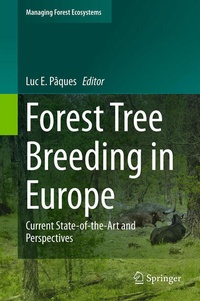
Forest Tree Breeding in Europe
Description

Forest tree breeding has been ongoing for more than 70 years across Europe. It has successfully generated improved varieties for the major economical forest tree species. They are part of the present European forestry landscape and largely contribute to intensive wood production and other forest activities. In this book, we describe the state-of-art of breeding for the main forest tree species. We provide a comprehensive, unique and up-to-date overview of the major scientific results and breeding achievements gathered from the many programmes scattered across Europe. The book is divided into 10 chapters, each as a monograph corresponding to a species or group of species Abies spp., (Larix spp., Picea abies, Picea sitchensis, Pinus sylvestris, Pseudotsuga menziesii, and Mediterranean pines; Acer pseudoplatanus, Fraxinus excelsior, and Prunus avium). Each of them is written by a group of experts and focuses on the distribution and economical importance of the species; motivation for breeding and breeding objectives; intraspecific genetic variability, breeding populations and breeding strategy; forest reproductive material deployment including mass-propagation and, prospects and perspectives for joint research and breeding. The book is a unique and up-dated source of information for students, researchers and professionals interested in the genetics and domestication of forest tree species.
More details
Other editions
Additional editions
Content
1. Introduction.- Part I: Breeding of Confires.- 2. Larches.- 3. Norway Spruce.- 4. Sitka Spruce.- 5. Mediterranean Pines.- 6. Scots Pine.- 7. Douglas Fir (Pseudotsuga menziesii (Mirb.) Franco).- Part II: Breeding of Broadleaves.- 8. Sycamore Maple (Acer pseudoplatanus L.).- 9. Common Ash (Fraxinus excelsior L.).- 10. Wild Cherry (Prunus avium (L.) L.).- List of authors and contributors.- Subject index.
