

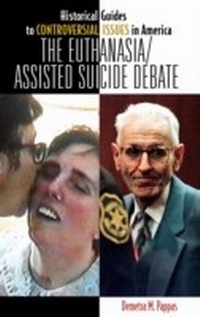
The Euthanasia/Assisted-Suicide Debate
1st Edition
Published on 20. September 2012
208 pages
978-0-313-34188-5 (ISBN)
Description

This revealing volume explores recent historical perspectives on the modern euthanasia and assisted-suicide debate and the political arenas in which it has unfolded.
Emotional public responses to widely publicized right-to-die and euthanasia cases, such as those revolving around Dr. Jack Kevorkian and Terri Schiavo, highlight their volatile mix of medical, ethical, religious, legal, and public policy issues. The Euthanasia/Assisted-Suicide Debate explores how this debate has evolved over the past 100 years as judicial approaches, legislative responses, and prosecutorial practices have shifted as a result of changes in medical technology and consumer sophistication.
Emphasizing the period from the 1950s forward, the book offers an unbiased examination of the origins of the modern medical euthanasia and assisted-suicide debates, the involvement of physicians, the history and significance of medical technology and practice, and the role of patients and their families in the ongoing controversy. This illuminating exploration of concepts, issues, and players will help readers understand both sides of the debate as viewed by participants.
Emotional public responses to widely publicized right-to-die and euthanasia cases, such as those revolving around Dr. Jack Kevorkian and Terri Schiavo, highlight their volatile mix of medical, ethical, religious, legal, and public policy issues. The Euthanasia/Assisted-Suicide Debate explores how this debate has evolved over the past 100 years as judicial approaches, legislative responses, and prosecutorial practices have shifted as a result of changes in medical technology and consumer sophistication.
Emphasizing the period from the 1950s forward, the book offers an unbiased examination of the origins of the modern medical euthanasia and assisted-suicide debates, the involvement of physicians, the history and significance of medical technology and practice, and the role of patients and their families in the ongoing controversy. This illuminating exploration of concepts, issues, and players will help readers understand both sides of the debate as viewed by participants.
All prices
More details
Series
Language
English
Place of publication
New York
United States
Publishing group
Bloomsbury Publishing Plc
Target group
Interest Age: From 7 to 17 years
File size
2,51 MB
ISBN-13
978-0-313-34188-5 (9780313341885)
Copyright in bibliographic data and cover images is held by Nielsen Book Services Limited or by the publishers or by their respective licensors: all rights reserved.
Schweitzer Classification
Other editions
Additional editions
Demetra M. Pappas
The Euthanasia/Assisted-Suicide Debate
Book
09/2012
Greenwood Press
€73.40
Shipment within 15-20 days
Content
Acknowledgments
Introduction
1 Medical Euthanasia and Assisted Suicide: A Twentieth-Century Issue
2 The 1930s and 1940s: From the King of England to the Holocaust
3 The 1950s: The First Anglo-American Prosecutions for Medical Euthanasia and the Resulting Academic Debate
4 The 1960s-1980s: Decriminalizing Suicide and Non-Voluntary Euthanasia of Those in Persistent Vegetative States
5 The 1990s and Jack "Dr. Death" Kevorkian: From Physician-Assisted Suicide to Medical Euthanasia
6 The 1990s: The Non-Michigan Parallel Text of Doctor Prosecution and Initial Failed Legislative Efforts
7 Legalizing and Implementing Physician-Assisted Suicide in Oregon in the 1990s and 2000s
8 The 2000s: Post-Millennium Case Studies of State Reactions to Euthanasia and Assisted Suicide
Concluding Commentary
Appendix: Table of Cases, Legislation, Proposed Legislation, and Initiatives
Glossary
Bibliography
Index
Introduction
1 Medical Euthanasia and Assisted Suicide: A Twentieth-Century Issue
2 The 1930s and 1940s: From the King of England to the Holocaust
3 The 1950s: The First Anglo-American Prosecutions for Medical Euthanasia and the Resulting Academic Debate
4 The 1960s-1980s: Decriminalizing Suicide and Non-Voluntary Euthanasia of Those in Persistent Vegetative States
5 The 1990s and Jack "Dr. Death" Kevorkian: From Physician-Assisted Suicide to Medical Euthanasia
6 The 1990s: The Non-Michigan Parallel Text of Doctor Prosecution and Initial Failed Legislative Efforts
7 Legalizing and Implementing Physician-Assisted Suicide in Oregon in the 1990s and 2000s
8 The 2000s: Post-Millennium Case Studies of State Reactions to Euthanasia and Assisted Suicide
Concluding Commentary
Appendix: Table of Cases, Legislation, Proposed Legislation, and Initiatives
Glossary
Bibliography
Index

