
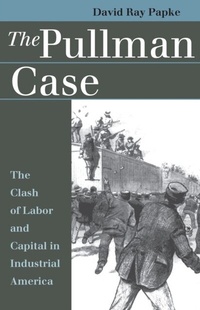
The Pullman Case
Description
Alles über E-Books | Antworten auf Fragen rund um E-Books, Kopierschutz und Dateiformate finden Sie in unserem Info- & Hilfebereich.
When the American Railway Union went on strike against the Pullman Palace Car Company in 1894, it set into motion a chain of events whose repercussions are still felt today. The strike pitted America's largest industrial union against twenty-four railroads, paralyzed rail traffic in half the country, and in the end was broken up by federal troops and suppressed by the courts, with union leader Eugene Debs incarcerated. But behind the Pullman case lay a conflict of ideologies at a watershed time in our nation's history.
David Ray Papke reexamines the events and personalities surrounding the 1894 strike, related proceedings in the Chicago trial courts, and the 1895 Supreme Court decision, In re Debs, which set important standards for labor injunctions. He shows how the Court, by upholding Debs's contempt citation, dealt fatal blows to broad-based unionism in the nation's most important industry and to any hope for a more evenhanded form of judicial involvement in labor disputes?thus setting the stage for labor law in decades to come.
The Pullman case was a defining moment in the often violent confrontation between capital and labor. It matched wealthy industrialist George Pullman against Debs and gave a stage to Debs's fledgling attorney Clarence Darrow. Throughout the trial, capital and labor tried to convince the public of the justice of their cause: Debs decrying the company's treatment of workers and Pullman raising fears of radical unionists. Papke provides an analytically concise and highly readable account of these proceedings, offering insight into the strengths and weaknesses of the law at the peak of industrial capitalism, showcasing Debs's passionate commitment to workers' rights, and providing a window on America during a period of rapid industrialization and social transformation.
Papke shows that the law was far from neutral in defending corporate interests and suggests what the Pullman case, by raising questions about both the legitimacy of giant corporations and the revolutionary style of industrial unions, can teach us about law and legal institutions in our own time. His book captures the passions of industrial America and tells an important story at the intersection of legal and cultural history.
All prices
More details
Other editions
Additional editions
Person
Content
Preface
1. Pullman, Debs, and Chicago
Editors' Preface
Preface
1. Pullman, Debs, and Chicago in the 1890s
2. The Strike and Boycott
3. The Strike on Trial
4. In the Eyes of the Unites States Supreme Court
5. Ramifications and Conclusions
Chronology
Bibliographical Essay
Index

in the 1890s2. The Strike and Boycott
3. The Strike on Trial
4. In the Eyes of the Unites States Supreme Court
5. Ramifications and Conclusions
Chronology
Bibliographical Essay
Index

System requirements
File format: ePUB
Copy protection: Adobe-DRM (Digital Rights Management)
System requirements:
- Computer (Windows; MacOS X; Linux): Install the free reader Adobe Digital Editions prior to download (see eBook Help).
- Tablet/smartphone (Android; iOS): Install the free app Adobe Digital Editions or the app PocketBook before downloading (see eBook Help).
- E-reader: Bookeen, Kobo, Pocketbook, Sony, Tolino and many more (not Kindle).
The file format ePub works well for novels and non-fiction books – i.e., „flowing” text without complex layout. On an e-reader or smartphone, line and page breaks automatically adjust to fit the small displays.
This eBook uses Adobe-DRM, a „hard” copy protection. If the necessary requirements are not met, unfortunately you will not be able to open the eBook. You will therefore need to prepare your reading hardware before downloading.
Please note: We strongly recommend that you authorise using your personal Adobe ID after installation of any reading software.
For more information, see our ebook Help page.
File format: PDF
Copy-Protection: Adobe-DRM (Digital Rights Management)
System requirements:
- Computer (Windows; MacOS X; Linux): Install the free reader Adobe Digital Editions prior to download (see eBook Help).
- Tablet/smartphone (Android; iOS): Install the free app Adobe Digital Editions or the app PocketBook before downloading (see eBook Help).
- E-reader: Bookeen, Kobo, Pocketbook, Sony, Tolino and many more (only limited: Kindle).
The file format PDF always displays a book page identically on any hardware. This makes PDF suitable for complex layouts such as those used in textbooks and reference books (images, tables, columns, footnotes). Unfortunately, on the small screens of e-readers or smartphones, PDFs are rather annoying, requiring too much scrolling.
This eBook uses Adobe-DRM, a „hard” copy protection. If the necessary requirements are not met, unfortunately you will not be able to open the eBook. You will therefore need to prepare your reading hardware before downloading.
Please note: We strongly recommend that you authorise using your personal Adobe ID after installation of any reading software.
For more information, see our eBook Help page.
File format: ePUB
Copy protection: Watermark-DRM (Digital Rights Management)
System requirements:
- Computer (Windows; MacOS X; Linux): Use a reading software that can process the file format ePUB: e.g., Adobe Digital Editions or FBReader – both free (see eBook Help).
- Tablet/Smartphone (Android; iOS): Before downloading, install the free app Adobe Digital Editions (see eBook Help).
- E-reader: Bookeen, Kobo, Pocketbook, Sony, Tolino and many more (not Kindle).
The file format ePUB works well for novels and non-fiction books – i.e., „flowing” text without complex layout. On an e-reader or smartphone, line and page breaks automatically adjust to fit the small displays.
This eBook uses Watermark-DRM, a „soft” copy protection. This means that there are no technical restrictions to prevent illegal distribution. However, there is a personalised watermark embedded in the eBook that can be used to identify the purchaser of the eBook in the event of misuse and to provide evidence for legal purposes.
For more information, see our eBook Help page.