

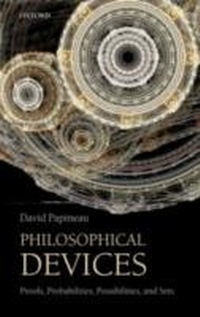
Philosophical Devices
Proofs, Probabilities, Possibilities, and Sets
1st Edition
Published on 1. October 2012
213 pages
978-0-19-165624-8 (ISBN)
Description

Philosophical Devices introduces the technical ideas that are taken for granted in contemporary philosophical writing. It offers simple explanations and covers a wealth of material that is normally available only to specialists. This original, distinctive book will appeal to anyone who is curious about the technical infrastructure of philosophy.
More details
Other editions
Additional editions
Book
10/2012
1st Edition
Oxford University Press
€26.00
Shipment within 15-20 days
Content
- Cover
- Contents
- List of Boxes
- Preface
- Introduction
- Part I: SETS AND NUMBERS
- 1 Naive Sets and Russell's Paradox
- 1.1 Sets
- 1.2 Membership and the Axiom of Extensionality
- 1.3 Unions, Intersections, and the Empty Set
- 1.4 Subsets
- 1.5 Members versus Subsets
- 1.6 Power Sets
- 1.7 The Axiom of Comprehension
- 1.8 Russell' s Set
- 1.9 Russell' s Paradox
- 1.10 Barbers and Sets
- 1.11 Alternatives to Naive Set Theory
- Further Reading
- Exercises
- 2 Infinite Sets
- 2.1 Some Infinite Sets
- 2.2 Different Kinds of Numbers
- 2.3 Two Senses of ' More'
- 2.4 Denumerability
- 2.5 More Denumerable Sets
- 2.6 The Non-Denumerability of the Real Numbers
- 2.7 The Abundance of the Real Numbers
- Further Reading
- Exercises
- 3 Orders of Infinity
- 3.1 Some Harder Stuff
- 3.2 The Numerical Size of Sets
- 3.3 The Reals and the Power Set of the Natural Numbers
- 3.4 The Continuum Hypothesis
- 3.5 An Infinity of Infinities
- 3.6 The Generalized Continuum Hypothesis
- Further Reading
- Exercises
- Part II: ANALYTICITY, A PRIORICITY, AND NECESSITY
- 4 Kinds of Truths
- 4.1 Three Distinctions among Truths
- 4.2 Analytic and Synthetic
- 4.3 A Priori and A Posteriori
- 4.4 Synthetic A Prioris
- 4.5 How is Synthetic A Priori Knowledge Possible?
- 4.6 Pure and Applied Geometry
- Further Reading
- Exercises
- 5 Possible Worlds
- 5.1 Necessity and Contingency
- 5.2 A Posteriori Necessities
- 5.3 A Priori Contingencies
- 5.4 Possibility and Necessity
- 5.5 Possible Worlds
- 5.6 Necessity and Possibility in terms of Worlds
- 5.7 Constraints on Possible Worlds
- 5.8 Essential Properties
- 5.9 The Nature of Necessity
- 5.10 Different Kinds of Possibility
- Further Reading
- Exercises
- 6 Naming and Necessity
- 6.1 Two Readings of Statements of Necessity
- 6.2 Scope Distinctions
- 6.3 Julius and the Inventor of the Zip
- 6.4 Rigid Designators
- 6.5 The Causal Theory of Reference
- 6.6 Rigidity and the Causal Theory
- 6.7 De Dicto and De Re
- 6.8 Necessary and A Priori Again
- 6.9 A Limit to Scepticism about A Posteriori Necessity
- Further Reading
- Exercises
- Part III: THE NATURE AND USES OF PROBABILITY
- 7 Kinds of Probability
- 7.1 Probabilities of Propositions
- 7.2 Kolmogorov's Axioms
- 7.3 Some Consequences
- 7.4 Joint Probabilities
- 7.5 Subjective and Objective Probabilities
- 7.6 Subjective Probability
- 7.7 Action, Utility, and Subjective Probability
- 7.8 Dutch Books
- 7.9 Objective Probability
- Further Reading
- Exercises
- 8 Constraints on Credence
- 8.1 The Principal Principle
- 8.2 Conditional Probability
- 8.3 Updating Degrees of Belief-Conditionalization
- 8.4 Bayes' Theorem
- 8.5 Conditional Probabilities and Conditional Statements
- 8.6 Material Conditionals
- 8.7 Indicative and Subjunctive Conditionals
- 8.8 Rational and Metaphysical Changes
- Further Reading
- Exercises
- 9 Correlations and Causes
- 9.1 Probabilistic Independence
- 9.2 Probabilistic Dependence
- 9.3 Correlation
- 9.4 Causation and Correlation
- 9.5 Screening Off
- 9.6 Spurious Correlations
- 9.7 Randomized Experiments
- 9.8 Survey Research
- 9.9 Simpson's Paradox
- Further Reading
- Exercises
- Part IV: LOGICS AND THEORIES
- 10 Syntax and Semantics
- 10.1 Validity
- 10.2 Logic and Metalogic
- 10.3 Different Kinds of Logic
- 10.4 Truth-Functional Connectives
- 10.5 Syntax and Semantics
- 10.6 Syntactic Consequence
- 10.7 Semantic Consequence
- Further Reading
- Exercises
- 11 Soundness and Completeness
- 11.1 Soundness and Completeness
- 11.2 Proving Soundness and Completeness
- 11.3 Reflections on Circularity
- 11.4 Predicate Logic
- 11.5 Predicate Syntax
- 11.6 Predicate Semantics
- 11.7 Predicate Logic-Soundness and Completeness
- 11.8 Predicate Logic-Undecidability
- 11.9 Second-Order Logic
- 11.10 The Incompleteness of Second-Order Logic
- Further Reading
- 12 Theories and Gödel's Theorem
- 12.1 Theories
- 12.2 Syntax and Semantics for Theories
- 12.3 Theoretical Completeness
- 12.4 Completeness for Theories versus Completeness for Logics
- 12.5 Gödel's Theorem Stated
- 12.6 A Sketch of Gödel's Proof
- 12.7 The Inescapability of Gödel's Theorem
- 12.8 Meta-Theorizing
- Further Reading
- Solutions to Exercises
- Index
- A
- B
- C
- D
- E
- F
- G
- H
- I
- J
- K
- L
- M
- N
- O
- P
- Q
- R
- S
- T
- U
- V
- W
