

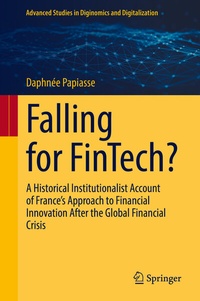
Falling for FinTech?
Description

This book presents a unique in-depth case study, supported by interviews with French experts, of France's early embrace and regulatory leadership on FinTech in an uncertain EU post-2008 crisis regulatory context, with an extension of the discussion to implications on EU level. FinTech- the recent wave of technological innovation in finance - is no longer a buzzword but a mainstream development in financial services. Although it raises much hope, FinTech creates challenges to post-global financial crisis regulation which raises an important research question at the heart of this book: How do financial regulators manage uncertain technological innovations in the wake of a protracted systemic crisis? This book analyzes this critical question for political economy and public policy through a qualitative in-depth analysis of FinTech regulation in France, a country where the State has promoted financial innovation as a matter of industrial policy within an evolving regulatory space, supported generally by market-shaping principles.
More details
Other editions
Additional editions
Person
Daphnée Papiasse is a Visiting Fellow and PhD graduate of the European Institute at the London School of Economics (UK) with an interest in financial regulation and digital finance policies. Specifically, her research is interested in analyzing the variety of regulatory approaches or responses to financial innovation in the European Union with a focus on FinTech regulation. More generally, she is interested in EU Financial regulation and the EU's international role in the governance of financial regulation. Daphnée is an alumni of the LSE (UK), La Sorbonne University (France), and the Catholic Institute of Paris (France).
Content
Introduction.- Theoretical Framework.- The Interpretive Politics of FinTech Regulation in France.- Regulating Crowdlending in France.- Non à la sandbox !.- Regulating Initial Coin Offerings in France.- Conclusion.
