

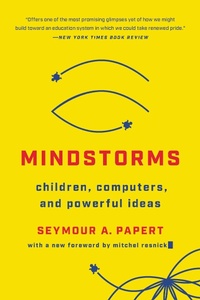
Mindstorms
Children, Computers, And Powerful Ideas
Published on 6. October 2020
288 pages
978-1-5416-7510-0 (ISBN)
Description

In this revolutionary book, a renowned computer scientist explains the importance of teaching children the basics of computing and how it can prepare them to succeed in the ever-evolving tech world.
Computers have completely changed the way we teach children. We have Mindstorms to thank for that. In this book, pioneering computer scientist Seymour Papert uses the invention of LOGO, the first child-friendly programming language, to make the case for the value of teaching children with computers. Papert argues that children are more than capable of mastering computers, and that teaching computational processes like de-bugging in the classroom can change the way we learn everything else. He also shows that schools saturated with technology can actually improve socialization and interaction among students and between students and teachers.
Technology changes every day, but the basic ways that computers can help us learn remain. For thousands of teachers and parents who have sought creative ways to help children learn with computers, Mindstorms is their bible.
Computers have completely changed the way we teach children. We have Mindstorms to thank for that. In this book, pioneering computer scientist Seymour Papert uses the invention of LOGO, the first child-friendly programming language, to make the case for the value of teaching children with computers. Papert argues that children are more than capable of mastering computers, and that teaching computational processes like de-bugging in the classroom can change the way we learn everything else. He also shows that schools saturated with technology can actually improve socialization and interaction among students and between students and teachers.
Technology changes every day, but the basic ways that computers can help us learn remain. For thousands of teachers and parents who have sought creative ways to help children learn with computers, Mindstorms is their bible.
More details
Other editions
Additional editions

Person
Seymour Papert (1928-2016) was a professor of mathematics and education at MIT, where he co-founded the Artificial Intelligence and Media Laboratories. He was the co-inventor of the LOGO programming language. He is the author of numerous books, including Perceptrons, The Connected Family, and The Children's Machine.
Mitchel Resnick is Lego Papert Professor of Learning Research, Director of the Okawa Center, and Director of the Lifelong Kindergarten group at the Massachusetts Institute of Technology (MIT) Media Lab. A former student of Papert's, Resnick developed Scratch, a programming language designed to help children learn coding, and his project Programmable Bricks served as the foundation for LEGO Mindstorms. He is the recipient of the Harold W. McGraw Jr. Prize in Education. Resnick is also the author of Lifelong Kindergarten.
Mitchel Resnick is Lego Papert Professor of Learning Research, Director of the Okawa Center, and Director of the Lifelong Kindergarten group at the Massachusetts Institute of Technology (MIT) Media Lab. A former student of Papert's, Resnick developed Scratch, a programming language designed to help children learn coding, and his project Programmable Bricks served as the foundation for LEGO Mindstorms. He is the recipient of the Harold W. McGraw Jr. Prize in Education. Resnick is also the author of Lifelong Kindergarten.
Content
- Intro
- Title Page
- Copyright
- Table of Contents
- Foreword by Mitchel Resnick: The Seeds That Seymour Sowed
- Preface: The Gears of My Childhood
- INTRODUCTION Computers for Children
- CHAPTER 1 Computers and Computer Cultures
- CHAPTER 2 Mathophobia: The Fear of Learning
- CHAPTER 3 Turtle Geometry: A Mathematics Made for Learning
- CHAPTER 4 Languages for Computers and for People
- CHAPTER 5 Microworlds: Incubators for Knowledge
- CHAPTER 6 Powerful Ideas in Mind-Size Bites
- CHAPTER 7 LOGO's Roots: Piaget and AI
- CHAPTER 8 Images of the Learning Society
- EPILOGUE The Mathematical Unconscious
- Afterword and Acknowledgments
- Discover More
- About the Author
- Notes
