

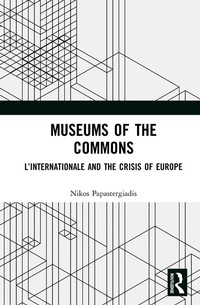
Museums of the Commons
L'Internationale and the Crisis of Europe
1st Edition
Published on 2. April 2020
172 pages
978-1-000-04550-5 (ISBN)
Description

Museums of the Commons examines L'Internationale, an ongoing confederation between six museums and contemporary art institutions in Europe.
Drawing on extensive interviews with the directors, curators, public programs officers in all the museums, as well as artists, critics and members associated with them, the book provides a transversal account that connects the ideas across the various institutions and situates this in the wider visual and social context. Chronicling the challenges faced by the museums, Papastergiadis goes on to situate their responses within the wider political and cultural context that is shaping the future of all contemporary art museums. Five key domains of research are explored within the book: the genealogy of the museum; the need for alternative models of trans-institutional governance; examples of innovation in the spaces of aesthetic production; experimentation in the forms of partnership and engagement with constituents; and finally, examination of the impact of a collaborative and collective regime of artistic practices.
Museums of the Commons provides a multi-perspectival account of a trans-institutional and transnational collaboration, which will be of great interest to academics, researchers and postgraduate students working in the fields of Museum Studies, Cultural Studies, Art History, Media and Communication.
Drawing on extensive interviews with the directors, curators, public programs officers in all the museums, as well as artists, critics and members associated with them, the book provides a transversal account that connects the ideas across the various institutions and situates this in the wider visual and social context. Chronicling the challenges faced by the museums, Papastergiadis goes on to situate their responses within the wider political and cultural context that is shaping the future of all contemporary art museums. Five key domains of research are explored within the book: the genealogy of the museum; the need for alternative models of trans-institutional governance; examples of innovation in the spaces of aesthetic production; experimentation in the forms of partnership and engagement with constituents; and finally, examination of the impact of a collaborative and collective regime of artistic practices.
Museums of the Commons provides a multi-perspectival account of a trans-institutional and transnational collaboration, which will be of great interest to academics, researchers and postgraduate students working in the fields of Museum Studies, Cultural Studies, Art History, Media and Communication.
More details
Edition
1. Auflage
Language
English
Place of publication
London
United Kingdom
Publishing group
Taylor & Francis Ltd
Target group
Professional and scholarly
College/higher education
Illustrations
8 Halftones, black and white; 8 Illustrations, black and white
ISBN-13
978-1-000-04550-5 (9781000045505)
Copyright in bibliographic data and cover images is held by Nielsen Book Services Limited or by the publishers or by their respective licensors: all rights reserved.
Schweitzer Classification
Other editions
Additional editions
Book
12/2021
1st Edition
Routledge
€67.20
Shipment within 10-20 days
Book
05/2020
Taylor & Francis
Unfortunately, price unknown
Available (delivery time upon request)
Book
04/2020
1st Edition
Routledge
€205.90
Shipment within 15-20 days
Person
Nikos Papastergiadis is Professor of Media and Communication and Director of the Research Unit of Public Cultures at the University of Melbourne. His most recent books are Cosmopolitanism and Culture (2012) and Ambient Screens (2016).
Content
1 Introduction: On trans-institutional collaborations
2 To place in common that which we cannot do alone
3 Conviviality as governance
4 Heterocosmoi
5 The constituents
6 Art without museums
7 Afterword: Confederate or perish
2 To place in common that which we cannot do alone
3 Conviviality as governance
4 Heterocosmoi
5 The constituents
6 Art without museums
7 Afterword: Confederate or perish
