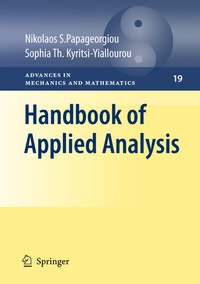
Handbook of Applied Analysis
Description

Accurate models to describe real-world phenomena are indispensable for research in such scientific fields as physics, engineering, biology, chemistry, and economics. The tools and techniques of applied analysis facilitate the development of mathematical models and can thereby serve as an excellent resource for students and researchers in various scientific and mathematical disciplines.
This self-contained, comprehensive handbook provides an in-depth examination of important theoretical methods and procedures in applied analysis.
Unique features of the Handbook of Applied Analysis :
Presents an accessible introduction to modern analysis, while still serving as a useful reference for researchers and practitioners;
Covers a large number of diverse topics: smooth and nonsmooth differential calculus, optimal control, fixed point theory, critical point theory, linear and nonlinear eigenvalue problems, nonlinear boundary value problems, set-valued analysis, game theory, stochastic analysis, and evolutionary equations;
Serves as a complete guide to the theory of nonlinear analysis;
Includes numerous examples that demonstrate and expand upon the topics presented;
Suggests many directions for further research and study.
In this one volume, the reader can find many of the most important theoretical trends in nonlinear analysis and applications to different fields. These features, together with an extensive bibliography, make the volume a valuable tool for every researcher working on nonlinear analysis.
Reviews / Votes
From the reviews:
"This volume provides a substantial survey of the basics of nonlinear analysis and also illustrates their use in selected applications. . Although the book explicitly addresses mathematicians and non-mathematicians (in particular, physicists, engineers and economists) . the presentation is given in a mathematical rigorous style throughout. This volume collects a vast amount of material . and will well serve as a reference book for the area." (R. Steinbauer, Monatshefte für Mathematik, Vol. 165 (3-4), March, 2012)
More details
Other editions
Additional editions