

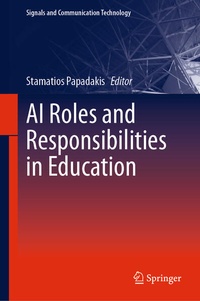
AI Roles and Responsibilities in Education
Description

This book explores how artificial intelligence (AI) is reshaping education through practical, pedagogical, and ethical lenses. It provides educators, policymakers, and researchers with evidence-based strategies for integrating AI tools into teaching and learning, particularly within STEAM education. Drawing from real-world implementations, including an in-depth case study of postgraduate teacher training in Europe, the author presents AI not merely as a tool but as a catalyst for educational transformation. Topics include generative AI, curriculum design, ethical integration, and responsible innovation. From adaptive tutoring systems to prompt engineering, the book equips readers with the knowledge and frameworks needed to critically and creatively engage with AI in classrooms.
- Demonstrates classroom-tested strategies for AI use in STEAM and broader educational contexts;
- Highlights ethical challenges, including algorithmic bias, transparency, and human oversight;
- Offers a future-oriented framework for AI literacy and curriculum integration.
More details
Other editions
Additional editions
Person
Stamatios Papadakis is an Assistant Professor of Educational Technology at the Department of Preschool Education, University of Crete, Greece. His research and teaching interests include mobile learning, computational thinking, coding, and the integration of generative artificial intelligence (AI) in early childhood and primary education. He focuses on fostering computational thinking and enhancing young learners' conceptual understanding through the use of innovative educational technologies.
Content
Part 1: AI in Educational Frameworks and Pedagogy.- Ch 1: Postgraduate Student Teachers' Perspectives Concerning AI and its Integration into STEAM Teaching and Learning.- Ch 2: AI-aided Decision-Making in Education - Uncertainty, Explainability, and Human Responsibility.- Ch 3: Literacy and Professional Development in STEM Education.- Ch 4: Innovation in Teacher Education: Integrating Artificial Intelligence for a Personalized Educational Future.- Ch 5: Pedagogies involving the use of AI generative tools for Teaching and Learning in Higher Education Institutions.- Part 2: Ethical and Responsible AI Use.- Ch 6: Ensuring Equity and Integrity in Academic Performance Prediction in Open and Distance Learning.- Ch 7: Leveraging AI in Education: Benefits, Responsibilities, and Trend.- Ch 8: Responsible AI in personalized adaptive learning: A global review of 40 products.- Ch 9: Human: The final decision-maker in the technological era.- Part 3: Generative AI and Learning Techniques.- Ch 10: Fostering a Student-In-the-Loop Approach in Interactions with Generative Artificial Intelligence in Online Discussions.- Ch 11: Addressing Challenges and Seizing Opportunities with ChatGPT in Computer Programming Education.- Ch 12: Promoting Generative AI Literacy Among Students and Teachers.- Ch 13: Deepfake Learning: Assessing Learning in the Generative AI Era.- Ch 14: Leveraging AI-generated illustrations for deeper understanding of complex concepts in education.- Part 4: AI in Problem-Solving and Innovation.- Ch 15: How future teachers perceive artificial intelligence?.- Ch 16: Unsupervised Learning and Teacher's Decision Support in Clustering Learning Patterns.- Ch 17: Transforming Creative Problem-Solving with Generative AI Tools.- Ch 18: Evaluating the Potential Impact of Large Language Models on Teaching and Learning Core Academic Subjects and Measuring System Wide Participation.- Ch 19: Innovative Strategies for Educating Learners with Disabilities Using Generative Artificial Intelligence.
