

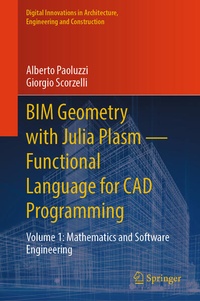
BIM Geometry with Julia Plasm-Functional Language for CAD Programming
Description

This book provides computational methods, tools, algorithms, code scriptlets, and examples for symbolically generating simple and very complex geometric shapes as solid models and structures for Building Information Modeling (BIM) environments.
The book introduces the Programming Language for Symbolic/Solid Modeling (Plasm), a concise symbolic design language for the construction industry. It explains how to utilize the recent adaptation to the MIT-originated language Julia, regarded as the premier modern language for scientific computing. In this context, the design is stored as a solid model and can be utilized by other Julia packages (e.g., for mechanical, thermal, simulation, etc.).
It is important to note that very complex shapes, including Boolean textures for new materials, may be challenging, if not impossible, to describe using architectural CAD and even harder to encode within the entity class representation methods of the BIM collaboration standard. On the other hand, Plasm.jl product/object descriptions are straightforward to encode and symbolically export/import. They can be used as source strings within IFC files, the collaborative platform for construction. The sender and receiver of such files can receive the symbolic description, the geometric breakdown (atoms of Boolean algebra) exported in the standard, and the precise integral properties (surface, volume, inertia).
The Julia Plasm language is an outstanding environment for teaching computer courses to architecture students and introducing BIM to new generations of ABC professionals, who are already familiar with network tools and will create and innovate with geometric shapes while learning computational methods.
The PLASM language is a preeminent environment to teach computer courses to architecture students and introduce BIM to the new generations of ABC pros, who are already acquainted with network instruments and will create and innovate with geometric shapes while learning computational methods.
More details
Other editions
Additional editions
Persons
Alberto Paoluzzi (retired) was professor of Computer Science and Computer Engineering at Roma Tre University, Italy. His research interests include computer aided design, computer graphics, design languages, geometric and solid modeling, dimension-independent modeling, computational geometry, computational topology.
Giorgio Scorzelli is Director of Software Development at the Center for Extreme Data Management Analysis and Visualization (CEDMAV) of the University of Utah, USA. His research interests include Big data, Cloud computing, Combinatorial topology, Computational geometry, Computer graphics Continuous integration, Data analysis and exploration, DevOps, Efficient data layouts, Experience architecting and developing distributed systems design, Geometric compression and programming, Integration of enterprise-level applications, Large project management, Solid modeling, Streaming techniques.
Content
Introduction to Julia Programming.- The Julia Package Plasm.jl.- Topology primer.- Geometric models.- Symbolic modeling with Julia Plasm.jl.- Space arrangement pipeline.- Boolean solid algebras.
