

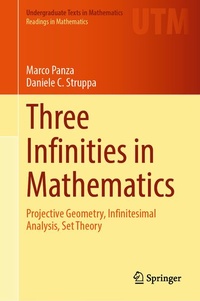
Three Infinities in Mathematics
Description

This book is intended as conceptual introduction to three mathematical theories arising from the attempt to understand (actual) infinity. Though the treatment does not avoid technical aspects, it tries to explain their origins and purposes. The book is divided into three parts, each composed of two chapters and a few appendices. Each part presents in detail one of three moments in which mathematicians made a concerted effort to control the idea of infinity: Projective Geometry, Infinitesimal Calculus, and Set Theory. The text includes exercises and philosophical and/or historical remarks. It is written both for non-mathematicians interested in understanding the most relevant ideas that govern these theories, and for professional mathematicians interested in exploring the possibility of a conceptually-engaged presentation of mathematical contents. The book can be used for advanced undergraduate students, as well as for beginning graduate students.
More details
Other editions
Additional editions
Persons
Marco Panza is currently Kennedy Professor of Philosophy at Chapman University, where he is a member of both departments of philosophy and mathematics, and Director of the Graduate Program MPP (Mathematics, Philosophy and Physics) at the Schmid College of Science and Technology. He is also Emeritus Research Director at the CNRS and a member of the IHPST (CNRS and Univ. of Paris 1, Panthéon-Sorbonne). He held also positions at the University of Geneva, Nantes and at ICREA (Univ. Pompeu Fabra, Barcelona).
He is the author of several peer reviewed articles and books in the domains of history and philosophy of mathematics and logic, and is presently co-editor in Chief of Historia Mathematica.
Daniele C. Struppa is currently the President of Chapman University, where he also holds the Donald Bren Presidential Chair in Mathematics. Before joining Chapman University as its Provost in 2006, he held positions at George Mason University in Virginia, and at the University of Calabria, the Scuola Normale Superiore in Pisa, and the University of Milano, all in Italy.
Daniele C. Struppa has published more than 250 peer reviewed articles and books in a variety of topics, but his current emphasis is on Fourier Analysis, with applications to Quantum Physics, and on Hypercomplex Analysis. He was the recipient of the Bartolozzi Prize of the Italian Mathematical Union in 1981, for his work on convolution equations, and more recently one of his papers on the violation of the pigeonhole principle in quantum physics was awarded the 2016 Cozzarelli Prize from the National Academy of Sciences .
Daniele C. Struppa is also a Managing Editor of Quantum Studies, Mathematics and Foundations , and is on the Editorial Board of several journals, including Complex Analysis and Operator Theory , and the Milan Journal of Mathematics.
Content
Introduction.- Part 1. Infinity in Projective Geometry.- The Geometry of the Painters.- Appendices to Chapter 1. Projective Geometry.- Part 2. Infinitesimal Analysis.- Inklings of Infinity in Greek Mathematics.- Appendices to Chapter 3.- The Birth and Development of Calculus.- Appendices to Chapter 4.- Part 3. Set Theory and Infinity.- Naive Set Theory.- Appendice to Chapter 5.- Axiomatic Set Theory.- Appendices to Chapter 6.- Conclusions: Three Infinities or Just One?.
