

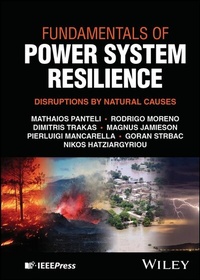
Fundamentals of Power System Resilience
Description

Comprehensive resource focusing on natural hazards and their impact on power systems, with case studies and tutorials included
Fundamentals of Power System Resilience is the first book to cover the topic of power system resilience in a holistic manner, ranging from novel conceptual frameworks for understanding the concept, to advanced assessment and quantifying techniques, to optimization planning algorithms and regulatory frameworks towards resilient power grids. The text explicitly addresses the needs and challenges of current network planning and operation standards and examines the steps and standard amendments needed to achieve low-carbon, resilient power systems. Practically, it provides frameworks to assess resilience in operation and planning and relevant quantification metrics.
Case studies from around the world (real data and project developments as well as simulations) including windstorms, wildfires, floods, earthquakes, blackouts, and brownouts, etc. are included, with applications from the UK, Chile, Australia, and Greece.
In Fundamentals of Power System Resilience, readers can expect to find specific information on:
- Classical reliability standards, covering the changing energy landscape and limitations of existing reliability-driven network planning and operation standards
- How resilience is interpreted in the power systems community, and characterizations and differentiation of threats
- Spatiotemporal impact assessment of external shocks on power systems, trapezoid applications to different events of different time-scales, and AC cascading models for resilience applications
- Conventional approaches to asset failure data representation and modeling of the relationship between weather/asset outages
Fundamentals of Power System Resilience provides fundamental knowledge of the subject and is an excellent supplementary reference for final undergraduates and postgraduate students due to its mix of basic and advanced content and tutorial-like exercises. It is also essential for regulators and practitioners for shaping the future resilient power systems.
More details
Other editions
Additional editions
Persons
Mathaios Panteli, Assistant Professor, University of Cyprus.
Rodrigo Moreno, Assistant Professor, University of Chile.
Dimitris Trakas, Senior Researcher, National Technical University of Athens, Greece.
Magnus Jamieson, Research Associate, Imperial College London, UK.
Pierluigi Mancarella, Chair Professor of Electrical Power Systems, University of Melbourne, Australia, and Professor of Smart Energy Systems, University of Manchester, UK.
Goran Strbac, Chair Professor in Electrical Energy Systems, Imperial College London, UK.
Nikos Hatziargyriou, Professor in Power Systems, National Technical University of Athens, Greece.
Content
About the Authors xi
Foreword by Professor Chongqing Kang xv
Foreword by Professor Ian Dobson xvii
Preface xix
1 From Reliability to Resilience 1
1.1 Why Power System Resilience? 1
1.2 The Historical Approaches to Power System Reliability 3
1.2.1 The Historical N-k Network Security Criterion 3
1.2.2 The More Advanced Probabilistic Network Security 3
1.3 Need for a (Tail)Risk-Aware Approach 4
1.4 Inspiration from Other Economic and Engineering Areas 5
1.4.1 Risk Hedging and Portfolio Optimization 5
1.4.2 Risk-Aware Design in Structural and Civil Engineering 6
1.5 From Reliability to Resilience Paradigm 7
1.5.1 Key Differentiators Between Reliability and Resilience 7
1.5.2 Expanding Resilience Practices 8
1.5.2.1 Broadening the Scope of Contingencies 8
1.5.2.2 Focusing on High-Risk Scenarios 8
1.5.2.3 Incorporating Environmental Interactions 8
1.5.2.4 Tailoring Strategies to Natural Threats 8
1.5.2.5 Integrating Diverse Measures and Technologies 9
1.5.2.6 Emphasizing Dynamics and Recovery 9
1.6 Fundamentals of Power System Resilience 9
1.6.1 Contribution to the Field 10
1.6.2 Closing Remarks 10
References 11
2 Conceptualizing and Contextualizing Power Grid Resilience 13
2.1 Shocks and Stresses on Critical Power Infrastructure 13
2.2 Defining Power System Resilience 15
2.3 Resilience Capacities and Features 18
2.4 Comparing and Clarifying Reliability and Resilience 20
2.5 Conceptualizing Power System Resilience to External Shocks 22
2.6 Domains of Resilience 26
2.6.1 Infrastructure Resilience 26
2.6.2 Operational Resilience 27
2.6.3 Organizational Resilience 27
2.6.4 Community Resilience 27
References 28
3 System Resilience Assessment and Quantification 31
3.1 Needed Resilience Metrics for Power Systems 31
3.2 Quantifying the Resilience Trapezoid 32
3.2.1 The FLEP and Area Metric Systems 32
3.2.2 Fragility-Driven Resilience Assessment Against Windstorms 35
3.3 CVaR-Driven Resilience Assessment 43
3.3.1 Illustrative Example of CVaR Resilience Assessment Against Wind Events 44
3.4 AC Cascading Modeling for Resilience Applications 45
3.4.1 Recursive Application of Protection Mechanisms 48
3.4.2 Obtaining a Solvable PF 50
3.4.3 Implementation of Protection Mechanisms 50
3.4.3.1 Cascade Visualization 54
3.4.4 Integration into Resilience Metric Frameworks 54
References 58
4 Addressing Data Granularity and Ambiguity 61
4.1 Understanding Outage Models on Power Systems 61
4.2 Homogeneous Versus Distributed Representations of Failure Hazard on Overhead Lines 66
4.2.1 Homogeneous Representations of Outage Risk on Lines 67
4.3 Distributed Failure Risk Representation on Lines 67
4.4 Method for Representing Spatial Risk of a Natural Hazard 70
4.5 Data Acquisition 70
4.5.1 Calculating Exposure of System to Natural Hazards 71
4.5.2 Modeling Failure Probability 73
4.5.3 Correcting Wind Speed Data for Different Heights of Asset 76
4.5.4 Interpolation of Datasets for the Purposes of Resilience Studies 77
4.5.5 A Tractable Method for Calculating Wind Power Outputs in Extreme Wind Events 78
4.5.6 A Case Study Using Demonstrated Methods on the Northern Scottish Transmission System 79
4.6 Exercises 84
4.7 Correlated Natural Hazards 86
4.8 Incorporating Imprecise Fragility Curves in Decision-Making Models 90
4.9 Summary 91
Acknowledgments 92
Reference 92
5 Resilient Investment Planning 95
5.1 Network Investment Decisions: Unraveling the Planner's Trilemma 95
5.1.1 Expanding and Hardening Solutions 95
5.1.2 Digitalized, Non-Wire and Smart Grid Solutions 96
5.1.3 The Resilience Enhancement Trilemma 97
5.2 Resilience and Risk Metrics for Risk-Averse Decision-Making 98
5.2.1 A Probabilistic Risk Metric 100
5.2.2 Risk Versus Resilience Metrics 101
5.2.3 Dependencies and Common Mode 101
5.2.4 Example of Probability Capacity Tables Accounting for Dependencies in a Double Circuit 102
5.2.5 Deterministic or "Robust" Approach to Risk 103
5.2.6 Distributionally Robust Approach to Risk 104
5.3 Mathematical Frameworks to Plan Resilient Grids 104
5.3.1 Possible Theoretical Formulations: From Robust to Stochastic Network Planning 104
5.3.1.1 Two-Stage Framework 104
5.3.1.2 Multi-Stage Framework with Two Layers of Uncertainty 105
5.3.2 CVaR Formulation 106
5.3.3 Optimization via Simulation Approach: A Two-Stage Stochastic Model 106
5.3.4 Advanced Resilient Investment Planning Models 109
5.4 Merging Resilience and Reliability Criteria for Practical Decisions 110
5.4.1 Illustrative Case Study 110
5.4.2 Reliability I: Adequacy 110
5.4.3 Reliability II: Security 110
5.4.4 Resilience 111
5.4.5 Combining Reliability and Resilience 113
5.5 Realistic Application to Earthquakes in Chile 113
5.5.1 Case Study Description 114
5.5.2 Results: Portfolio Solutions for Resilience Enhancement 115
5.6 Main Grid Resilience Investments Versus DER 116
5.6.1 A Suitable Methodology to Design DER Portfolios Against Wildfires 116
5.6.2 Illustrative Case Study Example 118
5.6.3 The Classic N-1 Design 119
5.6.4 The Resilient Design 120
5.6.5 The Actual Risks Associated with the Current Security Standards 120
5.7 Investment Versus Operational Measures 121
5.7.1 A Comment on Resilience and CVaR Effects on Portfolio Diversification 122
5.8 Fairness Considerations in Resilience 122
5.9 Beyond Networks: Long-Term Duration Energy Storage to Enhance Future Energy System Resilience Against Prolonged Low Output of RES 124
References 127
6 Operational Resilience Planning 131
Nomenclature 131
6.1 Introduction 132
6.2 Smart Operational Measures 135
6.3 Preventive Unit Commitment to Enhance Power System Resilience Under Extreme Weather Events 136
6.3.1 Resilience Preventive Unit Commitment Using Robust Optimization 138
6.3.1.1 Mathematical Formulation 138
6.3.1.2 Problem Reformulation and Solution Algorithm 140
6.3.1.3 Case Study Applications 141
6.3.2 Machine Learning Techniques to Deal with Multiple Line Failures Under Extreme Events 145
6.3.2.1 Mathematical Formulation 145
6.3.2.2 Machine Learning Assisted Stochastic Unit Commitment 147
6.3.2.3 Case Study Applications 148
6.4 Defensive Islanding to Enhance Power System Resilience Under Extreme Weather Events 151
6.4.1 Defensive Islanding Algorithm 151
6.4.2 Approach for Determining when to Apply Defensive Islanding 153
6.4.3 Case Study Applications 154
6.5 Resilience Enhancement in Low-Carbon, Low-Inertia Power Systems 160
6.5.1 Dynamic Network Model 161
6.5.2 Mathematical Formulation 162
6.5.3 Case Study Applications 163
6.5.3.1 Base Case Results 164
6.5.3.2 SECOPF Results 165
6.6 Appendix 167
6.6.1 Reformulation and Solution Algorithm of Tri-level Problems 167
6.6.2 Solution Algorithm 168
References 168
7 Resilience by Distributed Energy Resources and Microgrids 177
7.1 Local and Bulk System Resilience 177
7.1.1 Overview of Microgrids 178
7.1.2 Resilient Decarbonization of Multi-Energy Microgrids 179
7.1.3 Electrified Transport Sector and Mobile Sources Enhancing Resilience 181
7.2 Resilience Support by Real-World Microgrids 181
7.2.1 Princeton Microgrid Against Hurricanes - United States 181
7.2.2 The Sendai Microgrid During and After the Tsunami and Large-Scale Earthquake - Japan 182
7.2.3 Blue Lake Rancheria Microgrid Against Wildfires - United States 182
7.2.4 Texas Microgrids Against Winter Storms - United States 183
7.2.5 Louisiana Microgrids Against Hurricanes - United States 184
7.2.6 Microgrids Against Earthquakes - Haiti 185
7.2.7 The Kythnos Microgrid During Natural Disasters - Greece 185
7.2.8 Support from Mobile Generators - Ad Hoc Microgrids Against Wildfires - Greece 186
7.2.9 Support from Local Generation Islanded Operation of Constitución Against Wildfires - Chile 186
7.3 DER/Microgrids Role in Strengthening Resilience 187
7.3.1 Resilience Enhancement at All Power System Levels 187
7.3.2 Resilience Enhancement in All Resilience Phases 187
7.4 Preventive and Corrective Microgrid Formation 189
7.4.1 The Base Model 189
7.4.1.1 Partitioning Constraints 190
7.4.1.2 Operating Constraints 194
7.4.1.3 Objective Function 194
7.4.1.4 Numerical Results 195
7.4.2 Advances of the Base Model 197
7.4.2.1 Reformulating the Partitioning Constraints 197
7.4.2.2 Further Advances in MGs Formulation 199
7.4.2.3 Integration with DER Scheduling 200
7.5 Microgrids for Resilience-Oriented Restoration 201
7.5.1 Microgrids Aided Distribution System Restoration 201
7.5.1.1 Operating Constraints 202
7.5.1.2 Connectivity and Sequence Constraints 203
7.5.1.3 Topological Constraints 204
7.5.1.4 Initial Condition Constraints 204
7.5.1.5 Optimization Formulation 204
7.5.2 Restoration of a Microgrid 205
7.5.2.1 Microgrid Restoration Sequence 205
7.5.2.2 Protection Considerations 206
7.5.2.3 Decentralized Techniques 206
7.6 Resilience-Oriented Preventive and Emergency DER Scheduling 207
7.6.1 Problem Formulation 207
7.6.2 Study Case Application 209
7.6.2.1 Test Network and Simulation Data 209
7.6.2.2 Operation Against Approaching Wildfire 211
References 215
8 Resilience of Low-Carbon Power Systems: Standards, Market, Regulatory, and Policy Aspects 221
8.1 Introduction 221
8.2 Weather and Low-Carbon Grid Reliability 221
8.3 Weather and Low-Carbon Grid Resilience 222
8.4 From Reliability to Resilience in Low-Carbon Grids: Need for New Security Standards 223
8.5 Toward a New Regulatory Framework for Resilience 225
8.6 Measuring Power System Resilience 227
8.7 The Economics of Resilience: "Value of Customer Resilience" and Risk Aversion 229
8.8 The Economics of Resilience: Cost-Benefit Analysis and Risk Aversion 232
8.9 The Economics of Resilience: Cost-Effectiveness Analysis 232
8.10 Regulation, Policy, and Markets: Who Should Provide Resilience? 233
8.11 Regulation, Policy and Markets: Who Should Pay for Resilience? 235
8.12 Resilience, Decarbonization Policies, and Digitalization Paradigm 235
8.13 A Regulatory Perspective on Resilience: Final Considerations 237
References 238
Index 241
Preface
As power systems globally undergo a profound transformation driven by decarbonisation, digitalisation, and the growing integration of renewable energy sources, the need to move beyond traditional reliability standards towards risk-aware, resilience-focused strategies is becoming increasingly urgent. Extreme weather, natural disasters, and other high-impact, low-probability events are exposing the vulnerabilities of modern power systems, urging for new approaches that combine robustness, adaptability, and rapid recovery. This book addresses explicitly these challenges by providing a comprehensive exploration of the fundamentals of power system resilience, from conceptual frameworks and metrics to advanced modeling approaches, operational measures, and the exploitation of distributed energy resources such as microgrids. It also examines the critical roles of investment strategies, policy, regulation, and market design in shaping resilient energy futures. Through theoretical insights, practical tools, and real-world case studies, the book equips researchers, practitioners, and policymakers with the knowledge needed to design and operate power systems capable of withstanding and adapting to an increasingly uncertain world.
This book brings together more than 15 years of close collaborative work among the co-authors, who have pioneered the topic of resilience in the context of power systems. Drawing on their experience in leading international research projects, developing advanced methodologies, and engaging with utilities, regulators, and policymakers, the authors bring a unique blend of academic rigor and real-world insight. The content reflects not only theoretical progress but also lessons learned from practical applications, case studies, and industry partnerships, making the book both a research reference and a guide for practitioners seeking to strengthen the resilience of modern power systems.
Chapter 1 introduces the scope of power systems resilience, and examines the transition from reliability-centered frameworks to resilience-focused strategies in power systems. It initiates the discussion by highlighting that conventional N-1 and N-2 reliability standards are proving insufficient against high-impact, low-probability (HILP) events such as extreme weather and natural disasters. Resilience, by contrast, stresses robustness, adaptability, and rapid recovery to ensure systems can endure and bounce back from such shocks. After reviewing historical reliability practices, both deterministic and probabilistic, the chapter highlights the need for risk-aware approaches. It then outlines the book's structure, including resilience metrics, data challenges, investment and operational measures, the role of distributed energy resources and microgrids, and the influence of policy and regulation.
Building on Chapter 1, Chapter 2 then explores the shocks and stresses affecting the critical power infrastructure, showing how their combined effects can undermine resilient performance. It reviews common definitions of reliability before introducing key definitions of power system resilience, clarifying the frequent confusion between the two. Resilience is presented as a multi-dimensional concept, with essential capacities for withstanding, absorbing, and rapidly recovering from high-impact, low-probability events. The chapter then introduces popular resilience frameworks, such as the resilience triangle and trapezoid, and links them to core resilience features. It concludes with a discussion of different resilience types, including infrastructure, operational, and organizational.
Laying on the foundations of Chapter 1 and 2, Chapter 3 introduces the need for resilience metrics in the power sector and presents a quantification framework based on the resilience trapezoid from Chapter 2, with a focus on the multi-temporal and multi-spatial resilience metric systems. A detailed example on a simplified UK transmission network demonstrates step-by-step system-level resilience assessment. The chapter then examines risk metrics to better capture tail risks and black swan events, before presenting a novel cascading model that simulates climate-induced outages and their propagation. Illustrative results show how the model integrates seamlessly with established resilience frameworks.
Chapter 4 then presents methodologies for integrating failure rate, network-branch, and weather data to quantify and visualise overhead line failure probabilities. These are linked with wind power projections to assess the interplay between power transport risks and generation availability during extreme wind events. A case study on the Northern Scottish transmission network demonstrates the approach through a simple Monte Carlo simulation, with exemplar results provided. The chapter also addresses data ambiguity - the uncertainty inherent in statistical models connecting natural hazards to component failure probabilities. While not a full system risk analysis, the examples lay the groundwork for risk calculation methods, supported by pseudocode and practical illustrations.
Chapter 5 examines strategies to strengthen power system resilience against natural hazards, incorporating high-impact, low-probability events into investment planning. It introduces mathematical models for resilient network design and highlights the need for balanced investment across grid expansion, infrastructure hardening, and smart technologies. Probabilistic tools and risk metrics such as Conditional Value at Risk (CVaR) are emphasized, alongside stochastic and robust optimization approaches. The chapter also distinguishes resilience from traditional reliability, proposes a holistic planning framework, and considers fairness in investment decisions. Finally, it explores the roles of distributed energy resources, non-wire solutions, long-term storage, and climate change impacts in shaping future resilient energy systems, offering guidance for planners and policymakers.
Chapter 6 focuses on operational measures that enhance power system resilience through "smart" control actions. While such measures cannot prevent physical damage from external threats, they can mitigate outages and help avoid widespread blackouts. The discussion covers resilience strategies across all phases of extreme events, modeling their impacts on system operation. It also examines machine learning applications and the challenges of operating low-inertia, renewable-rich grids under stress. Case studies, including preventive unit commitment and defensive islanding, illustrate the effectiveness of these approaches. Complementing Chapter 6, Chapter 7 examines the role of Distributed Energy Resources, with a focus on microgrids (MGs), as a key operational measure for strengthening power system resilience. MGs can operate either grid-connected or islanded, supporting resilience before, during, and after extreme events. Practical examples from past natural disasters are reviewed, along with a basic framework for MG formation as a preventive or corrective measure. The chapter also addresses the use of MGs in system restoration, the challenges of restoring MGs themselves, and optimal resource scheduling to enable feasible islanding with minimal consumer disruption.
Concluding the book, Chapter 8 examines the economic, market, regulatory, and policy dimensions of power system resilience, supported by real-world case studies. It highlights how the shift to low-carbon, weather-dependent energy systems can increase grid fragility, creating a need for new standards, techno-economic models, and decision-making tools to address security, reliability, and resilience. Beyond network resilience, the chapter considers resource adequacy and generation resilience, raising questions about the roles of technical, market, regulatory, and governmental instruments in achieving resilience objectives, shaped by stakeholder risk attitudes. In the context of global decarbonisation and more frequent climate-driven hazards, we also explore the interplay between decarbonisation policies and resilience, and the opportunities offered by distributed energy resources and grid digitalisation.
Next to the co-authors of the book, there are many researchers who have contributed to the material of this book by their knowledge, research efforts and fruitful collaborations over the years. We are indebted to all of them, but we feel obliged to refer to some of them individually and apologize in advance for the names we might forget. We would like to start by thanking Robin Preece, Matthias Noebels, Yitian Dai, Balaji Venkatasubramanian, Seyedsina Hashemi, Marios Shimillas and Georgios Paphitis, and the members of the CIGRE Working Group C4.47 "Power System Resilience" (particularly Andrea Pitto, Diego Cirio and Emanuele Ciapessoni, RSE Italy) for the fruitful discussions on defining and conceptualizing resilience. We would also like to acknowledge the contributions of Farshad Mohammadi and Mostafa Sahraei-Ardakani for their leading contributions to the research on applying machine learning techniques to enhance resilience, Ektor-Ioannis E Stasinos for his contribution to the research on the role of microgrids in power system resilience and Kaiyuan Pang for his fundamental contributions in Microgrids formation. We would also like to thank Jacob Kelly, Keith Bell and Simon Tindemans for their support and contributions on data and fragility analysis of power systems. We are also grateful to the researchers involved in and around the Newton-Picarte project, whose work ultimately led to the Newton Prize awarded by the UK Government, particularly Hugh Rudnick, Duncan Shaw,...
