

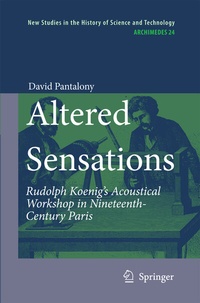
Altered Sensations
Description

Rudolph Koenig was one of the more prolific and colourful instrument makers in the renowned nineteenth-century precision instrument trade of Paris. Beginning his career as a violin maker, in 1858 the young Prussian immigrant shifted his talents towards the growing field of acoustics. Altered Sensations is a portrait of his vibrant atelier, a place of construction, commerce and experiment. For over forty years it was also a popular meeting place for scientists, artisans, musicians and teachers. Using archival and collection research from across North American and Europe, David Pantalony has traced the material and social influences of this space on the development of modern acoustics. In particular, he has detailed the manner in which Koenig modified, extended, spread and challenged Hermann von Helmholtz's Sensations of Tone.
A large part of the research on Koenig comes from the actual products of his workshop which survive in museums and collections around the world. The second section of Altered Sensations provides a Catalogue Raisonné of Koenig's entire line of instruments, including their history, details from specific examples, locations, and references in the literature. This catalogue will serve as a practical guide for curators and researchers as well as a comprehensive overview of nineteenth-century acoustical practice.
Reviews / Votes
From the reviews:
"Altered Sensations should of course be read by those with an interest in the science of sound and its development . . a valuable resource for anyone seeking to identify nineteenth-century acoustic apparatus and indeed could serve as inspiration for anyone presenting physical acoustics demonstrations today. . The volume is well endowed with scholarly endnotes to each chapter and a comprehensive bibliography; it is liberally illustrated . ." (Tacye Phillipson, ISIS, Vol. 102 (4), 2011)
Pantalony's work offers historians of technology and science and STS scholars an invaluable study of Rudolph Koenig's nineteenth-century acoustical workshop. In so doing, he explores in exquisite detail the importance of musical-instrument making to the production of scientific instruments and the crucial influence of market forces on Koenig's work. Rather than merely limiting himself to written sources, Pantalony forges a historical narrative based on a reading of the instruments themselves, in a sense providing us with an archaeology of artifacts. He also deftly recounts how crucial Koenig's instruments were to the development of nineteenth-century acoustics. This book superbly fills a tremendous gap in the secondary literature.
Myles W. Jackson, Professor of the History of Science, The Gallatin School, New York University
More details
Other editions
Additional editions
Content
Introduction. Workshops in the history of science. Showroom: The business of instrument making. Laboratory: Instrument making and experimentation. Life as an instrument maker. Sound in history. 1 - Training. 2 - Hermann von Helmholtz and the Sensations of Tone. 3 - Transformations in the workshop. 4 - The market and its influences. 5 - Constructing a reputation, 1866-1879. 6 - Expanding the North American Market, 1871-1882. 7 - The Faraday of sound. Conclusion - Beyond Sensations. Appendix 1. Key dates in Rudolph Koenig's life. Catalogue Raisonné. Notes. References.
