

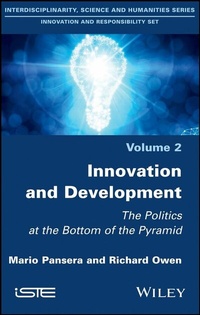
Innovation and Development
Description

Innovation, often tempered by the language of inclusion, has become an indispensable element of contemporary development policy and practice in the so-called Global South. Driven by multinational companies, public-private partnerships and social enterprises, 'innovation for development' aims to co-produce social goods (things of value) such as poverty alleviation with associated profit through innovative market-led solutions, opening up untapped and unserved markets in the developing world and exploiting the potential 'fortune at the bottom of the pyramid'. But innovation for development is a contested notion with the capacity to shelter multiple political agendas.
By reviewing existing academic theory and discussing four in-depth case studies from Bangladesh and India, this book interrogates how innovation for development is being framed, its politics and the impacts it is having on rural communities on the ground. The analysis suggests both an emerging hegemony constructed around a neoliberal, market-led agenda and the existence of countervailing voices that question this framing, sometimes radically so.
More details
Other editions
Additional editions
Content
- Cover
- Half-Title Page
- Title Page
- Copyright Page
- Contents
- List of Acronyms
- Preface
- Introduction
- Part 1: Theoretical Foundations: Innovation for Development, the Rise of a New Discourse
- 1. The Project of Development as a Discourse
- 1.1. Discourses, framings and narratives
- 1.1.1. The order of the discourse
- 1.1.2. Framings and narratives
- 1.2. Development as a discourse: underdevelopment and "the others
- 1.2.1. After post-development: the contemporary situation
- 1.2.2. Technology, innovation and development: a contested political field
- 1.3. Conclusion
- 2. The Cross-fertilization of Innovation into the Lexicon of Development
- 2.1. Economic development and the role of innovation
- 2.1.1. Growth theories and innovation
- 2.1.2. Evolutionary theory and innovation systems
- 2.1.3. Innovation systems and developing countries
- 2.2. Reviewing the innovation and development literature
- 2.2.1. Resource-constrained innovation (RCI): bricolage, frugality and jugaad
- 2.2.2. The fortune at the Bottom of the Pyramid
- 2.2.3. Critics of the BOP approach
- 2.2.4. Appropriate technology and grassroots innovations
- 2.2.5. "Inclusion": an emerging discursive bridge
- 2.3. Conclusions
- Part 2: Learning from the Field
- Introduction to Part 2
- 3. The Tale of the Poor as Market-led Consumers
- 3.1. Grameen Shakti
- 3.1.1. Creating resource-constrained innovation
- 3.1.2. The green sub-narrative
- 3.1.3. Institutional weaknesses and voids
- 3.1.4. Empathy and creating social value
- 3.2. Grameen Shakti's overall innovation and development narrative
- 3.3. Conclusion
- 4. The Tale of the Poor as Market-led Co-producers
- 4.1. The case of Mother Earth
- 4.1.1. The Industree ecosystem
- 4.1.2. The problems of rural production
- 4.1.3. Transforming production
- 4.1.4. Mother Earth's educating mission
- 4.2. Mother Earth's overall innovation and development narrative
- 4.3. Conclusion
- 5. The Tale of "Inclusive Business Models"
- 5.1. The case of the Indian Institute of Management Bangalore (IIMB)
- 5.1.1. IIMB's mission as a project of Western-inspired modernity
- 5.1.2. An "Indian way to modernity"
- 5.1.3. Inclusive business models and inclusive innovation
- 5.2. IIMB's overall innovation and development narrative
- 5.3. Conclusion
- 6. The Tale of Science, Technology and Innovation for Social Revolution
- 6.1. The case of the People's Science Movements (PSMs)
- 6.1.1. Competing narratives of science, technology and development in independent India
- 6.1.2. Pro-poor innovation for productive networks
- 6.1.3. Innovation as a political artifact
- 6.2. The People's Science Movements' overall innovation and development narrative
- 6.3. Conclusion
- 7. The Politics at the Bottom of the Pyramid
- 7.1. Words, meanings and politics
- 7.1.2. Comparing the case studies
- 7.2. Self-help and inclusion: key buzzwords connecting innovation to development
- 7.2.1. Self-help
- 7.2.2. Inclusion
- 7.2.3. Some important limitations
- 7.3. Closing thoughts
- Epilogue
- References
- Index
- Other titles from iSTE in Inter disciplinarity, Science and Humanities
- EULA
