

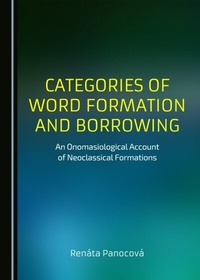
Categories of Word Formation and Borrowing
An Onomasiological Account of Neoclassical Formations
1st Edition
Published on 4. September 2015
175 pages
978-1-4438-8129-6 (ISBN)
Description

This book presents the onomasiological approach to word formation and applies it to neoclassical formations, using data taken from English and Russian medical terminology. The phenomenon of neoclassical formations is challenging for morphological theory because it raises questions about determining its boundaries as a distinct category. The difficulties of differentiating between compounding and affixation, between blending and compounding, and between word formation and borrowing represent key problematic areas here. The basic underlying hypothesis considered in this book is that the position of neoclassical formations in English and Russian is different. It will be argued that, whereas in English, neoclassical word formation is a system of word formation, Russian has only individual borrowings.This hypothesis and the theoretical problems it entails are viewed from the perspective of Stekauer's onomasiological theory of word formation. Stekauer's theory takes the needs of the speech community as its starting point in explaining word formation. In this theory, the different analyses of neoclassical formations in English and Russian can be accounted for in an intuitively appealing and theoretically elegant way. As naming needs are central, word formation and borrowing can be analysed as alternative responses activating different components of the language system.
More details
Other editions
Additional editions
Renata Panocova
Categories of Word Formation and Borrowing
An Onomasiological Account of Neoclassical Formations
Book
08/2015
Cambridge Scholars Publishing
€71.98
Shipment within 15-20 days
Content
- Intro
- Table of Contents
- List of Illustrations
- List of Tables
- Acknowledgements
- Chapter One
- Chapter Two
- 2.1 Historical background of the onomasiological approach to word formation
- 2.2 Stekauer's onomasiological theory of word formation
- 2.3 Categories - conceptual, semantic, grammatical or onomasiological?
- Chapter Three
- 3.1 Defining the process of borrowing
- 3.2 Onomasiological approaches to borrowing
- Chapter Four
- 4.1 Morphological status of the constituent elements of neoclassical formations
- 4.2 Rules governing the formation of neoclassical words
- 4.3 Productivity of neoclassical formations
- 4.4 Lexical, morphological and phonological properties shared by the category of neoclassical formations
- 4.5 Relation between neoclassical word formation and native word formation
- 4.6 Neoclassical formations and their treatment in Russian
- 4.7 Defining neoclassical word formation
- Chapter Five
- 5.1 Names of diseases, syndromes, and symptoms in Stekauer's onomasiological theory
- 5.2 Marginal cases of Onomasiological type 1 and Onomasiological type 2
- 5.3 Patterns within Onomasiological type 3
- 5.4 Patterns within Onomasiological type 7
- 5.5 Analysis overview
- Chapter Six
- 6.1 An approach to internationalisms in Russian
- 6.2 Classification of Russian translations of medical terms
- 6.3 An onomasiological analysis of Russian translations of medical terms
- 6.4 Summary of the results
- Conclusion
- Bibliography
- Author Index
- Subject Index
