

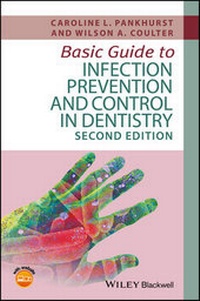
Basic Guide to Infection Prevention and Control in Dentistry
Description

Reviews / Votes
"This is a reputable source of infection control and prevention protocols, and this update is necessary to maintain current guidelines on infection control. The book can be used as an additional resource for U.S.-based practices, but it may not be suitable as the sole book because some information is pertinent only to U.K. practice. The book is very thorough if used for proper practice guidelines, but more detail may be necessary based on individual practices" Maria Prassas, RDH, MEd, MOT, University of Illinois at Chicago College of Dentistry on behalf of Doody'sMore details
Other editions
Additional editions
Persons
Content
Foreword viii
Preface ix
Acknowledgements x
About the companion website xi
1 Essentials of infection control 1
Why do we need infection control in dentistry? 1
Relative risk and risk perception 2
Risk assessment and the management decision-making process 3
How to perform a risk assessment in a dental practice 4
Hierarchy of risk management control 6
Infection control and the law 7
Legal acts under which dental practice is conducted 8
Published standards and guidance 12
Team approach to prevention of infection 13
2 Communicable diseases in the dental surgery 16
How infections are spread 16
Reservoirs and sources of infection 18
Infectious diseases by route of infection in dentistry 19
Infectious disease by route of transmission in the dental surgery 20
Emerging and re-emerging pathogens 28
3 Occupational health and immunization 34
Occupational health hazards 34
Building a culture of safety 35
Organizing staff health in a dental practice 37
Immunization requirements for dentistry 39
Protecting women of childbearing age 39
Occupational vaccines to protect against hepatitis and TB 43
Health checks and the consequences of blood-borne virus infection 46
Health clearance 47
Duty of care to patients 50
4 Sharp safe working in the dental surgery 53
Why sharps prevention is important 53
When do sharps injuries occur? 55
Preventable sharps injuries 56
How to avoid a sharps injury 56
Managing sharps injuries and splashes 60
Occupational health risk assessment for BBV exposure 62
Management of hepatitis C exposures 62
Postexposure prophylaxis for HIV and hepatitis B 64
Recording of sharps injuries 66
Clinical governance and accident risk assessment 66
5 Hand hygiene 68
Hands as a source of infection 68
Hands as a source of hospital-acquired infection 69
Hand hygiene and teamworking 70
Hand hygiene technique 76
Hand care and prevention of dermatitis 82
6 Personal protection for prevention of cross-infection 85
Why we wear personal protective equipment 85
The role of gloves 86
Choosing a suitable glove for the task 88
Managing an allergy to NRL gloves 88
Managing latex allergies in patients 90
Masks and when to use them 91
Protective eyewear and visors 95
Protection during cardiopulmonary resuscitation 97
Tunics and uniforms 99
Protective barriers - plastic aprons and surgical gowns 102
7 Sterilization and disinfection of dental instruments 105
Decontamination cycle 105
Why has cleaning become so important? 106
Legal requirements and technical standards for decontamination 107
Where should instrument decontamination take place? 110
Design of dedicated decontamination units 110
Purchasing of dental equipment 117
Cleaning of dental instruments 118
Disinfection of dental handpieces 121
Mechanical cleaning with an ultrasonic bath 124
Thermal washer disinfectors 126
Instrument inspection 130
Dental instrument sterilization 130
Suitability of sterilizer for different loads 130
Sterilizer installation and validation 131
Steam purity and maintenance of water reservoir chamber 132
How do you know your sterilizer is working? 133
Loading the sterilizer 138
Storage of wrapped and unwrapped instruments 138
Single-use items 142
Variant CJD and rationale for single-use items 144
Disinfection of heat-sensitive equipment and hard surfaces 144
Disinfection of dental impressions 146
8 Dental surgery design, surface decontamination and managing aerosols 148
Dental surgery design 148
Survival of microbes on surgery surfaces 153
General cleaning 154
Surface decontamination in the dental surgery 156
Management of aerosols and splatter 162
Managing large blood or body fluid spillages 164
9 Management of dental unit waterlines 167
What are biofilms? 167
Risk to staff and patient health from dental unit waterlines 168
Methods to reduce the biofilm 173
Control of legionellae in the dental practice water supply 180
10 Healthcare waste management 182
Legislation on hazardous waste disposal 182
Types of waste 184
What is hazardous waste? 185
Clinical waste segregation and classification 189
Amalgam waste and installation of amalgam separators 193
Mercury in the environment 193
Disposal and handling of hazardous waste in the surgery 195
Safe handling of clinical waste prior to disposal 197
Bulk storage of waste for collection 197
Transport of hazardous waste 198
Benefits of waste segregation 198
11 Transport and postage of diagnostic specimens, impressions and equipment for servicing and repair 201
Legal framework 201
Collecting specimens 202
Transport of specimens to the laboratory 203
Transport restrictions 204
Fixed pathological specimens 205
Transporting impressions 206
Equipment to be sent for service or repair 206
Appendix 208
Table A.1 Daily infection control clinical pathway 208
Table A.2 Decontamination methods for specific instruments and items of dental equipment 211
Table A.3 Examples of hand and hard surface disinfectants and dental unit waterline biocides 214
Index 217
Chapter 1
Essentials of infection control
WHY DO WE NEED INFECTION CONTROL IN DENTISTRY?
Dentists and other members of the dental team are exposed to a wide variety of potentially infectious micro-organisms in their clinical working environment. The transmission of infectious agents from person to person or from inanimate objects within the clinical environment which results in infection is known as cross-infection.
The protocols and procedures involved in the prevention and control of infection in dentistry are directed to reduce the possibility or risk of cross-infection occurring in the dental clinic, thereby producing a safe environment for both patients and staff. In the UK, all employers have a legal obligation under the Health and Safety at Work Act 1974 to ensure that all their employees are appropriately trained and proficient in the procedures necessary for working safely. They are also required by the Control of Substances Hazardous to Health (COSHH) Regulations 2002 to review every procedure carried out by their employees which involves contact with a substance hazardous to health, including pathogenic micro-organisms. Employers and their employees are also responsible in law to ensure that any person on the premises, including patients, contractors and visitors, is not placed at any avoidable risk, as far as is reasonably practicable.
Thus, management of the risks associated with cross-infection is important in dentistry. We do not deal in absolutes, but our infection control measures are directed towards reducing, to an acceptable level, the probability or possibility that an infection could be transmitted. This is usually measured against the background infection rate expected in the local population, i.e. the patient, student or member of the dental team is placed at no increased risk of infection when entering the dental environment. Infection control guidance used in dentistry has developed from an assessment of the evidence base, consideration of the best clinical practice and risk assessment (Figure 1.1).
Figure 1.1 Factors influencing the development of infection control guidance in dentistry.
How we manage the prevention of cross-infection and control the risk of spread of infection in the dental clinic is the subject of this book.
RELATIVE RISK AND RISK PERCEPTION
Risk has many definitions, and the dental profession and general public's perception of risk can be widely divergent. This difference in interpretation can impact on how safe the general public perceives treatment in a dental clinic to be, especially following sensational media reports of so-called 'dirty dentists' who are accused of failing to sterilize instruments between patients or wash their hands! For example, risks under personal control, such as driving a car, are often perceived as more acceptable than the risks of travelling by airplane or train, where control is delegated to others. Thus, the public often mistakenly perceives travelling by car to be safer than by air, even though the accident statistics do not support this perception. Unseen risks such as those associated with infection, particularly if they are associated with frightening consequences such as AIDS or MRSA, are predictably most alarming to the profession and the public. Risks can be clinical, environmental, financial, economic or political, as well as those affecting public perception and reputation of the dentist or the team.
What makes risks significant? There are a number of criteria which make risks significant and worthy of concern.
- Potential for actual injury to patients or staff
- Significant occupational health and safety hazard
- The possibility of erosion of reputation or public confidence
- Potential for litigation
- Minor incidents which occur in clusters and may represent trends
Understanding what is implied by the term hazard is important when we consider the control of infection. This may be defined as a situation, or substance, including micro-organisms, with the potential to cause harm. Risk assessment must take into account not only the likelihood or probability that a particular hazard may affect the patient or dental staff, but also the severity of the consequences.
RISK ASSESSMENT AND THE MANAGEMENT DECISION-MAKING PROCESS
It is the role of managers of dental practices to manage risk. The Management of Health and Safety at Work Regulations 1999 require employers to carry out a risk assessment as an essential part of a risk management strategy. Infection control is an application of risk management to the dental clinical setting.
Risk management involves identification, assessment and analysis of risks and the implementation of risk control procedures designed to eliminate or reduce the risk.
Risk control in dentistry is dependent on a single-tier approach, in which all patients are treated without discrimination as though they were potentially infectious. The practical interpretation of this concept, known as Standard Infection Control Precautions (SICPs), treats all body fluids, with the exception of sweat, as a source of infection. SICPs are a series of measures and procedures designed to prevent exposure of staff or patients to infected body fluids and secretions. Specifically, dental healthcare workers (HCWs) employ personal barriers and safe behaviours to prevent the two-way exchange of blood, saliva and respiratory secretions between patient and operator (Box 1.1).
Box 1.1 Summary of standard infection control precautions
- Use of hand hygiene
- Use of gloves
- Use of facial protection (surgical masks, visors or goggles)
- Use of disposable aprons/gowns
- Prevention and management of needlestick and sharps injuries and splash incidents
- Use of respiratory hygiene and cough etiquette
- Management of used surgical drapes and uniforms
- Ensure safe waste management
- Safe handling and decontamination of dental instruments and equipment
Decisions made within an organization, and within practice, should take into account the potential risks that could directly or indirectly affect a patient's care. If risks are properly assessed, the process can help all healthcare professionals and organizations to set their priorities and improve decision making to reach an optimal balance of risk, benefit and cost. If dental teams systematically identify, assess, learn from and manage all risks and incidents, they will be able to reduce potential and actual risks, and identify opportunities to improve healthcare.
Risk assessment has the following benefits for delivery of dental healthcare.
- Strives for the optimal balance of risk by focusing on the reduction or mitigation of risk while supporting and fostering innovation, so that greatest returns can be achieved with acceptable results, costs and risks.
- Supports better decision making through a solid understanding of all risks and their likely impact.
- Enables dentists to plan for uncertainty, with well-considered contingency plans which cope with the impact of unexpected events and increase staff, patient and public confidence in the care that is delivered.
- Helps the dentist comply with published standards and guidelines.
- Highlights weakness and vulnerability in procedures, practices and policy changes.
HOW TO PERFORM A RISK ASSESSMENT IN A DENTAL PRACTICE
A risk assessment in dental practice involves the following steps.
- Identify the hazards.
- Decide who might be harmed, and how.
- Evaluate the risks arising from the hazards and decide whether existing precautions are adequate or whether more needs to be done.
- Record your findings, focusing on the controls.
- Review your assessment periodically and revise it if necessary.
Stage 1: Identify the hazards
- Divide your work into manageable categories.
- Concentrate on significant hazards, which could result in serious harm or affect several people.
- Ask your employees for their views; involve the whole dental team.
- Separate activities into operational stages to ensure that there are no hidden hazards.
- Make use of manufacturers' datasheets to help you spot hazards and put risks in their true perspective.
- Review past accidents and ill health records.
Stage 2: Who might be harmed?
- Identify all members of staff at risk from the significant hazard.
- Do not forget people who only come into contact with the hazard infrequently, e.g. maintenance contractors, visitors, general public and people sharing your workplace.
- Highlight those persons particularly at risk who may be more vulnerable, e.g. trainees and students, pregnant women, immunocompromised patients or staff, people with disabilities, inexperienced or temporary workers and lone workers.
Stage 3: Evaluate the level of risk
- The aim is to eliminate or reduce all risks to a low level.
- For each significant hazard, determine whether the remaining risk, after all precautions have been taken, is high, medium or low.
- Concentrate on the...
