

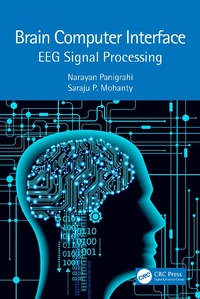
Brain Computer Interface
EEG Signal Processing
1st Edition
Published on 29. July 2022
224 pages
978-1-000-59552-9 (ISBN)
Description

Brain Computer Interface: EEG Signal Processing discusses electroencephalogram (EEG) signal processing using effective methodology and algorithms. This book provides a basic introduction to EEG and a classification of different components present in EEG. It also helps the reader to understand the scope of processing EEG signals and their associated applications. Further, it covers specific aspects such as epilepsy detection; exploitation of P300 for various applications; design of an EEG acquisition system; and detection of saccade, fix, and blink from EEG and EOG data.
Key Features:
Explains the basis of brain computer interface and how it can be established using different EEG signal characteristics
Covers the detailed classification of different types of EEG signals with respect to their physical characteristics
Explains detection and diagnosis of epileptic seizures from the EEG data of a subject
Reviews the design and development of a low-cost and robust EEG acquisition system
Provides mathematical analysis of EEGs, including MATLAB (R) codes for students to experiment with EEG data
This book is aimed at graduate students and researchers in biomedical, electrical, electronics, communication engineering, healthcare, and cyber physical systems.
Key Features:
Explains the basis of brain computer interface and how it can be established using different EEG signal characteristics
Covers the detailed classification of different types of EEG signals with respect to their physical characteristics
Explains detection and diagnosis of epileptic seizures from the EEG data of a subject
Reviews the design and development of a low-cost and robust EEG acquisition system
Provides mathematical analysis of EEGs, including MATLAB (R) codes for students to experiment with EEG data
This book is aimed at graduate students and researchers in biomedical, electrical, electronics, communication engineering, healthcare, and cyber physical systems.
More details
Edition
1. Auflage
Language
English
Place of publication
London
United Kingdom
Publishing group
Taylor & Francis Ltd
Target group
Professional and scholarly
Product notice
Reflowable
Illustrations
10 Tables, black and white; 70 Line drawings, black and white; 16 Halftones, black and white; 86 Illustrations, black and white
ISBN-13
978-1-000-59552-9 (9781000595529)
Copyright in bibliographic data and cover images is held by Nielsen Book Services Limited or by the publishers or by their respective licensors: all rights reserved.
Schweitzer Classification
Other editions
Additional editions
Book
11/2024
1st Edition
CRC Press
€72.30
Shipment within 10-20 days
Book
07/2022
1st Edition
CRC Press
€175.90
Shipment within 10-20 days
Persons
Narayan Panigrahi, Received his MSc (Computer Science) from J.K.Institute of Technology, University of Allahabad, M.Tech(Computer Science and Data Processing), IIT, Kharagpur and PhD from IIT, Bombay in the year 1990, 1999 and 2012 respectively. He is the best graduate of Berhampur University, Odisha in the year 1987. He started as a research scientist in the Institute for System Studies and Analysis (ISSA), New Delhi in the year 1991. He initiated research and development of modeling and visualization of terrain. Currently, he is serving as a scientist in Center for Artificial Intelligence and Robotics (CAIR) a DRDO Laboratory in Bangalore India. He leads a team of scientist to design and develop Geographical Information System comprising of topography, bathymetry and space navigation. He has researched the algorithmic aspect of Remote Sensing, spatio-temporal science and GIS. He has initiated in communication of science through authoring of various books in different languages. He has authored Geographic Information Science (GISc) and Computations in GIS which are being taught in different academic circle. He has been awarded the "National Geospatial Award for Excellence 2019" from ISRS (Indian Society for Remote Sensing), DRDO Performance Excellence Award 2012, Laboratory Technology Award for 2010, 2014, 2017 and 2019 respectively. Authored seven books, 69 international research papers and 6 patents. Two of his research papers were awarded best research award by INRIA, France and IEEE, Computer Society. Guided more than 40 graduate and undergraduate engineering students. He is a plenary and invited speaker in many international conferences and has chaired technical session.
Saraju P. Mohanty received B. Tech. (Honors) in electrical engineering from the Orissa University of Agriculture and Technology, Bhubaneswar, in 1995, the master's degree in Systems Science and Automation from the Indian Institute of Science, Bengaluru, in 1999, and the Ph.D. degree in Computer Sci- ence and Engineering from the University of South Florida, Tampa, in 2003. He is a Professor with the University of North Texas. His research is in "Smart Electronic Systems" which has been funded by National Science Foundations (NSF), Semiconductor Research Corporation (SRC), U.S. Air Force, IUSSTF, and Mission Innovation. He has authored 350 research articles, 4 books, and invented 4 granted and 1 pending patents. His Google Scholar h-index is 38 and i10-index is 147 with 6600 citations. He is regarded as a visionary researcher on Smart Cities technology in which his research deals with security and energy aware, and AI/ML-integrated smart components. He introduced the Secure Digital Camera (SDC) in 2004 with built-in security features designed using Hardware-Assisted Security (HAS) or Security by Design (SbD) principle. He is widely credited as the designer for the first digital watermarking chip in 2004 and first the low-power digital watermarking chip in 2006. He is a recipient of 12 best paper awards, Fulbright Specialist Award in 2020, IEEE Consumer Technology Society Outstanding Service Award in 2020, the IEEE-CS-TCVLSI Distinguished Leadership Award in 2018, and the PROSE Award for Best Textbook in Physical Sciences and Mathematics category in 2016. He has delivered 10 keynotes and served on 9 panels at various International Conferences. He has been serving on the editorial board of several peer-reviewed international journals. He has mentored 2 post-doctoral researchers, and supervised 12 Ph.D. dissertations, 26 M.S. theses, and 10 undergraduate projects.
Saraju P. Mohanty received B. Tech. (Honors) in electrical engineering from the Orissa University of Agriculture and Technology, Bhubaneswar, in 1995, the master's degree in Systems Science and Automation from the Indian Institute of Science, Bengaluru, in 1999, and the Ph.D. degree in Computer Sci- ence and Engineering from the University of South Florida, Tampa, in 2003. He is a Professor with the University of North Texas. His research is in "Smart Electronic Systems" which has been funded by National Science Foundations (NSF), Semiconductor Research Corporation (SRC), U.S. Air Force, IUSSTF, and Mission Innovation. He has authored 350 research articles, 4 books, and invented 4 granted and 1 pending patents. His Google Scholar h-index is 38 and i10-index is 147 with 6600 citations. He is regarded as a visionary researcher on Smart Cities technology in which his research deals with security and energy aware, and AI/ML-integrated smart components. He introduced the Secure Digital Camera (SDC) in 2004 with built-in security features designed using Hardware-Assisted Security (HAS) or Security by Design (SbD) principle. He is widely credited as the designer for the first digital watermarking chip in 2004 and first the low-power digital watermarking chip in 2006. He is a recipient of 12 best paper awards, Fulbright Specialist Award in 2020, IEEE Consumer Technology Society Outstanding Service Award in 2020, the IEEE-CS-TCVLSI Distinguished Leadership Award in 2018, and the PROSE Award for Best Textbook in Physical Sciences and Mathematics category in 2016. He has delivered 10 keynotes and served on 9 panels at various International Conferences. He has been serving on the editorial board of several peer-reviewed international journals. He has mentored 2 post-doctoral researchers, and supervised 12 Ph.D. dissertations, 26 M.S. theses, and 10 undergraduate projects.
Content
Chapter 1 Introduction
Chapter 2 Fundamentals of EEG Signals
Chapter 3 Signal Processing for EEGs
Chapter 4 Software and Hardware for EEG for Capturing and Analysis
Chapter 5 Protocol and Process of EEG Data Acquisition
Chapter 6 Methods to Detect Blink from the EEG Signal
Chapter 7 Saccade and Fix Detection from EOG Signals
Chapter 8 Detection of P300 and Its Applications
Chapter 9 Brain Computer Interface Using P300
Chapter 10 Designing an EEG Acquisition System
Chapter 11 A Method to Localize the Pupil of the Eye for Point of Gaze Estimation
Chapter 12 Detection of Epileptic Seizures from EEG Data
Chapter 2 Fundamentals of EEG Signals
Chapter 3 Signal Processing for EEGs
Chapter 4 Software and Hardware for EEG for Capturing and Analysis
Chapter 5 Protocol and Process of EEG Data Acquisition
Chapter 6 Methods to Detect Blink from the EEG Signal
Chapter 7 Saccade and Fix Detection from EOG Signals
Chapter 8 Detection of P300 and Its Applications
Chapter 9 Brain Computer Interface Using P300
Chapter 10 Designing an EEG Acquisition System
Chapter 11 A Method to Localize the Pupil of the Eye for Point of Gaze Estimation
Chapter 12 Detection of Epileptic Seizures from EEG Data
