

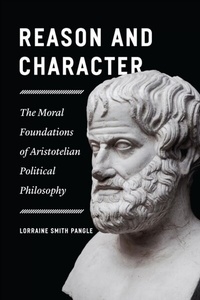
Reason and Character
The Moral Foundations of Aristotelian Political Philosophy
1st Edition
Published on 22. December 2022
336 pages
978-0-226-68833-6 (ISBN)
Description

What does it mean to live a good life or a happy life, and what part does reason play in the quest for fulfillment? Proceeding by means of a close and thematically selective commentary on Aristotle's
Nicomachean Ethics, this book offers a novel interpretation of Aristotle's teachings on the relation between reason and moral virtue. Pangle shows how Aristotle's arguments for virtue as the core of happiness and for reason as the guide to virtue emerge in dialectical response to Socrates's paradoxical claim that virtue is knowledge and vice is ignorance, and as part of a politically complex project of giving guidance to lawgivers and ordinary citizens while offering spurs to deep theoretical reflection.
Against Socrates, Aristotle insists that both virtue and vice are voluntary and that individuals are responsible for their characters, a stance that lends itself to vigorous defense of moral responsibility. At the same time, Pangle shows, Aristotle elucidates the importance of unchosen concerns in shaping all that we do and the presence of some form of ignorance or subtle confusions in all moral failings. Thus the gap between his position and that of Socrates comes on close inspection to be much smaller than first appears, and his true teaching on the role of reason in shaping moral existence far more complex. The book offers fresh interpretations of Aristotle's teaching on the relation of passions to judgments, on what it means to choose virtue for its own sake, on the way reason finds the mean, especially in justice, and on the crucial intellectual virtue of phronesis or active wisdom and its relation to theoretical wisdom. Offering answers to longstanding debates over the status of reason and the meaning of happiness in the Nicomachean Ethics, this book will kindle in readers a new appreciation for Aristotle's lessons on how to make the most out of life, as individuals and in society.
Against Socrates, Aristotle insists that both virtue and vice are voluntary and that individuals are responsible for their characters, a stance that lends itself to vigorous defense of moral responsibility. At the same time, Pangle shows, Aristotle elucidates the importance of unchosen concerns in shaping all that we do and the presence of some form of ignorance or subtle confusions in all moral failings. Thus the gap between his position and that of Socrates comes on close inspection to be much smaller than first appears, and his true teaching on the role of reason in shaping moral existence far more complex. The book offers fresh interpretations of Aristotle's teaching on the relation of passions to judgments, on what it means to choose virtue for its own sake, on the way reason finds the mean, especially in justice, and on the crucial intellectual virtue of phronesis or active wisdom and its relation to theoretical wisdom. Offering answers to longstanding debates over the status of reason and the meaning of happiness in the Nicomachean Ethics, this book will kindle in readers a new appreciation for Aristotle's lessons on how to make the most out of life, as individuals and in society.
All prices
More details
Other editions
Additional editions
Lorraine Pangle
Reason and Character - The Moral Foundations of Aristotelian Political Philosophy
The Moral Foundations of Aristotelian Political Philosophy
Book
10/2020
University of Chicago Press
€37.00
Shipment within 10-20 days
Person
Lorraine Smith Pangle is professor of government and codirector of the Thomas Jefferson Center for the Study of Core Texts and Ideas at the University of Texas at Austin. Her books include
Virtue Is Knowledge, also published by the University of Chicago Press.
Content
- Intro
- Contents
- Introduction
- 1. The Task and the Puzzle of Reason in the Nicomachean Ethics (NE 1 and 2)
- 2. Knowledge, Choice, and Responsibility for Character (NE 3.1-5)
- 3. Reason and Purpose in the Moral Virtues (NE 3.6-4.9)
- 4. Justice and the Rule of Reason (NE 5)
- 5. Wisdom and Active Wisdom: The Intellectual Virtues (NE 6)
- 6. Problems of Self-Control (NE 7.1-10)
- Epilogue: The Philosophic Life (NE 10.6-8)
- Acknowledgments
- Notes
- Bibliography of Modern Works and Editions
- Index

