

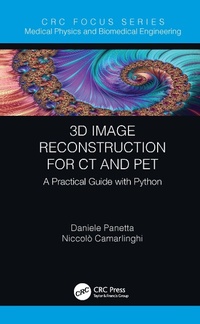
3D Image Reconstruction for CT and PET
A Practical Guide with Python
1st Edition
Published on 11. October 2020
134 pages
978-1-000-17588-2 (ISBN)
Description

This is a practical guide to tomographic image reconstruction with projection data, with strong focus on Computed Tomography (CT) and Positron Emission Tomography (PET). Classic methods such as FBP, ART, SIRT, MLEM and OSEM are presented with modern and compact notation, with the main goal of guiding the reader from the comprehension of the mathematical background through a fast-route to real practice and computer implementation of the algorithms. Accompanied by example data sets, real ready-to-run Python toolsets and scripts and an overview the latest research in the field, this guide will be invaluable for graduate students and early-career researchers and scientists in medical physics and biomedical engineering who are beginners in the field of image reconstruction.
A top-down guide from theory to practical implementation of PET and CT reconstruction methods, without sacrificing the rigor of mathematical background
Accompanied by Python source code snippets, suggested exercises, and supplementary ready-to-run examples for readers to download from the CRC Press website
Ideal for those willing to move their first steps on the real practice of image reconstruction, with modern scientific programming language and toolsets
Daniele Panetta is a researcher at the Institute of Clinical Physiology of the Italian National Research Council (CNR-IFC) in Pisa. He earned his MSc degree in Physics in 2004 and specialisation diploma in Health Physics in 2008, both at the University of Pisa. From 2005 to 2007, he worked at the Department of Physics "E. Fermi" of the University of Pisa in the field of tomographic image reconstruction for small animal imaging micro-CT instrumentation. His current research at CNR-IFC has as its goal the identification of novel PET/CT imaging biomarkers for cardiovascular and metabolic diseases. In the field micro-CT imaging, his interests cover applications of three-dimensional morphometry of biosamples and scaffolds for regenerative medicine. He acts as reviewer for scientific journals in the field of Medical Imaging: Physics in Medicine and Biology, Medical Physics, Physica Medica, and others. Since 2012, he is adjunct professor in Medical Physics at the University of Pisa.
Niccolo Camarlinghi is a researcher at the University of Pisa. He obtained his MSc in Physics in 2007 and his PhD in Applied Physics in 2012. He has been working in the field of Medical Physics since 2008 and his main research fields are medical image analysis and image reconstruction. He is involved in the development of clinical, pre-clinical PET and hadron therapy monitoring scanners. At the time of writing this book he was a lecturer at University of Pisa, teaching courses of life-sciences and medical physics laboratory. He regularly acts as a referee for the following journals: Medical Physics, Physics in Medicine and Biology, Transactions on Medical Imaging, Computers in Biology and Medicine, Physica Medica, EURASIP Journal on Image and Video Processing, Journal of Biomedical and Health Informatics.
A top-down guide from theory to practical implementation of PET and CT reconstruction methods, without sacrificing the rigor of mathematical background
Accompanied by Python source code snippets, suggested exercises, and supplementary ready-to-run examples for readers to download from the CRC Press website
Ideal for those willing to move their first steps on the real practice of image reconstruction, with modern scientific programming language and toolsets
Daniele Panetta is a researcher at the Institute of Clinical Physiology of the Italian National Research Council (CNR-IFC) in Pisa. He earned his MSc degree in Physics in 2004 and specialisation diploma in Health Physics in 2008, both at the University of Pisa. From 2005 to 2007, he worked at the Department of Physics "E. Fermi" of the University of Pisa in the field of tomographic image reconstruction for small animal imaging micro-CT instrumentation. His current research at CNR-IFC has as its goal the identification of novel PET/CT imaging biomarkers for cardiovascular and metabolic diseases. In the field micro-CT imaging, his interests cover applications of three-dimensional morphometry of biosamples and scaffolds for regenerative medicine. He acts as reviewer for scientific journals in the field of Medical Imaging: Physics in Medicine and Biology, Medical Physics, Physica Medica, and others. Since 2012, he is adjunct professor in Medical Physics at the University of Pisa.
Niccolo Camarlinghi is a researcher at the University of Pisa. He obtained his MSc in Physics in 2007 and his PhD in Applied Physics in 2012. He has been working in the field of Medical Physics since 2008 and his main research fields are medical image analysis and image reconstruction. He is involved in the development of clinical, pre-clinical PET and hadron therapy monitoring scanners. At the time of writing this book he was a lecturer at University of Pisa, teaching courses of life-sciences and medical physics laboratory. He regularly acts as a referee for the following journals: Medical Physics, Physics in Medicine and Biology, Transactions on Medical Imaging, Computers in Biology and Medicine, Physica Medica, EURASIP Journal on Image and Video Processing, Journal of Biomedical and Health Informatics.
More details
Series
Edition
1. Auflage
Language
English
Place of publication
London
United Kingdom
Publishing group
Taylor & Francis Ltd
Target group
College/higher education
Product notice
Reflowable
Illustrations
1 Tables, black and white; 30 Illustrations, black and white
ISBN-13
978-1-000-17588-2 (9781000175882)
Copyright in bibliographic data and cover images is held by Nielsen Book Services Limited or by the publishers or by their respective licensors: all rights reserved.
Schweitzer Classification
Other editions
Additional editions
Daniele Panetta | Niccolo Camarlinghi
3D Image Reconstruction for CT and PET
A Practical Guide with Python
Book
05/2022
1st Edition
CRC Press
€35.90
Shipment within 15-20 days
Daniele Panetta | Niccolo Camarlinghi
3D Image Reconstruction for CT and PET
A Practical Guide with Python
Book
10/2020
1st Edition
CRC Press
€83.90
Shipment within 15-20 days
Persons
Daniele Panetta is a researcher at the Institute of Clinical Physiology of the Italian National Research Council (CNR-IFC) in Pisa. He earned his MSc degree in Physics in 2004 and specialisation diploma in Health Physics in 2008, both at the University of Pisa. From 2005 to 2007, he worked at the Department of Physics "E. Fermi" of the University of Pisa in the field of tomographic image reconstruction for small animal imaging micro-CT instrumentation. His current research at CNR-IFC has as its goal the identification of novel PET/CT imaging biomarkers for cardiovascular and metabolic diseases. In the field micro-CT imaging, his interests cover applications of three-dimensional morphometry of biosamples and scaffolds for regenerative medicine. He acts as reviewer for scientific journals in the field of Medical Imaging: Physics in Medicine and Biology, Medical Physics, Physica Medica, and others. Since 2012, he is adjunct professor in Medical Physics at the University of Pisa.
Niccolo Camarlinghi is a researcher at the University of Pisa. He obtained his MSc in Physics in 2007 and his PhD in Applied Physics in 2012. He has been working in the field of Medical Physics since 2008 and his main research fields are medical image analysis and image reconstruction. He is involved in the development of clinical, pre-clinical PET and hadron therapy monitoring scanners. At the time of writing this book he was a lecturer at University of Pisa, teaching courses of life-sciences and medical physics laboratory. He regularly acts as a referee for the following journals: Medical Physics, Physics in Medicine and Biology, Transactions on Medical Imaging, Computers in Biology and Medicine, Physica Medica, EURASIP Journal on Image and Video Processing, Journal of Biomedical and Health Informatics.
Niccolo Camarlinghi is a researcher at the University of Pisa. He obtained his MSc in Physics in 2007 and his PhD in Applied Physics in 2012. He has been working in the field of Medical Physics since 2008 and his main research fields are medical image analysis and image reconstruction. He is involved in the development of clinical, pre-clinical PET and hadron therapy monitoring scanners. At the time of writing this book he was a lecturer at University of Pisa, teaching courses of life-sciences and medical physics laboratory. He regularly acts as a referee for the following journals: Medical Physics, Physics in Medicine and Biology, Transactions on Medical Imaging, Computers in Biology and Medicine, Physica Medica, EURASIP Journal on Image and Video Processing, Journal of Biomedical and Health Informatics.
Content
1. Preliminary notions 2. Short guide on Python samples 3. Analytical reconstruction algorithms 4. Iterative reconstruction algorithms 5. Overview of methods for generation of projection data
