

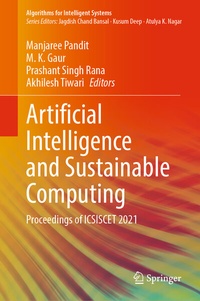
Artificial Intelligence and Sustainable Computing
Proceedings of ICSISCET 2021
1st Edition
Published on 15. November 2022
XXI, 763 pages
978-981-19-1653-3 (ISBN)
Description

This book presents high-quality research papers presented at 3rd International Conference on Sustainable and Innovative Solutions for Current Challenges in Engineering and Technology (ICSISCET 2021) held at Madhav Institute of Technology & Science (MITS), Gwalior, India, from November 13-14, 2021. The book extensively covers recent research in artificial intelligence (AI) that knits together nature-inspired algorithms, evolutionary computing, fuzzy systems, computational intelligence, machine learning, deep learning, etc., which is very useful while dealing with real problems due to their model-free structure, learning ability, and flexible approach. These techniques mimic human thinking and decision-making abilities to produce systems that are intelligent, efficient, cost-effective, and fast. The book provides a friendly and informative treatment of the topics which makes this book an ideal reference for both beginners and experienced researchers.
More details
Series
Language
English
Place of publication
Singapore
Singapore
Publishing group
Springer Singapore
Target group
Professional and scholarly
Product notice
Reflowable
Illustrations
XXI, 763 p. 423 illus., 277 illus. in color.
File size
20,62 MB
ISBN-13
978-981-19-1653-3 (9789811916533)
DOI
10.1007/978-981-19-1653-3
Schweitzer Classification
Other editions
Additional editions
Manjaree Pandit | M. K. Gaur | Prashant Singh Rana
Artificial Intelligence and Sustainable Computing
Proceedings of ICSISCET 2021
Book
11/2022
Springer
€235.39
Shipment within 3-4 weeks
Persons
Manjaree Pandit
obtained her M.Tech. degree in Electrical Engineering from Maulana Azad College of Technology, Bhopal, (India), in 1989, and Ph.D. degree from Jiwaji University Gwalior (India) in 2001. She is currently working as Dean Academics and Professor in the Department of Electrical Engineering, M.I.T.S., Gwalior, (India). She is a senior member of IEEE, a recognized reviewer of a few IEEE Transactions, Springer and Elsevier journals, and has published more than 65 papers in reputed international journals. She has been recognized as an outstanding reviewer by Elsevier and received Top Peer Reviewer Award from the international reviewer database site Publons (Clarivate Analytics) for being in top 1% of reviewers in Engineering for year 2017-19 and year 2018-2019 and Top Peer Reviewer Award by Publons for being in top 1% of reviewers in cross field in year 2018-19. Her areas of interest are hybrid renewable energy resources integration with the power grid, nature-inspired algorithms, ANN and fuzzy neural network applications to electrical power system. She has successfully completed research projects funded from AICTE, DST and UGC and has published 68 papers in International Journals of repute, guided more than 70 PG dissertations and 05 Ph.D. candidates. Her papers are very well cited in Google Scholar, Scopus, and Web of Science. She has also received ISTE National Research Award for the years 2002 and 2004, Certificate of Merit from Institution of Engineers, India, UGC Research Award for carrying out postdoctoral work during 2009-2011. She has been involved in conducting a number of national conferences, workshops, and short-term courses.
Manoj Kumar Gaur is working as Professor and Head in Mechanical Engineering Department, Associate Proctor and In-charge of the Institute Industry Interaction Cell at Madhav Institute of Technology and Science, Gwalior, India. He has made substantial contributions to the fields of solar thermal energy, solar distillation, and heat and mass transfer applications. He possesses eighteen years teaching experience of postgraduate and undergraduate classes. He has authored three books titled "Solar Energy: Problems Solutions and Experiments", "Optimization of machining parameters of hard porcelain on CNC machine", and "Solar Energy Systems: Thermal Analysis and Its Application". Eighty of his papers have been published in various International and National journals and conferences. He is an active reviewer of prestigious journal like Solar Energy, Desalination, Desalination and Water Treatment, Journal of Thermal Engineering, etc. His broad areas of interest include thermodynamics, heat transfer, solar energy and solar distillation. He is Life Member of the Indian Society for Technical Education (India) IET and Faculty Advisor of Society of Automotive Engineers INDIA MITS chapter. He attended one-week summer school 'UKERC' at University of Sussex, Brighton, U.K., in July 2009. He had obtained Ph.D. from Indian Institute of Technology Delhi, New Delhi, and Master of Technology in Engineering Materials from Maulana Azad National Institute of Technology Bhopal in 2002. He secured fifth position in the university in his Bachelor of Engineering in Mechanical Branch from Oriental Institute of Technology and Science, Bhopal, in 1999.
Dr Prashant Singh Rana is presently working as Associate Professor in the Computer Science and Engineering Department, Thapar Institute of Engineering & Technology, Patiala, Punjab. He received his both Ph.D. and M.Tech. from ABV-IIITM, Gwalior. His areas of research are machine learning, deep learning, bioinformatics, and optimization. He has published more than 70 research papers in different journals and conferences. He completed five projects sponsored by DST, ICMR, NVIDIA, and one project is going on. He published 10 patents.He guided seven Ph.D. students and 18 masters students.
Dr. Akhilesh Tiwari has received Ph.D. degree in Information Technology from Rajiv Gandhi Technological University, Bhopal, India. He is currently working as Professor and Head in the Department of Information Technology, Madhav Institute of Technology & Science (MITS), Gwalior, (M.P.), India. Previously, he has also worked as Head of CSE and IT department from March 2018 to December 2020, at MITS Gwalior. His areas of current research include knowledge discovery in databases and data mining, terrorist network mining, hesitation mining, and pattern warehousing. He has published more than 70 research papers in the journals and conferences of international repute, which include publications in international publishing houses such as IGI Global USA, Springer, Inderscience, Taylor & Francis (CRC Press), and Elsevier with SCI, SCIE, and SCOPUS indexing. He has published 10book chapters in edited books and also edited one book titled "Soft-Computing-Based Nonlinear Control Systems Design" for IGI Global USA. He has guided 04 Ph.D. scholars from various universities in India and more than 20 dissertations at master's level, and at present, he is guiding 08 Ph.D. scholars. Currently, he is Chairman of Board of Studies in Information Technology, contributed as Chairman of Research Advisory Committees (RACs), working as Member Secretary in the Academic Council, Member in the IQAC Cell, Member in the Academic Development Cell at Madhav Institute of Technology and Science, Gwalior (M.P.), India, and Member in the Board of Studies of Computer Science & Engineering at Rajiv Gandhi Proudyogiki Vishwavidyalaya, Bhopal (M.P.). He is also acting as a reviewer and member in editorial board/program committee of various international journals and conferences. He has been honored with the "Outstanding Young Person of Gwalior Award" in 2014 by the JCI Gwalior. He has been honored with the award of recognition for significant contribution in the "Implementation and preparation of structure of flexible curriculum based on AICTE model curriculum" at MITS Gwalior. He is having the memberships of various academic/scientific societies including IETE, GAMS (Gwalior Academy of Mathematical Sciences), IACSIT, and IAENG. He is also in the expert panel/selection committees of various agencies/universities/institutions of India, including National Institute of Electronics &Information Technology (NIELIT), Ministry of Electronics &Information Technology, Govt. of India.
Manoj Kumar Gaur is working as Professor and Head in Mechanical Engineering Department, Associate Proctor and In-charge of the Institute Industry Interaction Cell at Madhav Institute of Technology and Science, Gwalior, India. He has made substantial contributions to the fields of solar thermal energy, solar distillation, and heat and mass transfer applications. He possesses eighteen years teaching experience of postgraduate and undergraduate classes. He has authored three books titled "Solar Energy: Problems Solutions and Experiments", "Optimization of machining parameters of hard porcelain on CNC machine", and "Solar Energy Systems: Thermal Analysis and Its Application". Eighty of his papers have been published in various International and National journals and conferences. He is an active reviewer of prestigious journal like Solar Energy, Desalination, Desalination and Water Treatment, Journal of Thermal Engineering, etc. His broad areas of interest include thermodynamics, heat transfer, solar energy and solar distillation. He is Life Member of the Indian Society for Technical Education (India) IET and Faculty Advisor of Society of Automotive Engineers INDIA MITS chapter. He attended one-week summer school 'UKERC' at University of Sussex, Brighton, U.K., in July 2009. He had obtained Ph.D. from Indian Institute of Technology Delhi, New Delhi, and Master of Technology in Engineering Materials from Maulana Azad National Institute of Technology Bhopal in 2002. He secured fifth position in the university in his Bachelor of Engineering in Mechanical Branch from Oriental Institute of Technology and Science, Bhopal, in 1999.
Dr Prashant Singh Rana is presently working as Associate Professor in the Computer Science and Engineering Department, Thapar Institute of Engineering & Technology, Patiala, Punjab. He received his both Ph.D. and M.Tech. from ABV-IIITM, Gwalior. His areas of research are machine learning, deep learning, bioinformatics, and optimization. He has published more than 70 research papers in different journals and conferences. He completed five projects sponsored by DST, ICMR, NVIDIA, and one project is going on. He published 10 patents.He guided seven Ph.D. students and 18 masters students.
Dr. Akhilesh Tiwari has received Ph.D. degree in Information Technology from Rajiv Gandhi Technological University, Bhopal, India. He is currently working as Professor and Head in the Department of Information Technology, Madhav Institute of Technology & Science (MITS), Gwalior, (M.P.), India. Previously, he has also worked as Head of CSE and IT department from March 2018 to December 2020, at MITS Gwalior. His areas of current research include knowledge discovery in databases and data mining, terrorist network mining, hesitation mining, and pattern warehousing. He has published more than 70 research papers in the journals and conferences of international repute, which include publications in international publishing houses such as IGI Global USA, Springer, Inderscience, Taylor & Francis (CRC Press), and Elsevier with SCI, SCIE, and SCOPUS indexing. He has published 10book chapters in edited books and also edited one book titled "Soft-Computing-Based Nonlinear Control Systems Design" for IGI Global USA. He has guided 04 Ph.D. scholars from various universities in India and more than 20 dissertations at master's level, and at present, he is guiding 08 Ph.D. scholars. Currently, he is Chairman of Board of Studies in Information Technology, contributed as Chairman of Research Advisory Committees (RACs), working as Member Secretary in the Academic Council, Member in the IQAC Cell, Member in the Academic Development Cell at Madhav Institute of Technology and Science, Gwalior (M.P.), India, and Member in the Board of Studies of Computer Science & Engineering at Rajiv Gandhi Proudyogiki Vishwavidyalaya, Bhopal (M.P.). He is also acting as a reviewer and member in editorial board/program committee of various international journals and conferences. He has been honored with the "Outstanding Young Person of Gwalior Award" in 2014 by the JCI Gwalior. He has been honored with the award of recognition for significant contribution in the "Implementation and preparation of structure of flexible curriculum based on AICTE model curriculum" at MITS Gwalior. He is having the memberships of various academic/scientific societies including IETE, GAMS (Gwalior Academy of Mathematical Sciences), IACSIT, and IAENG. He is also in the expert panel/selection committees of various agencies/universities/institutions of India, including National Institute of Electronics &Information Technology (NIELIT), Ministry of Electronics &Information Technology, Govt. of India.
Content
Demand based Land Suitability Prediction Model for Sustainable Agriculture.- Power Generation Forecasting of Wind Farms using Machine Learning Algorithms.- Music Recommendation System Based on Emotion Detection.- Service Analytics on ITSM Processes using Time Series.- Comparative Analysis of Color-based Segmentation Methods Used for Smartphone Camera Captured Fingerphotos.- Prediction of Heart Disease through KNN, Random Forest and Decision Tree Classifier using K-Fold Cross Validation.- Distance Matrix Generation for Dynamic Vehicle Routing Optimization in Transport Fleets Management.- Enhancing Weighted Support Vector Machine for Noise Classification.- Optimized Hysteresis Region Authenticated Handover for 5G HetNets.- Performance Improvement of CTNR Protocol in Wireless Sensor Network Using Machine Learning.
