

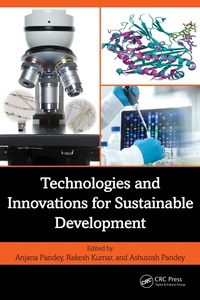
Technologies and Innovations for Sustainable Development
1st Edition
Published on 13. March 2025
240 pages
978-1-040-30235-4 (ISBN)
Description

Technologies and Innovations for Sustainable Development offers a comprehensive exploration of cutting-edge solutions that can help us build a greener, more equitable future. Too often, technologies are either not developed for a sufficiently profitable market, or if developed, are not accessible or well-adapted to end-user needs. This edited book seeks to advance knowledge and understanding of how to equitably improve the functioning of the "global innovation system" for sustainable development of technologies. This volume aims to examine specific cases of "system interventions" (e.g., policy interventions, institutional innovations, new approaches to shaping the innovation process, etc.) intended to strengthen the global innovation system, with the broader aim of developing policy recommendations and are generalizable across multiple sectors.
This book brings together contributions from leading experts across diverse fields, showcasing the latest advancements in technology and innovative practices that address pressing sustainability issues. From hydrogen production and fuel blending to waste management and additive manufacturing process and application of emerging technologies such as machine learning, deep learning, and CFD simulation, this book provides a roadmap for harnessing innovation to achieve global sustainability goals.
Key features include:
An integrative overview of emerging and cutting-edge solutions to sustainable development
Discussion on policy framework to address global environmental and public health challenges
Forward-looking insights into emerging trends and future directions in sustainable development.
Whether you are a policymaker, researcher, industry professional, or student, Technologies and Innovations for Sustainable Development is an essential resource for understanding the pivotal role of technology in creating a sustainable future. Join us in exploring the innovations that hold the key to a better world for generations to come.
This book brings together contributions from leading experts across diverse fields, showcasing the latest advancements in technology and innovative practices that address pressing sustainability issues. From hydrogen production and fuel blending to waste management and additive manufacturing process and application of emerging technologies such as machine learning, deep learning, and CFD simulation, this book provides a roadmap for harnessing innovation to achieve global sustainability goals.
Key features include:
An integrative overview of emerging and cutting-edge solutions to sustainable development
Discussion on policy framework to address global environmental and public health challenges
Forward-looking insights into emerging trends and future directions in sustainable development.
Whether you are a policymaker, researcher, industry professional, or student, Technologies and Innovations for Sustainable Development is an essential resource for understanding the pivotal role of technology in creating a sustainable future. Join us in exploring the innovations that hold the key to a better world for generations to come.
More details
Edition
1. Auflage
Language
English
Place of publication
London
United Kingdom
Publishing group
Taylor & Francis Ltd
Target group
College/higher education
Professional and scholarly
Illustrations
46 Tables, black and white; 129 Line drawings, black and white; 10 Halftones, black and white; 139 Illustrations, black and white
File size
5,49 MB
ISBN-13
978-1-040-30235-4 (9781040302354)
Copyright in bibliographic data and cover images is held by Nielsen Book Services Limited or by the publishers or by their respective licensors: all rights reserved.
Schweitzer Classification
Other editions
Additional editions
Anjana Pandey | Rakesh Kumar | Ashutosh Pandey
Technologies and Innovations for Sustainable Development
Book
03/2025
1st Edition
CRC Press
€170.90
Shipment within 10-20 days
Persons
Dr. Anjana Pandey is a Professor in the Department of Biotechnology at Motilal Nehru National Institute of Technology (MNNIT) Allahabad, located in Uttar Pradesh, India. With extensive experience in environmental and health biotechnology, Dr. Pandey's research focuses on bio-waste to biofuel conversion, genetically engineered microbes for biofuel enhancement, development of diagnostic markers for diseases, and the application of nanoparticles in disease identification and drug delivery. Dr. Pandey has received her Postdoctoral Fellowship in Molecular Microbiology, Bose Institute, Kolkata (1999-2001) and Ph.D. in Biochemistry, Banaras Hindu University, Varanasi (1998). She has been engaged in teaching in research for more than 24 years. Dr. Pandey has received numerous accolades, including the Dr. Sarvepalli Radhakrishnan Life Time Achievement IRDP Award 2023, the Millet Best Dish Award, and the International Young Scientist Award 2023. She has also been recognized as one of the 100 most dedicated professors by the World Education Congress in 2019.Dr. Pandey has led various significant projects, including: development of an electrochemical sensor for anticancer drug detection, augmentation of biohydrogen production using nanoparticles, integrated biohydrogen production from renewable biomass, generation of improved photovoltaic devices, and molecular mapping for plant pathogen detection. Dr. Pandey has provided consultancy services in areas like lake water analysis for U.P. Jal Nigam, Ramgarh Lake at Gorakhpur. With over 81 publications, Dr. Pandey holds several patents, including ones for an optical biosensor for Salmonella detection and a novel method for heavy metal detection using gold nanoparticles. She has been invited to deliver lectures and participate in academic councils and conferences worldwide, including institutions in Germany, Norway, Australia, and Russia. Dr. Pandey's contribution to biotechnology, especially in biofuel and environmental sustainability, marks her as a distinguished scientist and academician in her field.
Dr. Rakesh Kumar is presently working as Assistant Professor in the School of Management Studies, Motilal Nehru National Institute of Technology Allahabad, Uttar Pradesh, India. He has been involved in teaching and research for the last 10 years. He has received his Ph.D. from the Department of Business Administration, University of Lucknow, and his Master of Business Administration from Madan Mohan Malviya Government Engineering College, Gotrakhpur, Uttar Pradesh. His research mainly focuses on sustainable consumption, green consumption, circular consumption, sustainable business practices, adoption of emerging technologies. He has published a number of papers in Scopus/SCIE/SSCI/ABDC-listed Journals. He has presented his research work in numerous national and international conferences and has organized several workshops and FDPs on contemporary issues. He is also a reviewer for many internationally renowned journals. He is a resource person and expert in data analysis using MS Excel, SPSS, AMOS, and R & R Studio. He has chaired session in several national and international conferences and delivered expert lectures in several webinars/FDPs/workshops etc.
Dr. Ashutosh Pandey is Professor in the Department of Chemistry at Motilal Nehru National Institute of Technology (MNNIT) Allahabad, located in Prayagraj, Uttar Pradesh, India. With a robust background in chemistry, Dr. Pandey's research interests encompass nanotechnology, material science, and photocatalysis. Dr. Pandey received his Ph.D. in chemistry (1999) and Master of Science (M.Sc.) in chemistry from Banaras Hindu University, Varanasi (1994). He has served in various academic and research positions, contributing significantly to his field through numerous research projects and publications. Dr. Pandey has a strong portfolio of research with several patents to his name. Notable patents include an optical biosensor and a method of preparation for the detection of Salmonella Typhi, process optimization using Bacillus Licheniformis for biohydrogen production from corn starch, and a novel method for heavy metal detection using gold nanoparticles. Dr. Pandey has published extensively in renowned journals. Some key publications include: Synthesis and characterization of heterometallic aggregates in the European Journal of Inorganic Chemistry, studies on hydrogen production by microorganisms within reverse micelles in the International Journal of Hydrogen Energy, research on nanophosphors in Materials Chemistry & Physics and IEEE Transactions on Nanobioscience, and investigations into the synthesis and structural characterization of various compounds in journals like Inorganica Chemica Acta and Z. Naturforsch. He is a recipient of many prestigious awards, honours and recognitions including the DST-Nanoscience & Nanotechnology PDF ship award (2007), a nomination for Member of Core Group for the Solar Energy Mission, Govt. of U.P., India, the DST-SERC Young Scientist Project award (September 2003), and membership in the American Chemical Society. Dr. Pandey has led and participated in various research projects focusing on the synthesis and application of nanomaterials, photocatalysis, and the development of advanced materials for energy and environmental applications. He has also provided consultancy services, contributing his expertise to industrial and governmental projects. Dr. Pandey's contributions to the field of chemistry, particularly in nanotechnology and material science, have established him as a prominent researcher and educator. His work continues to impact the scientific community and contribute to advancements in environmental sustainability and energy solutions.
Dr. Rakesh Kumar is presently working as Assistant Professor in the School of Management Studies, Motilal Nehru National Institute of Technology Allahabad, Uttar Pradesh, India. He has been involved in teaching and research for the last 10 years. He has received his Ph.D. from the Department of Business Administration, University of Lucknow, and his Master of Business Administration from Madan Mohan Malviya Government Engineering College, Gotrakhpur, Uttar Pradesh. His research mainly focuses on sustainable consumption, green consumption, circular consumption, sustainable business practices, adoption of emerging technologies. He has published a number of papers in Scopus/SCIE/SSCI/ABDC-listed Journals. He has presented his research work in numerous national and international conferences and has organized several workshops and FDPs on contemporary issues. He is also a reviewer for many internationally renowned journals. He is a resource person and expert in data analysis using MS Excel, SPSS, AMOS, and R & R Studio. He has chaired session in several national and international conferences and delivered expert lectures in several webinars/FDPs/workshops etc.
Dr. Ashutosh Pandey is Professor in the Department of Chemistry at Motilal Nehru National Institute of Technology (MNNIT) Allahabad, located in Prayagraj, Uttar Pradesh, India. With a robust background in chemistry, Dr. Pandey's research interests encompass nanotechnology, material science, and photocatalysis. Dr. Pandey received his Ph.D. in chemistry (1999) and Master of Science (M.Sc.) in chemistry from Banaras Hindu University, Varanasi (1994). He has served in various academic and research positions, contributing significantly to his field through numerous research projects and publications. Dr. Pandey has a strong portfolio of research with several patents to his name. Notable patents include an optical biosensor and a method of preparation for the detection of Salmonella Typhi, process optimization using Bacillus Licheniformis for biohydrogen production from corn starch, and a novel method for heavy metal detection using gold nanoparticles. Dr. Pandey has published extensively in renowned journals. Some key publications include: Synthesis and characterization of heterometallic aggregates in the European Journal of Inorganic Chemistry, studies on hydrogen production by microorganisms within reverse micelles in the International Journal of Hydrogen Energy, research on nanophosphors in Materials Chemistry & Physics and IEEE Transactions on Nanobioscience, and investigations into the synthesis and structural characterization of various compounds in journals like Inorganica Chemica Acta and Z. Naturforsch. He is a recipient of many prestigious awards, honours and recognitions including the DST-Nanoscience & Nanotechnology PDF ship award (2007), a nomination for Member of Core Group for the Solar Energy Mission, Govt. of U.P., India, the DST-SERC Young Scientist Project award (September 2003), and membership in the American Chemical Society. Dr. Pandey has led and participated in various research projects focusing on the synthesis and application of nanomaterials, photocatalysis, and the development of advanced materials for energy and environmental applications. He has also provided consultancy services, contributing his expertise to industrial and governmental projects. Dr. Pandey's contributions to the field of chemistry, particularly in nanotechnology and material science, have established him as a prominent researcher and educator. His work continues to impact the scientific community and contribute to advancements in environmental sustainability and energy solutions.
Content
Potential Use of Microorganisms in Bioreactors for H2 Production
Health and Environmentally Sustainable Systems-An opinion
Simultaneous electrochemical sensing of organic dyes from wastewater effluent: A sustainable approach
Revolutionizing Drug Discovery and Development: The Impact of In silico and Bioinformatics Approaches
Unlocking the potential of Bacillus firmus NMBL-03 for enhanced hydrogen production using Response Surface Methodology
Prediction of PM2.5 levels using ANN and MLR machine Learning Models for Lucknow in India
Effect of operating parameters on condition monitoring of rotor-bearing system using deep learning
Utilization of Waste BOF Slag in Porous Concrete Pavement to Enhance Sustainability
Process Parameter Optimization of Electrochemical Machining Processes Using the Rao Algorithms
Sustainable Policy Framework for Managing Construction and Demolition Waste in India Based on the Status Review
Controlling of Automobile Exhaust Emissions Using Adsorption Technique
Implementation of Triplicate Fuel Blends to Enhance Diesel Engine Characteristics
Data based diagnosis of SOFC performance using Machine Learning approach
Production optimization of EPS and Photosynthetic pigment (Chlorophyll-a, Chlorophyll-b, Carotenoids) production from Chlorella using BBD matrix for RSM
CFD Simulation of Operation Theatre for Comfort of Patient
VRIKSHKOSH: Application Of Geospatial Technologies in Developing Curated Medicinal Plant Database
Effect of Sand Mixing on the Geotechnical Properties of Black Cotton Soil
A Review-Additive Manufacturing Process, Classification, Post Process, Porosity and Fatigue Fracture
Optimization of Waste Transformer Oil into Value Added Products
Health and Environmentally Sustainable Systems-An opinion
Simultaneous electrochemical sensing of organic dyes from wastewater effluent: A sustainable approach
Revolutionizing Drug Discovery and Development: The Impact of In silico and Bioinformatics Approaches
Unlocking the potential of Bacillus firmus NMBL-03 for enhanced hydrogen production using Response Surface Methodology
Prediction of PM2.5 levels using ANN and MLR machine Learning Models for Lucknow in India
Effect of operating parameters on condition monitoring of rotor-bearing system using deep learning
Utilization of Waste BOF Slag in Porous Concrete Pavement to Enhance Sustainability
Process Parameter Optimization of Electrochemical Machining Processes Using the Rao Algorithms
Sustainable Policy Framework for Managing Construction and Demolition Waste in India Based on the Status Review
Controlling of Automobile Exhaust Emissions Using Adsorption Technique
Implementation of Triplicate Fuel Blends to Enhance Diesel Engine Characteristics
Data based diagnosis of SOFC performance using Machine Learning approach
Production optimization of EPS and Photosynthetic pigment (Chlorophyll-a, Chlorophyll-b, Carotenoids) production from Chlorella using BBD matrix for RSM
CFD Simulation of Operation Theatre for Comfort of Patient
VRIKSHKOSH: Application Of Geospatial Technologies in Developing Curated Medicinal Plant Database
Effect of Sand Mixing on the Geotechnical Properties of Black Cotton Soil
A Review-Additive Manufacturing Process, Classification, Post Process, Porosity and Fatigue Fracture
Optimization of Waste Transformer Oil into Value Added Products
