

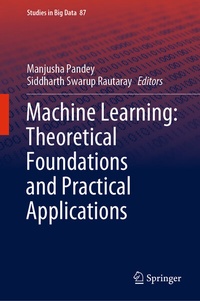
Machine Learning: Theoretical Foundations and Practical Applications
Description

This edited book is a collection of chapters invited and presented by experts at 10th industry symposium held during 9-12 January 2020 in conjunction with 16th edition of ICDCIT. The book covers topics, like machine learning and its applications, statistical learning, neural network learning, knowledge acquisition and learning, knowledge intensive learning, machine learning and information retrieval, machine learning for web navigation and mining, learning through mobile data mining, text and multimedia mining through machine learning, distributed and parallel learning algorithms and applications, feature extraction and classification, theories and models for plausible reasoning, computational learning theory, cognitive modelling and hybrid learning algorithms.
More details
Other editions
Additional editions
Persons
Dr. Siddharth Swarup Rautary presently working as Associate Professor at the School of Computer Engineering, Kalinga Institute of Industrial Technology, Deemed to be University, Bhubaneswar, Odisha, India. He has teaching and research experience of more than 9 years. He did his doctoral degree from Indian Institute of Information Technology, Allahabad, U.P., India. His research interest includes big data analytics, image processing, intelligent systems, human-computer interaction and similar innovative areas. His research contribution includes 05 co-edited proceedings/books which include ASIC Springer series, more than 60 research publications in reputed conferences, book chapters and journals indexed in Scopus/SCI/ESCI and with a citation index of 1800 as on date. As an organizing chair, he has organized 05 international conferences (ICCAN2017, ICCAN 2019, 16th ICDCIT 2020, FICTA 2016, FICTA 2017) and has been part of different core committees of other conferences and workshops. He has delivered invited talks in different workshops and conferences.
Dr. Manjusha Pandey presently working as Associate Professor at the School of Computer Engineering, Kalinga Institute of Industrial Technology, Deemed to be University, Bhubaneswar, Odisha, India. She has teaching and research experience of more than 9 years. She did her doctoral degree from Indian Institute of Information Technology, Allahabad, U.P., India; her research interest includes big data analytics, computer networks, intelligent systems, machine learning and similar innovative areas. Her research contribution includes 04 co-edited proceedings/books which include SIS Springer series, more than 65 research publications in reputed conferences, book chapters and journals indexed in Scopus/SCI/ESCI and with a citation index of 600 as on date. As an organizing chair, she has organized 02 international conferences and has been part of different core committees of other conferences andworkshops. She has delivered invited talks in different workshops and conferences.
