

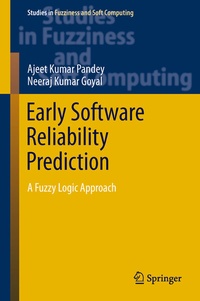
Early Software Reliability Prediction
Description

More details
Other editions
Additional editions
Persons
Dr. Ajeet Kumar Pandey is currently associated with AECOM India Private Limited, supporting RAM analysis of L&T Metro Rail, Hyderabad (India), one of the major public-private partnership (PPP) projects. He is also taking guest lectures, on invitation, at Indian Institute of Management Raipur, Raipur, India. He has more than 12 years of professional and research experience. He worked as a Sr. Research Fellow at IIT Kharagpur, Kharagpur, India, Sr. RAMS Engineer at Cognizant Technology Solutions, Hyderabad, India, and Sr. Systems Officer at UPTEC, Lucknow, India. Dr. Pandey received his Ph.D. in Reliability Engineering from Indian Institute of Technology Kharagpur, Kharagpur, India 2011. Prior to this, he did his M. Tech. from Motilal Nehru National Institute of Technology, Allahabad, India. His major areas of research are software engineering and project management; data mining; software metrics, software quality and testing; reliability analysis and prediction; hazard analysisand system safety; and handling compliance and regulatory issues of safety critical systems. He has also been involved with academics and has taught subjects like Operating System, Operational Research, Software Engineering, Data Mining & Business Intelligence, etc., to Undergraduate and Postgraduate students. He has also contributed several research papers to international journals and conference proceedings.
Dr. Neeraj Kumar Goyal is currently an Assistant Professor in Reliability Engineering Centre, Indian Institute of Technology Kharagpur, India. He has received his Ph.D. degree from IIT Kharagpur in Reliability Engineering in 2006. His Ph.D. topic was 'On Some Aspects of Reliability Analysis and Design of Communication Networks'. He received the Bachelor of Engineering degree with Honors in Electronics and Communications Engineering from MREC Jaipur, Rajasthan, India in 2000. His areas of research and teaching are network reliability, software reliability, electronic system reliability, reliability testing, probabilistic risk/safety assessment, and reliability design. He has completed various research and consultancy projects for various organizations, e.g. DRDO, NPCIL, Vodafone, ECIL etc. He has contributed several research papers to international journals and conference proceedings. He is also associate editor of International Journal of Performability Engineering.
Content
Introduction.- Backgrounds: Software Quality and Reliability Prediction.- Early Fault Prediction using Software Metrics and Process Maturity.- Multistage Model for Residual Fault Prediction.- Prediction and Ranking of Fault-prone Software Modules.- Reliability Centric Test Case Prioritization.- Software Reliability and Operational Profile.- Appendices.- References.
