

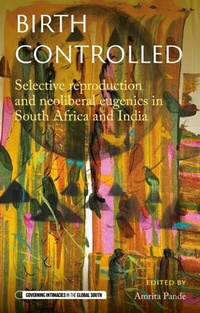
Birth Controlled
Selective Reproduction and Neoliberal Eugenics in South Africa and India
1st Edition
Published on 14. June 2022
408 pages
978-1-5261-6053-9 (ISBN)
Description

Birth controlled analyses the world of selective reproduction - the politics of who gets to legitimately reproduce the future - through a cross-cultural analysis of three modes of 'controlling' birth: contraception, reproductive violence and repro-genetic technologies. It argues that as fertility rates decline worldwide, the fervour to control fertility, and fertile bodies, does not dissipate; what evolves is the preferred mode of control. Although new technologies like those that assist conception or allow genetic selection may appear to be an antithesis of other violent versions of population control, this book demonstrates that both are part of the same continuum. All population control policies target and vilify women (Black women in particular), and coerce them into subjecting their bodies to state and medical surveillance; Birth controlled argues that assisted reproductive technologies and repro-genetic technologies employ a similar and stratified burden of blame and responsibility based on gender, race, class and caste.
To empirically and historically ground the analysis, the book includes contributions from two postcolonial nations, South Africa and India, examining interactions between the history of colonialism and the economics of neoliberal markets and their influence on the technologies and politics of selective reproduction.
The book provides a critical, interdisciplinary and cutting-edge dialogue around the interconnected issues that shape reproductive politics in an ostensibly 'post-population control' era. The contributions draw on a breadth of disciplines ranging from gender studies, sociology, medical anthropology, politics and science and technology studies to theology, public health and epidemiology, facilitating an interdisciplinary dialogue around the interconnected modes of controlling birth and practices of neo-eugenics. -- .
To empirically and historically ground the analysis, the book includes contributions from two postcolonial nations, South Africa and India, examining interactions between the history of colonialism and the economics of neoliberal markets and their influence on the technologies and politics of selective reproduction.
The book provides a critical, interdisciplinary and cutting-edge dialogue around the interconnected issues that shape reproductive politics in an ostensibly 'post-population control' era. The contributions draw on a breadth of disciplines ranging from gender studies, sociology, medical anthropology, politics and science and technology studies to theology, public health and epidemiology, facilitating an interdisciplinary dialogue around the interconnected modes of controlling birth and practices of neo-eugenics. -- .
Reviews / Votes
AAA Council on Anthropology and Reproduction (CAR) Monograph Prize 2024 Honorable Mention -- .All prices
More details
Series
Language
English
Place of publication
United Kingdom
Target group
College/higher education
Professional and scholarly
Illustrations
1 black & white figure
ISBN-13
978-1-5261-6053-9 (9781526160539)
Copyright in bibliographic data and cover images is held by Nielsen Book Services Limited or by the publishers or by their respective licensors: all rights reserved.
Schweitzer Classification
Other editions
Additional editions
Amrita Pande
Birth Controlled
Selective Reproduction and Neoliberal Eugenics in South Africa and India
Book
06/2024
Manchester University Press
€39.50
Shipment within 15-20 days
Amrita Pande
Birth Controlled
Selective Reproduction and Neoliberal Eugenics in South Africa and India
Book
06/2022
Manchester University Press
€125.80
Shipment within 15-20 days
Person
Amrita Pande is Professor of Sociology at the University of Cape Town -- .
Content
Foreword - Betsy Hartmann
Introduction - Amrita Pande
Prologue: Malika Ndlovu
Part I: Birth projects
1 Birth Projects, Selective reproduction and neoliberal eugenics - Amrita Pande
2 Spectres of biological politics: conversations within and across South Asia - Sushmita Chatterjee, Deboleena Roy, Banu Subramaniam
3 Ved Garbh Vihar: Hindutva's latest neo-eugenic repronational project - Vasudha Mohanka
4 Racialising ancient skeletons: how haplotypes are mobilised in the re-writing of origin
stories in the Indian media - Devika Prakash
5 Bio-power and assisted reproductive technologies in the global south: An ethical response
from South Africa - Manitza Kotze
Part II: Birth violated
6 Injectable contraceptives: technologies of power and language of rights - C. Sathyamala
7 Stratified and violent: young women's experiences of access to reproductive health in southern Africa - Kezia Batisai
8 The politics of naming: contested vocabularies of birth violence - Rachelle Chadwick
9 Individuals, institutions, and the global political economy: unpacking intentionality in obstetric violence - Sreeparna Chattopadhyay
Part III: Birth assisted
10 'The first thing is to...survive': Dalit feminist voices on reproductive rights in India - Johanna Gondouin, Suruchi Thapar-Bjoerkert and Mohan Rao
11 Hamstrung by hardship: protecting egg donors' reproductive labour in Kolkata, India - Meghna Mukherjee
12 The egg donation economy in South Africa: different levels of biopolitics - Verena Namberger
13 Subjects of scarcity: making white egg providers in the repro-hub of South Africa - Tessa Moll
14 The resurgence of eugenics through egg donation in South Africa: race as a central and 'obvious' choice - Rufaro Moyo
Epilogue: Malika Ndlovu -- .
Introduction - Amrita Pande
Prologue: Malika Ndlovu
Part I: Birth projects
1 Birth Projects, Selective reproduction and neoliberal eugenics - Amrita Pande
2 Spectres of biological politics: conversations within and across South Asia - Sushmita Chatterjee, Deboleena Roy, Banu Subramaniam
3 Ved Garbh Vihar: Hindutva's latest neo-eugenic repronational project - Vasudha Mohanka
4 Racialising ancient skeletons: how haplotypes are mobilised in the re-writing of origin
stories in the Indian media - Devika Prakash
5 Bio-power and assisted reproductive technologies in the global south: An ethical response
from South Africa - Manitza Kotze
Part II: Birth violated
6 Injectable contraceptives: technologies of power and language of rights - C. Sathyamala
7 Stratified and violent: young women's experiences of access to reproductive health in southern Africa - Kezia Batisai
8 The politics of naming: contested vocabularies of birth violence - Rachelle Chadwick
9 Individuals, institutions, and the global political economy: unpacking intentionality in obstetric violence - Sreeparna Chattopadhyay
Part III: Birth assisted
10 'The first thing is to...survive': Dalit feminist voices on reproductive rights in India - Johanna Gondouin, Suruchi Thapar-Bjoerkert and Mohan Rao
11 Hamstrung by hardship: protecting egg donors' reproductive labour in Kolkata, India - Meghna Mukherjee
12 The egg donation economy in South Africa: different levels of biopolitics - Verena Namberger
13 Subjects of scarcity: making white egg providers in the repro-hub of South Africa - Tessa Moll
14 The resurgence of eugenics through egg donation in South Africa: race as a central and 'obvious' choice - Rufaro Moyo
Epilogue: Malika Ndlovu -- .
