

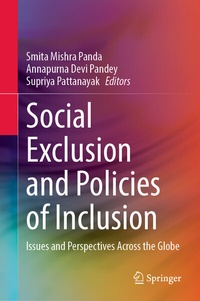
Social Exclusion and Policies of Inclusion
Description

This book brings together cross-cultural perspectives on political economy of social exclusion and a critical view of policies of inclusion. The themes covered are political economy of social exclusion; inclusionary policy outcomes; persistent challenges to social exclusion and rethinking social exclusion and inclusion. The contexts are located in varied geographies including India, South East Asia, USA, Canada, Mexico, Australia and Papua New Guinea. The book throws light on how, historically, social inclusion of various excluded communities has always been a part of nation building with varying results. Furthermore, it highlights how the terrain of social exclusion is becoming increasingly complex today. It provides the space to reimagine issues of inclusion and exclusion within the social policy landscape of a country. It provides ways to rethink policies of inclusion such that dialogue between the excluded and the state is enhanced, and the systems of seeking justice for a dignified life, peace and freedom are improved. It appeals to policy makers, academicians and practitioners of development and social policy studies, planning and governance in both developing and developed countries.
More details
Other editions
Additional editions
Persons
Smita Mishra Panda is Director Research at the Centurion University of Technology and Management, Bhubaneswar Odisha. She has a background in Social Anthropology and Development Planning. A gold medalist from University of Delhi, she has several national and international awards to her credit. Her broad areas of teaching and research for over 25 years include gender and development, natural resource management, local governance and livelihoods of the underprivileged.
Dr. Smita was Researcher with the Asian Institute of Technolgy (Bangkok, Thailand) and United Nations Centre for Regional Development (Nagoya, Japan). She has taught at the Institute of Rural Management, Anand (Gujarat). She has been Visiting Faculty at the Norwegian University of Science and Technology, (Norway), Monash University (Australia) and Curtin University (Australia).
Annapurna Pandey is Lecturer in Anthropology at the University of California, Santa Cruz (USA). She has also taught for a decade at the San Jose State University and has spent a teaching Semester at Sea sponsored by the University of Virginia. She has been Senior Fulbright Scholar in India as well. Her areas of research and teaching include gender and Indian diaspora in the USA and indigenous communities in India.
Supriya Pattanayak is Vice Chancellor of Centurion University of Technology and Management, Bhubaneswar, Odisha. She is trained in Social Work and has extensive teaching, research and policy experience. Her research interest is in the field of gender and development issues, and social work pedagogy. She has worked with NGOs, multilateral and bilateral agencies, federal and state governments. In her role as State Representative (Odisha), Department for International Development India (British High Commission), she collaborated with various development partners in pursuance of harmonization of development efforts and achievement of MDGs. She has taught in Australian Universities and been Visiting Research Fellow at the St Petersburg State University, Russia.
