

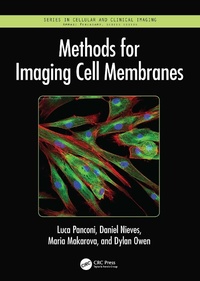
Methods for Imaging Cell Membranes
1st Edition
Published on 21. December 2023
136 pages
978-1-003-82314-8 (ISBN)
Description

This book will serve as an introduction to microscopy and biomedical imaging methods, with a focus on the study of the distributions and dynamics of molecules on the cell surface. It will provide readers with an in-depth understanding of how modern microscopy methodology can be used to understand the organisation of cell membrane systems and how experiments can be designed around these methodologies.
There are numerous methods employed to understand cell membrane organisation, but foremost among them are microscopy methods which can map the distributions of molecules on the cell surface and even map the biophysical properties of membranes themselves. Fluorescence microscopy has been especially widely used due to its specificity and relatively noninvasive nature, allowing live-cell imaging. However, the recent advance of super-resolution fluorescence microscopy has broken the previous resolution limit for this type of microscopy, which has been an important advancement in the field. Atomic force microscopy and electron microscopy have also been deployed to learn about membrane organisation and properties.
Each chapter in this volume will be themed around measuring a particular property of cell membranes. In each case, the authors examine the range of methodology applicable to the task, comparing the advantages and disadvantages of each one, and will also provide an overview of important discoveries that have been made using the methodology being discussed. The chapters will cover:
Measuring membrane protein distributions using single-molecule localisation microscopy (SMLM)
Measuring membrane protein dynamics and diffusion using fluorescence correla-tion spectroscopy (FCS)
Mapping membrane lipid backing using environmentally sensitive fluorescence probes
Mapping membrane thickness and rigidity using atomic force microscopy
Mapping membrane proteins and the cytoskeleton using electron microscopy
This book will be a valuable resource to graduate and upper-level undergraduate students and industry researchers in the fields of cell biology, microbiology, microscopy, and medical imaging.
There are numerous methods employed to understand cell membrane organisation, but foremost among them are microscopy methods which can map the distributions of molecules on the cell surface and even map the biophysical properties of membranes themselves. Fluorescence microscopy has been especially widely used due to its specificity and relatively noninvasive nature, allowing live-cell imaging. However, the recent advance of super-resolution fluorescence microscopy has broken the previous resolution limit for this type of microscopy, which has been an important advancement in the field. Atomic force microscopy and electron microscopy have also been deployed to learn about membrane organisation and properties.
Each chapter in this volume will be themed around measuring a particular property of cell membranes. In each case, the authors examine the range of methodology applicable to the task, comparing the advantages and disadvantages of each one, and will also provide an overview of important discoveries that have been made using the methodology being discussed. The chapters will cover:
Measuring membrane protein distributions using single-molecule localisation microscopy (SMLM)
Measuring membrane protein dynamics and diffusion using fluorescence correla-tion spectroscopy (FCS)
Mapping membrane lipid backing using environmentally sensitive fluorescence probes
Mapping membrane thickness and rigidity using atomic force microscopy
Mapping membrane proteins and the cytoskeleton using electron microscopy
This book will be a valuable resource to graduate and upper-level undergraduate students and industry researchers in the fields of cell biology, microbiology, microscopy, and medical imaging.
More details
Series
Edition
1. Auflage
Language
English
Place of publication
London
United Kingdom
Publishing group
Taylor & Francis Ebooks
Target group
College/higher education
Product notice
Reflowable
Illustrations
4 Line drawings, color; 13 Line drawings, black and white; 8 Halftones, black and white; 4 Illustrations, color; 21 Illustrations, black and white
ISBN-13
978-1-003-82314-8 (9781003823148)
Copyright in bibliographic data and cover images is held by Nielsen Book Services Limited or by the publishers or by their respective licensors: all rights reserved.
Schweitzer Classification
Other editions
Additional editions
Luca Panconi | Daniel Nieves | Maria Makarova
Methods for Imaging Cell Membranes
Book
06/2025
1st Edition
CRC Press
€85.90
Shipment within 10-20 days
Luca Panconi | Daniel Nieves | Maria Makarova
Methods for Imaging Cell Membranes
Book
12/2023
1st Edition
CRC Press
€175.30
Shipment within 10-20 days
Persons
Luca Panconi is a mathematician and bioinformatician who specialises in implementing analysis techniques for super-resolution microscopy data. His work crosses the boundaries of computer science and biology, creating innovative data analysis tools that unlock unprecedented details at a molecular level. As a statistician with a commitment to advancing the scientific community, his work bridges the gap between complex mathematics and biological research.
Dr. Daniel Nieves has been a research fellow in the lab of Prof. Dylan Owen within the Institute of Immunology and Immunotherapy at the University of Birmingham, UK since 2019. His work has focused on implementation and design of a framework to aid cluster analysis implementation for single molecule localisation microscopy. His research focuses on the development of new labelling and analysis methods to improve quantitative biological measurements using super-resolution microscopy.
Dr. Maria Makarova was promoted to Assistant Professor in 2022 in the School of Biosciences. Her work combines comparative microbiology, genetics, lipidomics and advanced microscopy to understand the interplay of metabolism, the membrane and the environment.
Prof. Dylan Owen moved to the University of Birmingham in 2019 and now holds an interdisciplinary chair position between the Institute of Immunology and Immunotherapy and the School of Mathematics, as well as serving as the deputy-director of the Centre of Membrane Proteins and Receptors (COMPARE). His lab's work seeks to develop new microscopy methodology (especially single-molecule localisation microscopy, image analysis and AI) and apply these methods to study membrane biophysics and T cell immunology.
Dr. Daniel Nieves has been a research fellow in the lab of Prof. Dylan Owen within the Institute of Immunology and Immunotherapy at the University of Birmingham, UK since 2019. His work has focused on implementation and design of a framework to aid cluster analysis implementation for single molecule localisation microscopy. His research focuses on the development of new labelling and analysis methods to improve quantitative biological measurements using super-resolution microscopy.
Dr. Maria Makarova was promoted to Assistant Professor in 2022 in the School of Biosciences. Her work combines comparative microbiology, genetics, lipidomics and advanced microscopy to understand the interplay of metabolism, the membrane and the environment.
Prof. Dylan Owen moved to the University of Birmingham in 2019 and now holds an interdisciplinary chair position between the Institute of Immunology and Immunotherapy and the School of Mathematics, as well as serving as the deputy-director of the Centre of Membrane Proteins and Receptors (COMPARE). His lab's work seeks to develop new microscopy methodology (especially single-molecule localisation microscopy, image analysis and AI) and apply these methods to study membrane biophysics and T cell immunology.
Content
Chapter 1. General introduction to imaging the Plasma membrane
Chapter 2. How to map membrane proteins at the single-molecule level
Chapter 3. Measuring diffusion of membrane biomolecules using fluorescence microscopy
Chapter 4. Detecting membrane protein dimers and oligomers by FRET
Chapter 5. Imaging membrane biophysical properties
Chapter 6. Conclusions and future perspectives
Chapter 2. How to map membrane proteins at the single-molecule level
Chapter 3. Measuring diffusion of membrane biomolecules using fluorescence microscopy
Chapter 4. Detecting membrane protein dimers and oligomers by FRET
Chapter 5. Imaging membrane biophysical properties
Chapter 6. Conclusions and future perspectives
