

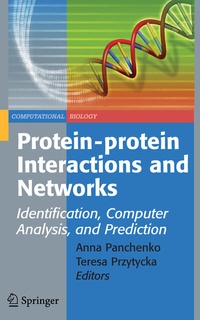
Protein-protein Interactions and Networks
Description

Integrates different approaches from bioinformatics, biochemistry, computational analysis and systems biology to offer the reader a global view of the diverse data on protein-protein interactions and protein interaction networks
Protein-protein interactions and networks: identification, analysis and prediction brings together the descriptions of experimental techniques and expounds on different computational algorithms for protein network analysis and prediction of protein and domain interactions
Each chapter contains a description of the problem, a review of methods and algorithms, a list of online resources, conclusions and future directions
Offering broad coverage on the topic, this book will be of interest to researchers from academia and the bioinformatics industry; will also be of use to graduate students studying the topic
Reviews / Votes
From the reviews:
"This book consists of nine papers, written by diverse authors, each of which discusses specific problems in the area of protein-protein interactions, and different approaches to solving these problems. . offers a high-level overview of computational methods for predicting protein interactions. . This book is geared more toward biologist . ." (D. Bollman, ACM Computing Reviews, January, 2009)
More details
Other editions
Additional editions
Content
Mona Singh
Abstract The recent availability of large-scale protein-protein interaction data provides new opportunities for characterizing a protein’s function within the context of its cellular interactions, pathways and networks. In this paper, we review computational approaches that have been developed for analyzing protein interaction networks in order to predict protein function.
8.1 Introduction
A major challenge in the post-genomic era is to determine protein function at the proteomic scale. Most organisms contain a large number of proteins whose functions are currently unknown. For example, about one-third of the proteins in the baker’s yeast Saccharomyces cerevisiae—arguably one of the most wellcharacterized model organisms—remain uncharacterized. Traditionally, computational methods to assign protein function have relied largely on sequence homology. However, the recent emergence of high-throughput techniques for determining protein interactions has enabled a new line of research where protein function is predicted by utilizing interaction data.
Proteome-scale physical interaction networks, or interactomes, have been determined for several organisms, including yeast and human. These networks are comprised of direct physical interactions between proteins (typically obtained via two hybrid analysis [FS89]) as well as of interactions indicating that two proteins are part of the same multi-protein complex (review, [BK03]).
High-throughput experiments have also linked together proteins in several other ways, and it is possible to build large-scale networks consisting of links between proteins that are synthetic lethals or are coexpressed, or between proteins where one regulates or phosphorylates the other (review, [ZGS07]). In addition to interaction networks that have been determined experimentally, there are a number of computational methods for building functional interaction networks, where two proteins are linked if they are predicted to perform a shared biological task (review, [GK00])).
In this chapter, we review some of the basic computational methods developed for analyzing protein interaction networks in order to predict protein function. The majority of these methods use some version of guilt-by-association, where proteins are annotated by transferring the functions of the proteins with which they interact.
The methods differ in the extent to which they use global properties of the interactome in annotating proteins, what topological features of the interactome they exploit, and whether they rely on first identifying tight clusters of proteins within the interactome before transferring annotations. Additionally, the underlying formulations are quite diverse, typically exploiting and further developing well understood concepts from graph theory, graphical models, discriminative learning and/or clustering."
