

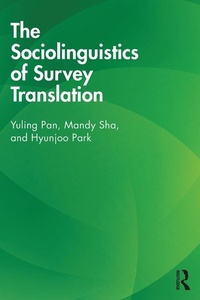
The Sociolinguistics of Survey Translation
1st Edition
Published on 26. June 2019
182 pages
978-1-000-02169-1 (ISBN)
Description

The Sociolinguistics of Survey Translation presents an overview of challenges in survey translation, introduces a sociolinguistic framework to overcome these challenges, and demonstrates step-by-step how this framework works to guide and evaluate survey translation. Topics covered in the book include the relationship between linguistic rules, cultural norms, and social practices and their impact on survey translation, the role of orthography and semiotic symbols in translation, translation of different types of survey materials, and various stages of translation review and evaluation.
This accessible book not only demonstrates how sociolinguistics can be a useful framework to address thorny survey translation problems but also provides practical and useful tools to guide survey translators and survey practitioners as they conduct and evaluate survey translations.
Presenting an easy to implement yet comprehensive survey translation methodology and providing practical tools for survey translators, practitioners and students, this book is the essential guide to this fast-growing area.
This accessible book not only demonstrates how sociolinguistics can be a useful framework to address thorny survey translation problems but also provides practical and useful tools to guide survey translators and survey practitioners as they conduct and evaluate survey translations.
Presenting an easy to implement yet comprehensive survey translation methodology and providing practical tools for survey translators, practitioners and students, this book is the essential guide to this fast-growing area.
Reviews / Votes
"Survey translation has received relatively little scholarly attention to date. The Sociolinguistics of Survey Translation is a very welcome addition to the field. The book discusses elements from sociolinguistics and translation studies, such as speech act theory, pragmatics, cultural norms, and functional equivalence, and applies them to the field of survey translation."Ineke Crezee, Auckland University of Technology, Center for Translation and Interpreting, New Zealand, and coeditor of Translation & Interpreting
"This volume provides a great step forward for modern survey translation by enhancing its linguistic foundation with sociolinguistic concepts. It is a marvelous tool box as well, with the added benefit of examples from cultures as diverse as Arabic, Chinese or Spanish, all linked to English as the source language."
Peter Ph. Mohler, Universitaet Mannheim, Germany, and coeditor of Survey Methods in Multinational, Multiregional and Multicultural Contexts
"One of the biggest contributions this book makes is providing the reader with an understanding of the reasons why much more work is required after the initial translation process to ensure functional equivalence across different language versions of a survey. It gives the reader an in-depth understanding of the steps to take and the basics of how to do this."
Patricia Goerman, Journal of Official Statistics, Volume 36: Issue 4, 2020
More details
Edition
1. Auflage
Language
English
Place of publication
London
United Kingdom
Publishing group
Taylor & Francis Ltd
Target group
Professional and scholarly
College/higher education
Product notice
Reflowable
Illustrations
25 Tables, black and white; 39 Line drawings, black and white; 4 Halftones, black and white; 43 Illustrations, black and white
ISBN-13
978-1-000-02169-1 (9781000021691)
Copyright in bibliographic data and cover images is held by Nielsen Book Services Limited or by the publishers or by their respective licensors: all rights reserved.
Schweitzer Classification
Other editions
Additional editions
Yuling Pan | Mandy Sha | Hyunjoo Park
The Sociolinguistics of Survey Translation
Book
06/2019
1st Edition
Routledge
€73.31
Shipment within 10-20 days
Yuling Pan | Mandy Sha | Hyunjoo Park
The Sociolinguistics of Survey Translation
Book
06/2019
1st Edition
Routledge
€215.77
Shipment within 10-20 days
Persons
Yuling Pan, Independent Researcher
Dr. Yuling Pan, a leading researcher in the field of sociolinguistics and multilingual survey research, has over 30 years of experience in language and cultural research, and 16 years of experience in survey translation and questionnaire development and pretesting. She taught and lectured at university level in various countries, including United States, China, Hong Kong, and Finland. She also held a position of Principal Researcher and Senior Sociolinguist at the United States Census Bureau for 12 years. She has published widely, including authored and edited books, book chapters, and journal articles in the field of sociolinguistics and survey research. Yuling Pan holds a Ph.D. in Linguistics from Georgetown University, Washington, D.C.
Mandy Sha, www.mandysha.com
Mandy Sha directs research studies and increases the scientific body of knowledge through publications, international speaking engagements, and professional service. While working on this book, she coedited the 2018 special issue of refereed international journal Translation & Interpreting on questionnaire translation in cross-national and cross-cultural research, presented a seminar at the World Bank on maximizing quality of qualitative research in multilingual and multicultural contexts, and coauthored the Quality of Comparative Surveys task force report commissioned by the World Association for Public Opinion Research and American Association for Public Opinion Research (AAPOR). She chairs the 75th anniversary AAPOR national conference to represent the outlook and leading research in the scientific community, including the topic of applying sociolinguistics to survey translation.
Hyunjoo Park: Principal, HP Research
Hyunjoo Park is a social scientist with 20 years of experience conducting international marketing and social science research in Korea as well as in the U.S. Ms. Park has experience in both qualitative and quantitative survey research including questionnaire development and pretesting, cognitive interviews, focus groups, interviewer training and monitoring, and statistical analysis. She has published quite a few number of book chapters and journal articles in the field of survey research such as Journal of Official Statistics, Field Methods, International Journal of Social Research Methodology, Quality and Quantity, Survey Practice, Advances in Comparative Survey Methodology Survey Methods in Multinational Multiregional and Multicultural Contexts, including the first Korean survey methodology book. She currently resides in Korea and has been teaching survey methodology courses in a college and a graduate school while supporting various survey projects in and outside of Korea.
Dr. Yuling Pan, a leading researcher in the field of sociolinguistics and multilingual survey research, has over 30 years of experience in language and cultural research, and 16 years of experience in survey translation and questionnaire development and pretesting. She taught and lectured at university level in various countries, including United States, China, Hong Kong, and Finland. She also held a position of Principal Researcher and Senior Sociolinguist at the United States Census Bureau for 12 years. She has published widely, including authored and edited books, book chapters, and journal articles in the field of sociolinguistics and survey research. Yuling Pan holds a Ph.D. in Linguistics from Georgetown University, Washington, D.C.
Mandy Sha, www.mandysha.com
Mandy Sha directs research studies and increases the scientific body of knowledge through publications, international speaking engagements, and professional service. While working on this book, she coedited the 2018 special issue of refereed international journal Translation & Interpreting on questionnaire translation in cross-national and cross-cultural research, presented a seminar at the World Bank on maximizing quality of qualitative research in multilingual and multicultural contexts, and coauthored the Quality of Comparative Surveys task force report commissioned by the World Association for Public Opinion Research and American Association for Public Opinion Research (AAPOR). She chairs the 75th anniversary AAPOR national conference to represent the outlook and leading research in the scientific community, including the topic of applying sociolinguistics to survey translation.
Hyunjoo Park: Principal, HP Research
Hyunjoo Park is a social scientist with 20 years of experience conducting international marketing and social science research in Korea as well as in the U.S. Ms. Park has experience in both qualitative and quantitative survey research including questionnaire development and pretesting, cognitive interviews, focus groups, interviewer training and monitoring, and statistical analysis. She has published quite a few number of book chapters and journal articles in the field of survey research such as Journal of Official Statistics, Field Methods, International Journal of Social Research Methodology, Quality and Quantity, Survey Practice, Advances in Comparative Survey Methodology Survey Methods in Multinational Multiregional and Multicultural Contexts, including the first Korean survey methodology book. She currently resides in Korea and has been teaching survey methodology courses in a college and a graduate school while supporting various survey projects in and outside of Korea.
Content
List of figures
List of tables
List of exhibits
Acknowledgments
Chapter 1: Introduction
Chapter 2: Sociolinguistics and survey translation
Chapter 3: Questionnaire translation
Chapter 4. Translation beyond words
Chapter 5: Translation of data-collection materials and research protocol guides
Chapter 6. Evaluating survey translation using the sociolinguistic framework
Chapter 7: Implementing the sociolinguistic framework in survey translation
Appendices
Index
List of tables
List of exhibits
Acknowledgments
Chapter 1: Introduction
Chapter 2: Sociolinguistics and survey translation
Chapter 3: Questionnaire translation
Chapter 4. Translation beyond words
Chapter 5: Translation of data-collection materials and research protocol guides
Chapter 6. Evaluating survey translation using the sociolinguistic framework
Chapter 7: Implementing the sociolinguistic framework in survey translation
Appendices
Index
