

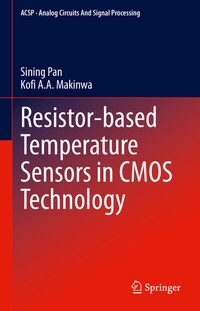
Resistor-based Temperature Sensors in CMOS Technology
Description

This book describes the background, principles, implementations, characterization, and future trends of temperature sensors made from silicon resistors in CMOS technology, including their readout circuits. Readers will benefit from the latest research of CMOS temperature sensors, and could learn about various precision analog techniques such as phase detection, continuous-time ?S ADC, zoom ADC, FIR-DAC, dynamic element matching, OTA linearization, etc.
More details
Other editions
Additional editions
Persons
Sining Pan was born in Beijing, China, in 1991. He received the B.Sc. degree in electronic engineering from Tsinghua University, Beijing, China, in 2013, and the M.Sc. and Ph.D. degrees in electrical engineering (both cum laude) from Delft University Technology, Delft, the Netherlands, in 2016 and 2021, respectively. He is now a Postdoc researcher at Electronic Instrumentation Laboratory, Delft University of Technology. His research interests include smart sensors, CMOS frequency references, and ?S modulators. Dr. Pan was a recipient of the ADI outstanding student designer award (2019) and the IEEE SSCS predoctoral achievement award (2020). He serves as a reviewer for the JSSC, TCAS-I, TCAS-II, TIM, Sensors J., and T-VLSI.
Kofi A. A. Makinwa received the B.Sc. and M.Sc. degrees from Obafemi Awolowo University, Ife, Nigeria, in 1985 and 1988, respectively, the M.E.E. degree from Philips International Institute, Eindhoven, The Netherlands, in 1989, and the Ph.D. degree from the Delft University of Technology, Delft, The Netherlands, in 2004. From 1989 to 1999, he was a Research Scientist with Philips Research Laboratories, Eindhoven, The Netherlands, where he worked on interactive displays and digital recording systems. In 1999, he joined the Delft University of Technology, where he is currently an Antoni van Leeuwenhoek Professor and Head of the Microelectronics Department. His research interests include the design of mixed-signal circuits, sensor interfaces and smart sensors. This has led to 16 books, over 300 technical papers, and over 30 patents. Dr. Makinwa has been on the program committees of several IEEE conferences, and was the Analog Subcom chair of ISSCC. He has also served the Solid-State Circuits Society as a distinguished lecturer and as an elected member of its Adcom. He is currently one of the organizers of the Advances in Analog Circuit Design workshop and the Sensor Interfaces Meeting. Dr. Makinwa is an ISSCCtop-10 contributor, and a co-recipient of 16 best paper awards, from the JSSC, ISSCC, VLSI, ESSCIRC and Transducers, among others. He is a member of the Royal Netherlands Academy of Arts and Sciences.
Content
1. Introduction.- 2. Sensor and readout topologies.- 3. Wien-bridge-based temperature sensors.- 4. Wheatstone-bridge-based temperature sensors.- 5. Application-driven designs.- 6. Conclusions and outlook.
