

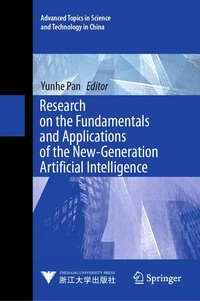
Research on the Fundamentals and Applications of the New-Generation Artificial Intelligence
Description

New-generation Artificial Intelligence (AI) is a strategic technology that exhibits strong spillover and driving effects, leading this round of technological revolution and industrial transformation. It has distinct characteristics: application empowerment, cross-disciplinary integration, and dual technical and social attributes . In the last two decades, AI, much like historical inventions such as steam engines, electricity, computers, and the Internet, has become a general-purpose enabling technology that has profoundly changed human society and promoted economic development at an unprecedented speed. New-generation AI is making great strides in multiple directions, offering tremendous opportunities to unleash human creativity and promote economic growth.
This book is the research outcome of a major consulting research project "Strategic Research on Artificial Intelligence 2.0 in China" by the Chinese Academy of Engineering. It provides detailed introductions and discussions on the development and challenges of new-generation AI; the driving forces of the new generation of AI include big data intelligence, cross-media intelligence, collective intelligence, human-machine hybrid augmented intelligence, and intelligent autonomous unmanned systems; as well as innovative AI applications in manufacturing, urban development, agriculture, healthcare, education, and other fields. This book presents key theoretical frameworks and core technologies in AI, while offering forward-looking and substantiated perspectives on future development trends in AI research.
More details
Other editions
Additional editions
Person
Yunhe Pan is an academician of the Chinese Academy of Engineering and a professor at Zhejiang University. He once served as Executive Vice President of the Chinese Academy of Engineering and President of Zhejiang University. Currently, he is the Director of the National Strategic Advisory Committee for New-Generation Artificial Intelligence in China, Director of the Advisory Group of the Expert Group on Artificial Intelligence Science and Technology Innovation under the Ministry of Education, Chairman of the China Artificial Intelligence Industry Development Alliance, and Chairman of the China Innovation Design Industry Strategic Alliance. From 1986 to 1988, he was a visiting scholar at Carnegie Mellon University (CMU) and the University of California, Los Angeles (UCLA) in the United States, with his cooperative supervisor being Professor Raj Reddy (Turing Award winner) from CMU.
He is the proposer and leader of "Strategic Research on Artificial Intelligence 2.0 in China" project. He played a pivotal role in drafting the national "New-Generation Artificial Intelligence Development Plan" and its implementation, advocating for AI's inclusion in the "Science and Technology Innovation 2030" megaprojects. He is a pioneer in the research of intelligent CAD and computer art in China and has achieved significant innovative results in engineering practices such as intelligent textile pattern design, product innovation design, digital libraries, and knowledge centers. He has also led the publishing of AI and "AI+X" interdisciplinary textbooks, driving the digitalization and internationalization of AI education materials.
Content
Chapter 1. New-Generation Artificial Intelligence: Development and Challenges.- Chapter 2. Big Data Intelligence.- Chapter 3. Collective Intelligence: From the Perspective of Complex Systems.- Chapter 4. Cross-Media Intelligence.- Chapter 5. Human-Machine Hybrid Augmented Intelligence.- Chapter 6. Intelligent Autonomous Unmanned Systems.- Chapter 7. Artificial Intelligence Applications.
