

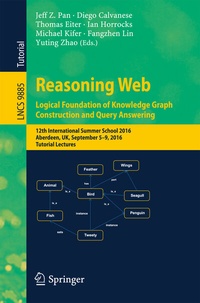
Reasoning Web: Logical Foundation of Knowledge Graph Construction and Query Answering
Description

This volume contains some lecture notes of the 12th Reasoning Web Summer School (RW 2016), held in Aberdeen, UK, in September 2016.
In 2016, the theme of the school was "Logical Foundation of Knowledge Graph Construction and Query Answering". The notion of knowledge graph has become popular since Google started to use it to improve its search engine in 2012. Inspired by the success of Google, knowledge graphs are gaining momentum in the World Wide Web arena. Recent years have witnessed increasing industrial take-ups by other Internet giants, including Facebook's Open Graph and Microsoft's Satori.
The aim of the lecture note is to provide a logical foundation for constructing and querying knowledge graphs. Our journey starts from the introduction of Knowledge Graph as well as its history, and the construction of knowledge graphs by considering both explicit and implicit author intentions. The book will then cover various topics, including how to revise and reuseontologies (schema of knowledge graphs) in a safe way, how to combine navigational queries with basic pattern matching queries for knowledge graph, how to setup a environment to do experiments on knowledge graphs, how to deal with inconsistencies and fuzziness in ontologies and knowledge graphs, and how to combine machine learning and machine reasoning for knowledge graphs.
More details
Other editions
Additional editions
Persons
Content
Understanding Author Intentions: Test Driven Knowledge Graph Construction.- Inseparability and Conservative Extensions of Description Logic Ontologies: A Survey .- Navigational and Rule-Based Languages for Graph Databases.- LOD Lab: Scalable Linked Data Processing.- Inconsistency-Tolerant Querying of Description Logic Knowledge Bases.- From Fuzzy to Annotated Semantic Web Languages.- Applying Machine Reasoning and Learning in Real World Applications.
