

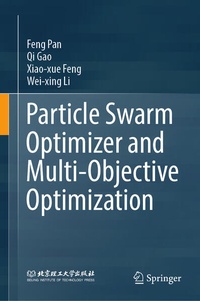
Particle Swarm Optimizer and Multi-Objective Optimization
Description

This book provides a comprehensive overview of the foundational attributes of the Particle Swarm Optimization(PSO) algorithm, including general descriptions, topological structures, evaluation metrics, and diversity. It explores in depth the issues of premature convergence and the kinematic characteristics of the Gbest (Global best), Pbest (Personal best), and standard particle models. The book also introduces a stability criterion based on dynamic time-varying systems and examines the Markov properties and convergence behavior of the standard PSO algorithm.
For single-objective optimization problems, the book presents four paradigmatic design philosophies and enhancement strategies for PSO algorithms. In addressing multi-objective optimization challenges, it offers a systematic analysis and design methodology for multi-objective PSO.
This book is ideal for researchers in the fields of swarm intelligence and optimization techniques. It aids scholars and professionals in gaining a deep understanding of swarm intelligence methodologies, with a particular focus on the systematic characteristics, stability, convergence, and other critical aspects of the PSO algorithm. This knowledge equips readers to navigate and contribute to the evolving field of swarm intelligence.
More details
Other editions
Additional editions
Persons
Feng Pan, Associate Professor in the School of Automation, Beijing Institute of Technology. He received his B.S. and Ph.D. degrees from the Beijing Institute of Technology, Beijing, China, in 2000 and 2005, respectively. In 2007, he served as a Postdoctoral Researcher at Indiana University-Purdue University Indianapolis, USA. He is currently a council member of the Chinese Association for Artificial Intelligence (CAAI) and the Chinese Society of Educational Development Strategy (CSEDS). He has been selected for the Beijing "Young Talent Plan" and Yunnan Province's "Yunling Talent Plan." He research interests include computational intelligence and optimization techniques, edge computing and artificial intelligence.
Qi Gao, Associate Professor in the School of Automation and Associate Director of the Center for Enhanced Learning and Teaching (CELT) at Beijing Institute of Technology. He is a Fellow of the International Society for the Scholarship of Teaching and Learning (ISSOTL) and a member of the Academic Committee of the Chinese Higher Education Development Network (CHED). His research interests include pattern recognition and complex networks.
Xiaoxue Feng, Associate Professor in the School of Automation, Beijing Institute of Technology. She received her B.S. and Ph.D. degrees in Control Science and Engineering from Northwestern Polytechnical University, Xi'an, China, in 2010 and 2015, respectively. Her research interests include multi-sensor data fusion technology, target detection, tracking, and recognition.
Li Weixing, Associate Professor in the School of Automation, Beijing Institute of Technology.He is mainly engaged in the practical teaching of intelligent control theory. His research interests include deep learning and object detection, optimization algorithms and applications.
Content
Introduction.- Overview of PSO.- Algorithm characteristics of PSO.- Sampling Distribution and Particle Trajectories in Standard PSO.- Stability analysis of the standard PSO.
