

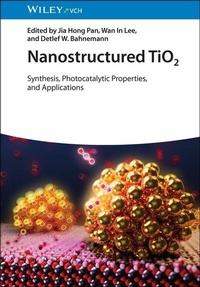
Nanostructured TiO2
Synthesis, Photocatalytic Properties, and Applications
1st Edition
Published on 3. October 2025
544 pages
978-3-527-84833-1 (ISBN)
Description

With in-depth analysis and coverage, the book goes beyond basic concepts, offering advanced techniques, characterizations, and novel approaches to TiO2 nanostructures.
More details
Other editions
Additional editions
Jia Hong Pan | Wan In Lee | Detlef W. Bahnemann
Nanostructured TiO2
Synthesis, Photocatalytic Properties, and Applications
Book
11/2025
1st Edition
Wiley-VCH
€169.00
Available immediately
Persons
Jia Hong Pan received his PhD degree from Inha University, Korea, in 2007 under the supervision of Prof. Wan In Lee. Then he moved to Singapore, and worked at Nanyang Technological University and National University of Singapore as a research fellow. Meanwhile, he worked with Prof. Detlef Bahnemann at Leibniz University Hannover in 2012-2013 as a Humboldt Fellow. In October 2015, he joined North China Electric Power University as a full professor and later moved to Guangxi University in December 2023. He serves on the Editorial Boards of Catal. Lett. and Chem. Inorg. Mater., and on the International Scientific Committee of the International Conference of Semiconductor Photochemistry, as well as the International Organizing Committee of the International Conference on Photochemical Conversion and Storage of Solar Energy. He has published over 140 papers, which have been cited over 8000 times (h-index: 44). Together with Detlef, he co-founded the International Joint Center for Nature-Inspired Carbon Neutrality Solutions. His current research interests focus on semiconductor photo(electro)catalysis, nanostructured inorganic materials, and electrochemical energy storage.
Wan In Lee retired as a Fellow Professor from the Department of Chemistry and Chemical Engineering at Inha University, Korea, in September 2023 and is currently serving as an Emeritus Professor at the same institution. He received his B.Sc. and M.Sc. degrees in Chemistry from Seoul National University, Korea, and his Ph.D. in Solid State Chemistry from Brown University, USA, in 1993. His research has centered on the investigation of charge transport phenomena in various nanostructured semiconductors. In particular, he has focused on the synthesis of metal oxide nanostructures, the design of visible-light-responsive photocatalysts, and the development of advanced nanostructure-based solar cells. He has served as President of several academic societies, including the Korean Society of Photoscience, the Korea Organic Photovoltaic Society, and the Materials Division of the Korean Chemical Society. Over the course of his career, he has authored more than 280 scientific publications.
Detlef W. Bahnemann has been retired as Head of the Research Unit Photocatalysis and Nanotechnology at the Leibniz University Hannover at the end of 2021 and is now Director of the "International Joint Center for Nature Inspired Carbon Neutrality Solutions" at Saint Petersburg State University in Russia as well as Distinguished Professor at Shaanxi University of Science & Technology in Xi'an (China). His research topics include photocatalysis, photoelectrochemistry, solar chemistry and photochemistry focused on synthesis and physical-chemical properties of semiconductor and metal nanoparticles. He has edited seven books, and published more than 750 publications with citations over 85,000 times (h-index: 120). He is Visiting Research Professor at Queens University Belfast, DeTao Master of Photocatalysis, Nanomaterials and Energy Applications, and holds a Guest Professorship at Tianjin University (China), and several visiting professorships in China, Malaysia, Saudi Arabia and Britain. In 2022, he became Fellow of the European Academy of Sciences (EURASC) and Member of the Academia Europaea (AE).
Wan In Lee retired as a Fellow Professor from the Department of Chemistry and Chemical Engineering at Inha University, Korea, in September 2023 and is currently serving as an Emeritus Professor at the same institution. He received his B.Sc. and M.Sc. degrees in Chemistry from Seoul National University, Korea, and his Ph.D. in Solid State Chemistry from Brown University, USA, in 1993. His research has centered on the investigation of charge transport phenomena in various nanostructured semiconductors. In particular, he has focused on the synthesis of metal oxide nanostructures, the design of visible-light-responsive photocatalysts, and the development of advanced nanostructure-based solar cells. He has served as President of several academic societies, including the Korean Society of Photoscience, the Korea Organic Photovoltaic Society, and the Materials Division of the Korean Chemical Society. Over the course of his career, he has authored more than 280 scientific publications.
Detlef W. Bahnemann has been retired as Head of the Research Unit Photocatalysis and Nanotechnology at the Leibniz University Hannover at the end of 2021 and is now Director of the "International Joint Center for Nature Inspired Carbon Neutrality Solutions" at Saint Petersburg State University in Russia as well as Distinguished Professor at Shaanxi University of Science & Technology in Xi'an (China). His research topics include photocatalysis, photoelectrochemistry, solar chemistry and photochemistry focused on synthesis and physical-chemical properties of semiconductor and metal nanoparticles. He has edited seven books, and published more than 750 publications with citations over 85,000 times (h-index: 120). He is Visiting Research Professor at Queens University Belfast, DeTao Master of Photocatalysis, Nanomaterials and Energy Applications, and holds a Guest Professorship at Tianjin University (China), and several visiting professorships in China, Malaysia, Saudi Arabia and Britain. In 2022, he became Fellow of the European Academy of Sciences (EURASC) and Member of the Academia Europaea (AE).
Content
Preface and Overview
PART I. SYNTHETIC METHODOLOGIES
Chapter 01. Selective synthesis of TiO2 nanoparticles
Chapter 02. Synthesis of one dimensional TiO2 nanomaterials
Chapter 03. Synthesis of Two-Dimensional TiO2 Nanostructures
Chapter 04. 3D TiO2 via Self-Assembly
Chapter 05. Immobilization of TiO2 on Various Substrates
Chapter 06. Surface Modification of TiO2
PART II. PHOTOCATALYTIC PROPERTIES
Chapter 07. Photocatalytic Fixed Bed Reactions for Efficient Photon Utilization of TiO2
Chapter 08. Carrier Transport and Recombination in Sensitized Nanostruc-tured TiO2
Chapter 09. TiO2-based heterojunction photocatalysts: type, characterization and activity
Chapter 10. Plasmonic metal-TiO2 photocatalysts
Chapter 11. Ecotoxicological and antibacterial assessment of nanostructured TiO2
PART III. APPLICATIONS
Chapter 12. Applications of TiO2 for Photocatalytic Water Treatment
Chapter 13. TiO2 photocatalytic degradation of antibiotics
Chapter 14. Ecotoxicological and antibacterial properties of TiO2 and processes based on TiO2
Chapter 15. The application of TiO2 for the photocatalytic conversion of the nitrogen oxides - NO and NO2
Chapter 16. Recycling of heavy metal ions from wastewater by TiO2 photocatalysis
Chapter 17. Solar Fuel Generation
Chapter 18. Visible-Light-Induced Selective Oxidation of Organic Molecules over Nanostructured TiO2
Chapter 19. Photoelectrochemical Sensing Applications of Nanostructured TiO2
Chapter 20. Reactor Engineering in Competitive Photocatalytic Performance: Advancements and Challenges
Chapter 21. TiO2-based protective coatings for buildings and monuments
PART I. SYNTHETIC METHODOLOGIES
Chapter 01. Selective synthesis of TiO2 nanoparticles
Chapter 02. Synthesis of one dimensional TiO2 nanomaterials
Chapter 03. Synthesis of Two-Dimensional TiO2 Nanostructures
Chapter 04. 3D TiO2 via Self-Assembly
Chapter 05. Immobilization of TiO2 on Various Substrates
Chapter 06. Surface Modification of TiO2
PART II. PHOTOCATALYTIC PROPERTIES
Chapter 07. Photocatalytic Fixed Bed Reactions for Efficient Photon Utilization of TiO2
Chapter 08. Carrier Transport and Recombination in Sensitized Nanostruc-tured TiO2
Chapter 09. TiO2-based heterojunction photocatalysts: type, characterization and activity
Chapter 10. Plasmonic metal-TiO2 photocatalysts
Chapter 11. Ecotoxicological and antibacterial assessment of nanostructured TiO2
PART III. APPLICATIONS
Chapter 12. Applications of TiO2 for Photocatalytic Water Treatment
Chapter 13. TiO2 photocatalytic degradation of antibiotics
Chapter 14. Ecotoxicological and antibacterial properties of TiO2 and processes based on TiO2
Chapter 15. The application of TiO2 for the photocatalytic conversion of the nitrogen oxides - NO and NO2
Chapter 16. Recycling of heavy metal ions from wastewater by TiO2 photocatalysis
Chapter 17. Solar Fuel Generation
Chapter 18. Visible-Light-Induced Selective Oxidation of Organic Molecules over Nanostructured TiO2
Chapter 19. Photoelectrochemical Sensing Applications of Nanostructured TiO2
Chapter 20. Reactor Engineering in Competitive Photocatalytic Performance: Advancements and Challenges
Chapter 21. TiO2-based protective coatings for buildings and monuments
