

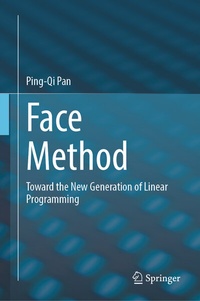
Face Method
Description

The famous simplex method, invented by George B. Dantzig in 1947, moves from vertex to vertex in the underlying polyhedron until achieving an optimal vertex. As one of the most widely used mathematical tools, it has dominated the field of Linear Programming for nearly eighty years. However, it has exponential time complexity, and its performance turned out somehow unsatisfactory when solving some difficult LP problems since the solution process can sink into a degenerate vertex for too long.
In 1984, Karmarkar published his work on the interior-point algorithm, which goes across the interior of the polyhedron, and which was not only of polynomial time complexity but also appeared fast. As such, it immediately drew the attention of researchers worldwide, giving rise to an upsurge in the interor-point method. Some scholars even considered it the winner against the simplex method for solving large-scale and sparse LP problems. However, the technique can only approach an optimal solution on the boundary, and it cannot be "warmly" started; hence, it is not applicable for solving integer LP problems, which form the primary domain of LP applications. The interior-point method failed to shake the domination of the simplex method.
After years of research and exploration, the author proposes to break out of the simplex and interior-point methods. Over the recent years, the author has developed the so-called face method, which moves face by face to achieve an optimal face and solution. As the first book on the topic of face method, the monograph summarizes valuable findings and puts forward the theme to the academic world.
More details
Other editions
Additional editions
Person
Ping-Qi Pan is a Professor and PhD Supervisor at the School of Mathematics of Southeast University (China). He was a standing council member of the Mathematical Programming Society of China and the standing council member of the Operation Research Society of China. He was a Visiting Scholar at the University of Washington (1986-1987) and a Visiting Scientist at Cornell University (1987-1988). His research interest focuses on mathematical programming and operations research, especially large-scale linear programming. Prof. Pan has received the honorary title of Outstanding Scientific-Technical Worker of the Jiangsu Province of China. The International Biographical Centre nominated him as one of the Top 100 Scientists (2012). Listed as a Noteworthy Mathematician, he won the Lifetime Achievement Award by Who's Who in the World (2017). He is the author of "Linear Programming Computation" (1st and 2nd ed.) published by Springer (2014, 2023).
Content
Preface.- Acknowledgments.- Notation.- Simplex Method: The State of the Art.- Face Algorithm.- Generalized Face Method.- Dual Face Method.- Generalized Dual Face Method.- Reduced Face Method.- Dual Reduced Face Method.- Face Method with Cholesky Factorization.- Dual Face Method with Cholesky Factorization.- Appendix: Empirical Evaluation of Face and Dual Face Methods with Cholesky Factorization.- References.
