

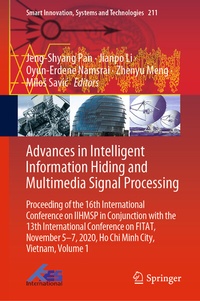
Advances in Intelligent Information Hiding and Multimedia Signal Processing
Description

More details
Other editions
Additional editions
Persons
Jeng-Shyang Pan received the B.S. degree in Electronic Engineering from the National Taiwan University of Science and Technology, in 1986, the M.S. degree in Communication Engineering from National Chiao Tung University, Taiwan, in 1988, and the Ph.D. degree in Electrical Engineering from the University of Edinburgh, UK, in 1996. He is currently the Professor in Shandong University of Science and Technology. He joined the Editorial Board of Journal of Network Intelligence, the Journal of Computers, and the Chinese Journal of Electronics. His current research interests include soft computing, information security, and signal processing.
Jianpo Li received his B.S., M.S., and Ph.D. from the Department of Communication Engineering, Jilin University, China, in 2002, 2005, and 2008, respectively. In 2008, he joined the School of Information Engineering, Northeast Electric Power University (NEEPU). He was Visiting Scholar with New York University in 2013 and the Universityof Ottawa in 2016. Now, he is Full Professor and Vice-Dean of the School of Computer Science, NEEPU. He has published more than 70 research papers and has 16 patents. His research interests focus on wireless sensor networks, intelligent signal processing, 5G, and wireless power transmission.
Prof. Dr. Oyun-Erdene Namsrai is Full Professor and Head of the Department of Information and Computer Science at the National University of Mongolia (NUM). In 2008, she received her Ph.D. in Computer Science from Chungbuk National University (CBNU) and in recent years worked as Visiting Professor at the CBNU, Republic of Korea. She has been working as Active Member of the Information Technology Professionals Examination Council (ITPEC) since 2008. Prof. Namsrai has served on numerous Organizing and Program Committees of international conferences such as ICISCA, ICW, ICCS, ICAST, ISPM, MMT, DBMI, and FITAT. Her research interests include core database paradigms and temporal databases, spatiotemporal database, temporal GIS and stream data processing, data structure, knowledgebase information retrieval, database security, data mining, bioinformatics, and biomedical informatics.
Zhenyu Meng received the B.S., M.Phil., and Ph.D. Degrees in Computer Science from Shandong Normal University, Harbin Institute of Technology Shenzhen Graduate School, Harbin Institute of Technology Shenzhen in 2008, 2011, and 2018, respectively. Currently, he is Director of the Institute of Artificial Intelligence, Fujian University of Technology, and Professor in Fujian Key Provincial Key Laboratory of Data Mining and Application, Fujian University of Technology. He also serves as Reviewer of several JCR Q1 SCI journals such as IEEE T EC, IEEE T CYB., INF. SCI., KBS, ASOC, SWEVO, ESWA, IEEE Access, EAAI, and several Chinese SCI journals. His research interest includes evolutionary computation and vehicle navigation.
Milos Savic is Assistant Professor at the Department of Mathematics and Informatics, Faculty of Sciences, University of Novi Sad, where he received his B.Sc., M.Sc., and Ph.D. degrees in the field of computer science. His research interests are in the field of complex network analysis, intelligent systems, graph-based machine learning, and scientometrics.
