

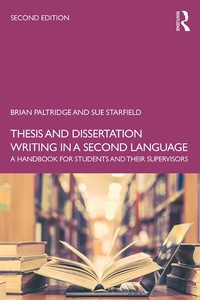
Thesis and Dissertation Writing in a Second Language
A Handbook for Students and their Supervisors
2nd Edition
Published on 25. July 2019
248 pages
978-1-351-69067-6 (ISBN)
Description

Fully updated and packed with new material, the second edition of Thesis and Dissertation Writing in a Second Language is the ideal guide for non-native speaker students and their supervisors working on writing a thesis or dissertation in English.
Considering the purposes of thesis and dissertation of writing alongside writer/reader relationships, this book uses accessible language and practical examples to discuss issues that are crucial to successful thesis and dissertation writing. This edition offers:
Insights into the experience of being a doctoral writer, issues of writer identity, and writing with authority
Typical language and discourse features of theses and dissertations
Advice on the structure and organisation of key sections
Suggestions for online resources which support writing
Extracts from completed theses and dissertations
Guidance on understanding examiner expectations
Advice on publishing from a PhD
Suitable for students from all disciplines, Thesis and Dissertation Writing in a Second Language is essential reading for non-native speaker students looking to complete a thesis or dissertation in English.
Considering the purposes of thesis and dissertation of writing alongside writer/reader relationships, this book uses accessible language and practical examples to discuss issues that are crucial to successful thesis and dissertation writing. This edition offers:
Insights into the experience of being a doctoral writer, issues of writer identity, and writing with authority
Typical language and discourse features of theses and dissertations
Advice on the structure and organisation of key sections
Suggestions for online resources which support writing
Extracts from completed theses and dissertations
Guidance on understanding examiner expectations
Advice on publishing from a PhD
Suitable for students from all disciplines, Thesis and Dissertation Writing in a Second Language is essential reading for non-native speaker students looking to complete a thesis or dissertation in English.
Reviews / Votes
Doctoral Writing Blog (https://doctoralwriting.wordpress.com/recommended-reading/)The highly popular Doctoral Writing Blog recommends the book in these terms:
Brian Paltridge and Sue Starfield's Thesis and dissertation writing in a second language: A handbook for supervisors, London: Routledge, remains hard to beat. This book is for doctoral students who haven't studied linguistics, and suspect that their supervisors and advisors are not that clear with spelling out how to meet the criteria that will please examiners. We've found that the focus on second language explanation makes this a wonderfully clear book for anyone.
In a list of resources for doctoral students, the Blog says about our book:
As a teaching resource this is probably the most well used book in my library. I return to it time and time again because it provides me with the confidence to say 'research shows that this is a common pattern in thesis writing'. That's really important for me. This use of empirical evidence makes the book stand out from the crowd - it's so unlike those other writing advice books
Anne Lee, University of Stavanger, Norway.
There is a need for this book, internationally candidates are struggling with how to write their work up, and supervisors are struggling with how to help them. The pedagogical expectations from different cultural backgrounds are enormous.
The market is growing, international doctoral candidates are a growing force in the UK (partially because of the funding difficulties that local students face).
I think the various national Council's for Doctoral/Graduate Education should be alerted to this book when it is published (EG UKCGE).
This book is different from the competition as the focii of existing books are either on academic writing, supervising writing or a first language doctoral candidate writing their thesis up in English.
I recommend that a second edition of this book is published.
Professor Jerry Wellington, University of Sheffield, UK
Yes, I think there is a need for this book as most books of this kind do not focus as clearly on international students. Having said that, most of the points and guidelines in the first edition apply to all students: what's good for the goose is good for the gander.
Yes, I recommend publication. I like it and I know that our students will find it valuable, clear and helpful.
More details
Edition
2nd edition
Language
English
Place of publication
London
United Kingdom
Publishing group
Taylor & Francis Ltd
Target group
College/higher education
Illustrations
25 Tables, black and white; 12 Line drawings, black and white
ISBN-13
978-1-351-69067-6 (9781351690676)
Copyright in bibliographic data and cover images is held by Nielsen Book Services Limited or by the publishers or by their respective licensors: all rights reserved.
Schweitzer Classification
Other editions
Additional editions
Brian Paltridge | Sue Starfield
Thesis and Dissertation Writing in a Second Language
A Handbook for Students and their Supervisors
Book
08/2019
2nd Edition
Routledge
€48.40
Shipment within 10-20 days
Brian Paltridge | Sue Starfield
Thesis and Dissertation Writing in a Second Language
A Handbook for Students and their Supervisors
Book
08/2019
2nd Edition
Routledge
€187.30
Shipment within 10-20 days
Persons
Brian Paltridge is Professor of TESOL at the University of Sydney, Australia.
Sue Starfield is a Professor in the School of Education at the University of New South Wales, Australia.
Sue Starfield is a Professor in the School of Education at the University of New South Wales, Australia.
Content
Acknowledgments; Author Biographies; List of tables, figures and boxes; 1 Introduction; 2 Becoming a researcher in a global world; 3 Issues in thesis and dissertation writing in English as a second language; 4 Writing a research proposal; 5 The overall shape of theses and dissertations; 6 Writing the introduction; 7 Writing the background chapters; 8 Writing the methodology chapter; 9 Writing the results chapter; 10 Writing discussions and conclusions; 11 Writing the abstract and acknowledgements sections; 12 Publishing from a thesis or dissertation; 13 Resources for thesis and dissertation writing; References; Index
