

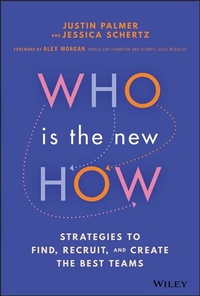
Who Is the New How
Description

In Who Is the New How: Strategies to Find, Recruit, and Create the Best Teams, a team of accomplished talent experts delivers a hands-on roadmap to filling your most mission-critical roles with the best people. In the book, you'll explore strategies that guide the world's most innovative companies and high-performing organizations as they scour the globe to build impactful, productive teams.
You'll learn how to reimagine your talent acquisition strategy, from who you're looking for to how you should recruit them. You'll also discover how and why to say goodbye to familiar phrases like, "just get a butt in the seat," and counter-productive metrics like "time-to-fill." The authors also explain:
* Why identifying candidates aligned with your company's mission and culture is so critical to long-term talent success
* How using the right combination of technology and human expertise in the recruitment process can be the key to winning top talent
* What building teams filled with the right people can do for your team's morale and ultimately make companies successful
A revolutionary new approach to one of the most critical issues facing organizations today, Who Is the New How is the talent playbook that business and HR leaders have been waiting for.
More details
Other editions
Additional editions
Persons
JESSICA SCHERTZ is the Chief Operating Officer of Teamable and Founder of Teamable Women. She's passionate about using technology to build strong teams and create equitable opportunities.
Content
Introduction xi
Strategy I Rethink Who You're Looking For 1
Chapter 1 A Matter of Intention 3
Chapter 2 Diverse Intangibles 23
Strategy II Rethink How You're Going to Do It 45
Chapter 3 State of the Union 47
Chapter 4 On the Shoulders of Giants 69
Chapter 5 The Future of Work 81
Strategy III Rethink What It Could Mean 99
Chapter 6 The Culture Crutch 101
Chapter 7 A Human-Centric Workforce 121
Acknowledgments 141
Notes 145
Index 173
Introduction
We believe that something is wrong with the way we're all working. And in 2017, we founded Teamable in order to fix it.
In today's world, the what and how often drive product and company growth. Successful brands have strong missions and clear business development strategies; they know exactly what they're aiming to accomplish and how they're going about it. But there's something far more significant that makes it all possible, something that gives those brands the competence, momentum, scalability, and execution they need to achieve long-term success: the who.
This isn't a revolutionary insight. Every employer knows how important it is to have a capable, talented team of people working for them. Every team member knows how productive and invigorating it is when they're working with the right blend of people. Every recruiter knows how valuable it is to find the superstars who will perfectly round out a team. But here's what everyone doesn't seem to know: traditional recruitment practices aren't cutting it.
Recruitment today is so similar to how it was 100 years ago. Employers want candidates based on specific criteria and recruiters source people who meet them. While the ways in which recruiters go about the sourcing has changed-insofar as technology has made it more convenient-they're still pressed for time and competing for the same pool of candidates as everyone else. To add to the chaos, they're now also drowning in recruitment tools. But is it working?
If you're holding this book, you know it's not.
We reached the same conclusion just prior to founding Teamable. But before we go any further, we want to introduce you to who we are. This book is written by two of us: Justin Palmer and Jessica Schertz, CEO and COO of Teamable, respectively. While the book is penned as one voice, we'll briefly deviate here so you get to know who you're hearing from.
I'm Justin, and my road to working on Teamable wasn't obvious at the time, but it is now.
My career started as a technologist first. I studied computer science for about five years, dropped out of a PhD program, and worked as a researcher and engineer working on AI and human language for over a decade. I fell in love with the idea that you could build software systems that learn to do things people can do, and I haven't looked back.
To make progress in that field takes a ton of different skill sets, and so I spent the better part of 15 years training up. I had so many great mentors along the way who taught me about building great software, managing data, setting up good experiments, the math behind modern AI, and so much more. That's the super short version of the technologist in me. I talk about some of that later in this book.
What gets me excited about technology is simple: it's the opportunity for impact. If you build systems that deal with even small language problems, that helps people communicate and make sense of ideas at a scale only made possible by technology. It redefines the limits of human ability and creativity. But it wasn't until I moved to Silicon Valley that I came to understand that there are equally impactful opportunities to do the same thing in business, and that happens through building technology companies.
My first job in the Valley was at LendingHome. We wanted to reinvent the mortgage bank and it was a crash course in a lot of things. I learned all about how mortgage finance and the capital markets work. I came to understand how all kinds of stuff from my days in natural language processing applied to the way people think about predicting how mortgages and financial markets perform. Our team grew from the first five of us, sitting around a single table in the same room where Uber started, to a team of over 250 in two years. We became the number one lender for home investor loans in the United States. I loved it. But it was building the company, and the team side of things, that struck me. We all worked so hard and did all of this because of each other. It wouldn't have been possible any other way. I met people who had spent most of their careers doing marketing, mortgage, or finance and we worked together to make each other better. I saw how much impact a diverse team could have when working together on a hard problem.
So when starting Teamable, I didn't fully appreciate it at the time, but it was a similar motivation that got me started and has kept me excited. We started out doing recruiting. I got to know an awesome person named Teresa and helped her find a new job that she still has today. She and I still talk every so often. Ask any recruiter, and they'll tell you the first person they helped find a new role. Everyone who's done this remembers the first person we helped get hired, and when it works, they remember us too. It's an amazing feeling.
That's how our company started. By doing some recruiting then figuring out how technology fit in. We felt the pain firsthand and wanted to create a good solution. So we knew exactly what to build in order to help anyone work like the best recruiters, but also with technology at the heart of it.
Our team still works this way, and so do I. We always acknowledge that the crux of our work is people and software coming together to get things done. When you add people to part of what you're building, it opens new doors. We have always done that, and it makes all the difference. It pushes the limits of how we think about what's possible, so we're always forward-thinking as technologists. We stay rooted in the day-to-day of what our customers do, so that we get better in ways that are really direct. It also means our entire team works together without silos, and that is what makes us build special things.
The more we grow, the more we want to do, and the more excited I get. Finding a job, or your next teammate, has changed some in the last 70 years but so much hasn't. We know that technology hasn't really transformed this space yet, and we're changing that. Our motivation is why we got here, and our mission is growing.
We're writing this because we want to share how we think about that mission. This book is about what we've learned so far, what we plan to do, and our motivation. It's about the stories we love of amazing teams that inspire us. We teamed up with Alex Morgan because she's one of those people. She is an awesome athlete, a force in sports, and has transformed how we think. She's a team builder and like so many people we find inspiring and feature in this book, Alex plays the long game and wants to change how the world works. We want to make a similar impact as a company, and we're honored to be part of that story.
Hi, I'm Jessica. As a lover of data and problem solving, I joined Teamable in its earliest days. My role morphed from the one-person Operations team to the Head of Operations who oversaw dozens of people. I then became the Chief of Staff to have a broader impact on all parts of the business, before my focus kept naturally returning to all things operations and I became Teamable's COO.
I never thought I'd be a COO. After studying Public Health in college, I went to law school and then got my master's degree in Education, focusing on English Language Learners (ELL). I started volunteering a lot with refugees, teaching ELL classes and helping them get their bearings once they started to build a life in my community. I absolutely loved the work. I felt like I'd been set on fire-I was so excited, so passionate, and so driven by seeing the students thrive. It was my first glimpse into what fulfilling work was all about. And if you know, you know. It's that stop-at-nothing, keep-you-up-at-night, what-I'm-doing-matters feeling.
That's when a former colleague of Justin's reached out to me for help with some work. It was a lot of the same types of problems that early-stage Teamable was working on-weird little natural language processing problems, human-in-the-loop, AI, etc. And it was really interesting to me from a language standpoint. It felt like the same approach I'd used to teach English to a room full of people who all had a different native language. Except this time, it was communicating with a robot, essentially. And trying to find a way for us to understand each other just as I'd tried to achieve with a student.
I became obsessed with the work. I had no idea that my output was ten times more than any other contributor's because I was just focused on getting my hands on more projects and cracking the code and figuring out how to make it work. There was a brilliant engineer named Dima, Teamable's future CTO, working on the same project and when Justin wanted to build a recruitment platform that used a similar approach, he contacted Dima and me to see if we were interested. We both jumped at the chance.
I thought it would be temporary. But as the series of really interesting problems emerged, I got more and more hooked. As soon as we'd solved one, there would be something else that caught my attention that I wanted to rip apart and figure out. I remember wearing out the button on my wireless mouse in the middle of the night because I was just constantly cranking on those weird little problems for hours and hours every day.
I brought in some other people-most of whom still work with us, shout-out to Bruce, Jared, Joe, and Ray!-and...
