

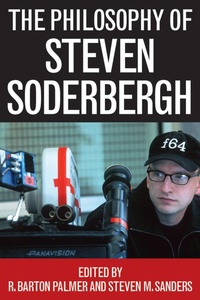
The Philosophy of Steven Soderbergh
Description

"Provocative, insightful, and instructive analysis of the cinematic and philosophical significance of Steven Soderbergh's work." -Jason Holt, editor of The Daily Show and Philosophy: Moments of Zen in the Art of Fake News Widely regarded as a turning point in American independent cinema, Steven Soderbergh's sex, lies, and videotape launched the career of its twenty-six-year-old director, whose debut film was nominated for an Academy Award and went on to win the Cannes Film Festival's top award, the Palme d'Or. The Philosophy of Steven Soderbergh breaks new ground by investigating salient philosophical themes through the unique story lines and innovative approaches to filmmaking that distinguish this celebrated artist. Editors R. Barton Palmer and Steven M. Sanders have brought together leading scholars in philosophy and film studies for the first systematic analysis of Soderbergh's entire body of work, offering the first in-depth exploration of the philosophical ideas that form the basis of the work of one of the most commercially successful and consistently inventive filmmakers of our time.
More details
Other editions
Additional editions
Persons
Content
- Intro
- The Philosophy of Popular Culture
- Title Page
- Copyright
- Dedication
- Contents
- Acknowledgments
- Introduction: R. Barton Palmer and Steven M. Sanders
- Part 1. Knowledge, Truth, Sexuality
- Knowledge, Truth, and Thought Experiments in Schizopolis and sex, lies, and videotape David Rodríguez-Ruiz
- Love, Truth, and the Medium in sex, lies, and videotape Yannis Tzioumakis
- Amplified Discourse and Desire in sex, lies, and videotape Murray Pomerance
- Part 2. Temporality, Intertextuality, Genre
- Alain Resnais Meets Film Noir in The Underneath and The Limey R. Barton Palmer
- Consciousness, Temporality, and the Crime-Revenge Genre in The Limey Geoff King
- Intertextuality, Broken Mirrors, and The Good German Andrew deWaard
- Remade by Steven Soderbergh Aaron Baker
- Part 3. Self-Reflexivity, Self-Centeredness, Autobiography
- Philosophical Reflections on Steven Soderbergh's Kafka Ivo Ritzer
- Responsibility and Self-Centered Narration in Erin Brockovich Andrew Patrick Nelson
- Schizopolis as Philosophical Autobiography Drew Morton
- Part 4. Politics, Morals, Methodology
- Mr. Soderbergh Goes to Washington Steven M. Sanders
- Schizoanalyzing the Informant David Sterritt
- Competing Modes of Capital in Ocean's Eleven R. Colin Tait
- An Ethical Analysis of Traffic Shai Biderman and William J. Devlin
- Part 5. Simulacra, Space, Solaris
- The Philosophy of Space and Memory in Solaris Douglas McFarland
- Solaris, Cinema, and Simulacra Michael Valdez Moses
- Contributors
- Index
