

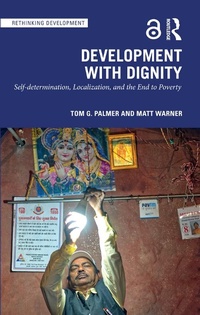
Development with Dignity
Self-determination, Localization, and the End to Poverty
Published on 31. January 2022
202 pages
978-1-000-53672-0 (ISBN)
Description

At a time when the global development industry is under more pressure than ever before, this book argues that an end to poverty can only be achieved by prioritizing human dignity.
Unable to adequately account for the roles of culture, context, and local institutions, today's outsider-led development interventions continue to leave a trail of unintended consequences, ranging from wasteful to even harmful. This book shows that increased prosperity can only be achieved when people are valued as self-governing agents. Social orders that recognize autonomy and human dignity unleash enormous productive energy. This in turn leads to the mobilization of knowledge-sharing that is critical to innovation and localized problem-solving. Offering a wide range of interdisciplinary perspectives and specific examples from the field showing these ideas in action, this book provides NGOs, multilateral institutions, and donor countries with practical guidelines for implementing "dignity-first" development.
Compelling and engaging, with a wide range of recommendations for reforming development practice and supporting liberal democracy, this book will be an essential read for students and practitioners of international development.
The Open Access version of this book, available at http://www.taylorfrancis.com, has been made available under a Creative Commons Attribution-Non Commercial-No Derivatives (CC-BY-NC-ND) 4.0 license.
Unable to adequately account for the roles of culture, context, and local institutions, today's outsider-led development interventions continue to leave a trail of unintended consequences, ranging from wasteful to even harmful. This book shows that increased prosperity can only be achieved when people are valued as self-governing agents. Social orders that recognize autonomy and human dignity unleash enormous productive energy. This in turn leads to the mobilization of knowledge-sharing that is critical to innovation and localized problem-solving. Offering a wide range of interdisciplinary perspectives and specific examples from the field showing these ideas in action, this book provides NGOs, multilateral institutions, and donor countries with practical guidelines for implementing "dignity-first" development.
Compelling and engaging, with a wide range of recommendations for reforming development practice and supporting liberal democracy, this book will be an essential read for students and practitioners of international development.
The Open Access version of this book, available at http://www.taylorfrancis.com, has been made available under a Creative Commons Attribution-Non Commercial-No Derivatives (CC-BY-NC-ND) 4.0 license.
Reviews / Votes
"The liberalism of Warner and Palmer could be called 'adultism.' The other policies-of a statist right or a statist left or for that matter a statist middle-all treat adults as bad children or sad children. Poor things, poor things, they're waiting to be fed. On the contrary, adults are to be accorded the dignity of 'the equal presumption of liberty and citizen-based democratic political principles' . . . You need this lucid and eloquent book. Read it, right away. No time to waste . . . ."Deirdre N. McCloskey, Distinguished Professor Emerita of Economics and of History, and Professor Emerita of English and of Communication, adjunct in classics and philosophy, at the University of Illinois at Chicago, USA
"Read this book and you will be introduced to new perspectives on the power of local knowledge - rooted in human experience - to fuel sustainable development and to generate the socio-economic wealth of nations."
Vernon L. Smith, Nobel Laureate in Economic Sciences
"Development with Dignity is an outstanding contribution to the public discourse addressing the intimate relationships between universal rights, human dignity, and economic prosperity. Adam Smith's liberal plan of liberty, equality, and justice is restated and grounded in the latest research in the social sciences and humanities, and readers will learn of the power of entrepreneurship to improve lives as individuals as they are empowered to pursue productive specialization and realize social cooperation through mutually beneficial exchange. As a result, these individuals experience greater freedom and prosperity. Palmer and Warner have produced a must-read book dealing with the most fundamental and important question in the social sciences.
Peter Boettke, George Mason University, USA
More details
Series
Language
English
Place of publication
London
United Kingdom
Publishing group
Taylor & Francis Ltd
Target group
College/higher education
Professional and scholarly
Product notice
Reflowable
Illustrations
3 Line drawings, black and white; 3 Illustrations, black and white
File size
0,82 MB
ISBN-13
978-1-000-53672-0 (9781000536720)
Copyright in bibliographic data and cover images is held by Nielsen Book Services Limited or by the publishers or by their respective licensors: all rights reserved.
Schweitzer Classification
Other editions
Additional editions
Tom G. Palmer | Matt Warner
Development with Dignity
Self-determination, Localization, and the End to Poverty
Book
01/2022
1st Edition
Routledge
€38.40
Shipment within 10-20 days

Tom G. Palmer | Matt Warner
Development with Dignity
Self-determination, Localization, and the End to Poverty
Book
01/2022
1st Edition
Routledge
€205.80
Shipment within 10-20 days
Persons
Tom G. Palmer is executive vice president for international programs at Atlas Network, where he holds the George M. Yeager Chair for Advancing Liberty. He is also a senior fellow at the Cato Institute.
Matt Warner is president of Atlas Network and the editor of Poverty and Freedom: Case Studies on Global Economic Development (2019).
Matt Warner is president of Atlas Network and the editor of Poverty and Freedom: Case Studies on Global Economic Development (2019).
Content
Introduction: Why Dignity Matters Chapter 1. Dignity Chapter 2. Dignity and Innovation Chapter 3. Dignity and Enterprise Chapter 4. Dignity and Democracy Chapter 5. Indignity of Autocracy Chapter 6. Indignity of Development Aid Chapter 7. Dignity and Institutions Chapter 8. Dignity and Knowledge Chapter 9. Dignity and Innovation Diffusion Chapter 10. Development with Dignity
