

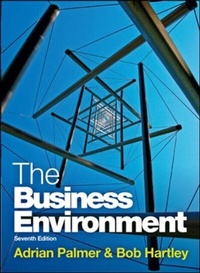
Business Environment 7e
1st Edition
Published on 16. January 2011
705 pages
978-0-07-714138-7 (ISBN)
Description

The seventh edition of The Business Environment has been perfectly tailored to cover the core topics that will be studied on an introductory Business Environment module. This fully updated new edition provides comprehensive coverage of the varying factors that make up the business environment, with a particular focus on how these factors impact business organisations and the decisions organisations make.Key Features:Up-to-date coverageThe business environment continues to evolve, and this new edition takes on board recent issues including: The after-effects of the credit crunch The emerging economic power of China, India and Brazil Data security and privacy Business ethics Cultural identity Climate change Real life examplesNew opening vignettes introduce the main topic and show the business environment in real life. In addition, the book contains a wealth of shorter and longer case studies featuring companies such as Google, Amazon and Virgin Trains.PedagogyClearly written and user friendly, the book boasts a full range of learning tools which include: Learning Objectives, Thinking Around the Subject boxes, Review Questions, and Activities.
More details
Other editions
Additional editions
Adrian Palmer | Bob Hartley
The Business Environment
Book
11/2011
7th Edition
McGraw Hill Higher Education
€70.67
Shipment within 15-20 days
Content
- Cover
- Half Title
- Title
- Copyright
- Brief Table of Contents
- Detailed Table of Contents
- Preface
- About the Authors
- Guided Tour
- Online Learning Centre
- McGraw-Hill Create
- Make the Gradel
- Acknowledgements
- Part 1 Contexts
- Chapter 1 What is the Business Environment?
- 1.1 Defining the business environment
- 1.2 Why study the business environment?
- 1.3 The macroenvironment
- 1.4 The microenvironment
- 1.5 The internal environment
- 1.6 Contextual issues in a dynamic environment
- 1.7 The globalized business environment
- Case Study: A war of words over green airline claims
- Part 2 The Macroenvironment
- Chapter 2 The Political Environment
- 2.1 Defining the political environment
- 2.2 Political systems
- 2.3 The importance of monitoring the political environment
- 2.4 Political ideologies
- 2.5 The structure of government
- 2.6 Central government
- 2.7 Regional and national government
- 2.8 Local government
- 2.9 The European Union
- 2.10 Supranational governmental organizations
- 2.11 Improving the standards of government administration
- 2.12 Impacts of government on business operations
- 2.13 Influences on government policy formation
- Case study: Should government be running the railways?
- Chapter 3 The Social and Demographic Environment
- 3.1 Social change and its effects on business organizations
- 3.2 The cultural environment
- 3.3 The family
- 3.4 Reference groups
- 3.5 Values, attitudes and lifestyles
- 3.6 Identifying and measuring social groups
- 3.7 Demography
- Case study: A journey through Liverpool ? European Capital of Culture 2008
- Chapter 4 The Technological and Information Environment
- 4.1 What is technology?
- 4.2 Impacts of technology on business operations
- 4.3 Techonology and society
- 4.4 Forecasting new technologies
- 4.5 Expenditure on research and development
- 4.6 Product design and development
- 4.7 Manufacturing and processing
- 4.8 Supply chain management
- 4.9 Point of scale, order and payment processing
- 4.10 Communicating with customers
- 4.11 Managing customer relationships
- 4.12 Performance measurement
- 4.13 Technology and the ecological enviroment
- 4.14 The internet and electronic business
- 4.15 Data security and privacy
- Case study: Will the bank of the future be 'mobile'?
- Chapter 5 The Ecological and Social Responsibilities of Organizations
- 5.1 Introduction
- 5.2 Challenges to the market-led business environment
- 5.3 The stakeholders of organizations
- 5.4 Corporate governance
- 5.5 Ethics
- 5.6 Business and ecological responsibility
- Case study: 'Bikes for all' may be a big plus for the environment, but a big challenge for all stakeholders
- Chapter 6 The Legal Environment
- 6.1 Introduction
- 6.2 The law of contract
- 6.3 Non-contractual liability
- 6.4 Legal processes
- 6.5 Legislation affecting the supply of goods and services
- 6.6 Statutory legislation on employment
- 6.7 The Human Rights Act 1998
- 6.8 Protection of a company's intangible property rights
- 6.9 The law and production processes
- 6.10 Legislation to protect the competitiveness of markets
- Case study: Legislation strengthened in a bid to end 'nightmare' holidays
- Part 3 Firms
- Chapter 7 Types of Business Organization
- 7.1 Introduction: organizations and their environment
- 7.2 The sole trader
- 7.3 Partnerships
- 7.4 Limited companies
- 7.5 Commercial and quasi-commercial organizations operating in the public sector
- 7.6 Quangos
- 7.7 Public-private partnerships
- 7.8 Other types of organization
- Case study: Cooking by yourself or with company?
- Chapter 8 Business Relationships and Networks
- 8.1 Introduction
- 8.2 Types of business relationship
- 8.3 Theories and explanations underpinning networks and relationships
- 8.4 'Just-in-time' relationships
- 8.5 Power in business networks
- 8.6 Developing close relationships with customers
- 8.7 Relationships between connected customers
- Case study: Contaminated food spreads through the value chain from the fields of India to the supermarkets of Sheffield
- Chapter 9 Managing and Financing Organizational Growth
- 9.1 Introduction
- 9.2 The objectives of organizations
- 9.3 What is the right size for an organization?
- 9.4 Patterns of growth
- 9.5 Finance for growing organizations
- 9.6 Finance implications of strategic growth options
- Case study: Can Tesco become too big?
- Chapter 10 People in Organizations
- 10.1 The link between internal and external environments
- 10.2 Defining the organizational strategy
- 10.3 Creating engagement by employees
- 10.4 Training and development
- 10.5 Rewarding staff
- 10.6 Controlling and empowering staff
- 10.7 Industrial relations
- 10.8 The internal functions of commercial organizations
- 10.9 Bases for organizing a commercial organization
- 10.10 The flexible organization
- 10.11 Reducing dependence on human resources
- Case study: A 24/7 society may be good for customers, but can employees cope with the stress?
- Part 4 Markets
- Chapter 11 The Principles of Market Forces
- 11.1 Introduction
- 11.2 The characteristics of very competitive markets
- 11.3 Batering and auctions
- 11.4 Going rate pricing
- 11.5 Elasticity of demand
- 11.6 Imperfect competition and elasticity of demand
- 11.7 Elasticity of supply
- 11.8 Limitations of the theory of perfect competition
- Case study: Can market mechanisms reduce global climate change?
- Chapter 12 Distortions to Market Forces
- 12.1 Introduction
- 12.2 Oligopoly
- 12.3 Analysing competitive forces within a market
- 12.4 Monopolistic markets
- 12.5 Competition policy
- Case study: Competitive market for mobile phones still needs regulation
- Chapter 13 The National Economic and Financial Environment
- 13.1 Macroeconomic analysis
- 13.2 The structure of national economies
- 13.3 The circular flow of income
- 13.4 The business cycle
- 13.5 Macroeconomic policy
- 13.6 The international macroeconomic environment
- Case study: How sustainable is the Chinese economic boom?
- Chapter 14 The Global Business Environment
- 14.1 The trend towards a global business environment
- 14.2 Theory of international trade
- 14.3 Overseas trade patterns
- 14.4 International trade institutions and agreements
- 14.5 Evaluating overseas business opportunities
- 14.6 Sources of information on overseas markets
- Case study: Indian call centres create new international trade
- Part 5 Bringing it Together: Environmental Analysis
- Chapter 15 The Dynamic Business Environment
- 15.1 Introduction
- 15.2 The importance of environmental knowledge
- 15.3 Information systems
- 15.4 Forward planning with research
- 15.5 Frameworks for analysing the business environment
- 15.6 Forming a view of environmental influence
- 15.7 Managing operational risk
- Case study: Strategic challenges and opportunities at Thomas Cook
- Chapter 16 Case Studies
- 16.1 Farming becomes part of the services sector
- 16.2 How many winning ideas can you back?
- 16.3 Health services go online in an increasingly competitive environment
- 16.4 UK rail fares move to market-based pricing
- 16.5 Retailers drown in information about their customers
- Glossary
- Index
