

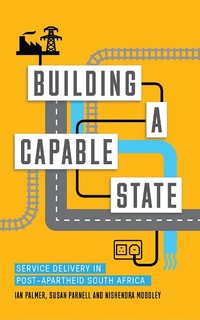
Building a Capable State
Service Delivery in Post-Apartheid South Africa
1st Edition
Published on 15. November 2017
320 pages
978-1-78360-966-6 (ISBN)
Description

The sustainable development goals signed in 2016 marked a new phase in global development thinking, one which is focused on ecologically and fiscally sustainable human settlements. Few countries offer a better testing ground for their attainment than post-apartheid South Africa. Since the coming to power of the African National Congress, the country has undergone a policy making revolution, driven by an urgent need to improve access to services for the country's black majority.
A quarter century on from the fall of apartheid, Building a Capable State asks what lessons can be learned from the South African experience. The book assesses whether the South African government has succeeded in improving service delivery, focusing on the vital sectors of water and sanitation, energy, roads, public transport and housing. Emphasizing the often-overlooked role of local government institutions and finance, the book demonstrates that effective service delivery can have a profound impact on the social structure of emerging economies, and must form an integral part of any future development strategy.
A comprehensive examination of urban service delivery in the global South, Building a Capable State is essential reading for students and practitioners across the social sciences, public finance and engineering sectors.
A quarter century on from the fall of apartheid, Building a Capable State asks what lessons can be learned from the South African experience. The book assesses whether the South African government has succeeded in improving service delivery, focusing on the vital sectors of water and sanitation, energy, roads, public transport and housing. Emphasizing the often-overlooked role of local government institutions and finance, the book demonstrates that effective service delivery can have a profound impact on the social structure of emerging economies, and must form an integral part of any future development strategy.
A comprehensive examination of urban service delivery in the global South, Building a Capable State is essential reading for students and practitioners across the social sciences, public finance and engineering sectors.
Reviews / Votes
Lucid and detailed. * Foreign Affairs * This brilliantly researched book holds lessons for the many countries dealing with rapid urbanisation and growing demands for basic infrastructure in cities. * Julio D. Davila, University College London * A landmark critical review drawing on a rich evidence base from both academic and practitioner perspectives. Its insights and analytical framework have relevance for other countries and cities facing the challenges of the "new urban" agenda. * Stephen Essex, Plymouth University * The authors present a rich, comprehensive but sober analysis of progress achieved by the South African public sector in the two decades after apartheid. Their view from the local level is particularly relevant, as South Africa is one of the few African countries with empowered sub-national government. * William Cobbett, Director, Cities Alliance *More details
Edition
1. Auflage
Language
English
Place of publication
London
United Kingdom
Publishing group
Bloomsbury Publishing PLC
Target group
College/higher education
Professional and scholarly
Illustrations
Tables, black and white 40 ; Figures 76
ISBN-13
978-1-78360-966-6 (9781783609666)
Copyright in bibliographic data and cover images is held by Nielsen Book Services Limited or by the publishers or by their respective licensors: all rights reserved.
Schweitzer Classification
Other editions
Additional editions
Ian Palmer | Nishendra Moodley | Susan Parnell
Building a Capable State
Service Delivery in Post-Apartheid South Africa
Book
11/2017
Zed Books Ltd
€118.60
Shipment within 3-4 weeks
Ian Palmer | Nishendra Moodley | Susan Parnell
Building a Capable State
Service Delivery in Post-Apartheid South Africa
Book
11/2017
Zed Books Ltd
€54.65
Shipment within 3-4 weeks
Persons
Ian Palmer is the founder of Palmer Development Group (PDG). He has 40 years experience in the fields of civil engineering and development. Ian is also an adjunct professor at the University of Cape Town (UCT) attached to the African Centre for Cities. For a period of 15 years from 1997 to 2012 he was on the board of Mvula Trust, an NGO focused on providing water and sanitation for rural communities.
Nishendra Moodley currently works with the South African National Treasury's City Support Programme. He joined the City of Cape Town in 1998 to manage local government transformation projects and subsequently joined and later led Palmer Development Group (PDG). He has a Master's degree in Public Administration. He has worked on local government policy development, monitoring and evaluation processes for national government, and institutional transformation projects for municipalities.
Susan Parnell is a Professor of Urban Geography in the Department of Environmental and Geographical Sciences at UCT. She is centrally involved in the African Centre for Cities, serving on its executive. She is the author of over a hundred peer reviewed papers, and a number of books, including Africa's Urban Revolution (co-edited with E. Pieterse, Zed 2014)
Nishendra Moodley currently works with the South African National Treasury's City Support Programme. He joined the City of Cape Town in 1998 to manage local government transformation projects and subsequently joined and later led Palmer Development Group (PDG). He has a Master's degree in Public Administration. He has worked on local government policy development, monitoring and evaluation processes for national government, and institutional transformation projects for municipalities.
Susan Parnell is a Professor of Urban Geography in the Department of Environmental and Geographical Sciences at UCT. She is centrally involved in the African Centre for Cities, serving on its executive. She is the author of over a hundred peer reviewed papers, and a number of books, including Africa's Urban Revolution (co-edited with E. Pieterse, Zed 2014)
Content
Preface
1. What is the 'Capable' State?
2. Twenty Years: Local Government in Transition
3. Institutions
4. Improving Capability through Regulation and Support
5. Municipal Organisational Capability
6. Financing Municipal Services
7. Water and Sanitation
8. Electricity
9. Roads and Public Transport
10. Housing
11. Is South Africa a Capable State?
Appendix A: Comparative Country Profiles
Appendix B: Economic Factors
1. What is the 'Capable' State?
2. Twenty Years: Local Government in Transition
3. Institutions
4. Improving Capability through Regulation and Support
5. Municipal Organisational Capability
6. Financing Municipal Services
7. Water and Sanitation
8. Electricity
9. Roads and Public Transport
10. Housing
11. Is South Africa a Capable State?
Appendix A: Comparative Country Profiles
Appendix B: Economic Factors
