

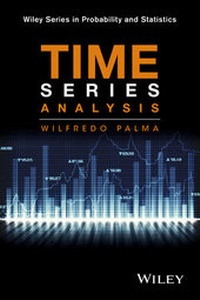
Time Series Analysis
Description

Reviews / Votes
"This book offers a comprehensive overview of time series analysis...The focus throughout is on methodologies and techniques selected to help the reader develop a working knowledge of practical applications of time series methods... The author manages to incorporate a huge number of topics and his book verges on the encyclopedic...This is a book that would likely be of more use to a serious practitioner of time series analysis than anyone coming fresh to the subject." (Mathematical Association of America 29/03/2017) "The book has many merits, covering carefully standard basic vocabulary of recently developing time series analysis and presenting lots of illustrative examples of applications that are well organized for the reader who intends to use R libraries for numerical computation" Yuzo Hosoya, MathSciNet, Aug 2017More details
Other editions
New editions
Additional editions
Person
Wilfredo Palma, PhD, is Professor of Statistics in the Department of Statistics at Pontificia Universidad Católica de Chile. Dr. Palma has published several refereed articles and has received over a dozen academic honors and awards. His research interests include time series analysis, prediction theory, state space systems, linear models, and econometrics. He is the author of Long-Memory Time Series: Theory and Methods, also published by Wiley.
Content
Preface xiii
Acknowledgments xvii
Acronyms xix
1 Introduction 1
1.1 Time Series Data 2
1.2 Random Variables and Statistical Modeling 16
1.3 Discrete-Time Models 22
1.4 Serial Dependence 22
1.5 Nonstationarity 25
1.6 Whiteness Testing 32
1.7 Parametric and Nonparametric Modeling 36
1.8 Forecasting 38
1.9 Time Series Modeling 38
1.10 Bibliographic Notes 39
Problems 39
2 Linear Processes 43
2.1 Definition 44
2.2 Stationarity 44
2.3 Invertibility 45
2.4 Causality 46
2.5 Representations of Linear Processes 46
2.6 Weak and Strong Dependence 49
2.7 ARMA Models 51
2.8 Autocovariance Function 56
2.9 ACF and Partial ACF Functions 57
2.10 ARFIMA Processes 64
2.11 Fractional Gaussian Noise 71
2.12 Bibliographic Notes 72
Problems 72
3 State Space Models 89
3.1 Introduction 90
3.2 Linear Dynamical Systems 92
3.3 State space Modeling of Linear Processes 96
3.4 State Estimation 97
3.5 Exogenous Variables 113
3.6 Bibliographic Notes 114
Problems 114
4 Spectral Analysis 121
4.1 Time and Frequency Domains 122
4.2 Linear Filters 122
4.3 Spectral Density 123
4.4 Periodogram 125
4.5 Smoothed Periodogram 128
4.6 Examples 130
4.7 Wavelets 136
4.8 Spectral Representation 138
4.9 Time-Varying Spectrum 140
4.10 Bibliographic Notes 145
Problems 145
5 Estimation Methods 151
5.1 Model Building 152
5.2 Parsimony 152
5.3 Akaike and Schwartz Information Criteria 153
5.4 Estimation of the Mean 153
5.5 Estimation of Autocovariances 154
5.6 Moment Estimation 155
5.7 Maximum-Likelihood Estimation 156
5.8 Whittle Estimation 157
5.9 State Space Estimation 160
5.10 Estimation of Long-Memory Processes 161
5.11 Numerical Experiments 178
5.12 Bayesian Estimation 180
5.13 Statistical Inference 184
5.14 Illustrations 189
5.15 Bibliographic Notes 193
Problems 194
6 Nonlinear Time Series 209
6.1 Introduction 210
6.2 Testing for Linearity 211
6.3 Heteroskedastic Data 212
6.4 ARCH Models 213
6.5 GARCH Models 216
6.6 ARFIMA-GARCH Models 218
6.7 ARCH(1) Models 220
6.8 APARCH Models 222
6.9 Stochastic Volatility 222
6.10 Numerical Experiments 223
6.11 Data Applications 225
6.12 Value at Risk 236
6.13 Autocorrelation of Squares 241
6.14 Threshold autoregressive models 247
6.15 Bibliographic Notes 252
Problems 253
7 Prediction 267
7.1 Optimal Prediction 268
7.2 One-Step Ahead Predictors 268
7.3 Multistep Ahead Predictors 275
7.4 Heteroskedastic Models 276
7.5 Prediction Bands 281
7.6 Data Application 287
7.7 Bibliographic Notes 289
Problems 289
8 Nonstationary Processes 295
8.1 Introduction 296
8.2 Unit Root Testing 297
8.3 ARIMA Processes 298
8.4 Locally Stationary Processes 301
8.5 Structural Breaks 326
8.6 Bibliographic Notes 331
Problems 332
9 Seasonality 337
9.1 SARIMA Models 338
9.2 SARFIMA Models 351
9.3 GARMA Models 353
9.4 Calculation of the Asymptotic Variance 355
9.5 Autocovariance Function 355
9.6 Monte Carlo Studies 359
9.7 Illustration 362
9.8 Bibliographic Notes 364
Problems 365
10 Time Series Regression 369
10.1 Motivation 370
10.2 Definitions 373
10.3 Properties of the LSE 375
10.4 Properties of the BLUE 376
10.5 Estimation of the Mean 379
10.6 Polynomial Trend 382
10.7 Harmonic Regression 386
10.8 Illustration: Air Pollution Data 388
10.9 Bibliographic Notes 392
Problems 392
11 Missing Values and Outliers 399
11.1 Introduction 400
11.2 Likelihood Function with Missing Values 401
11.3 Effects of Missing Values on ML Estimates 405
11.4 Effects of Missing Values on Prediction 407
11.5 Interpolation of Missing Data 410
11.6 Spectral Estimation with Missing Values 418
11.7 Outliers and Intervention Analysis 421
11.8 Bibliographic Notes 434
Problems 435
12 Non-Gaussian Time Series 441
12.1 Data Driven Models 442
12.2 Parameter Driven Models 452
12.3 Estimation 453
12.4 Data Illustrations 466
12.5 Zero-Inflated Models 477
12.6 Bibliographic Notes 483
Problems 483
Appendix A: Complements 487
A.1 Projection Theorem 488
A.2 Wold Decomposition 490
A.3 Bibliographic Notes 497
Appendix B: Solutions to Selected Problems 499
Appendix C: Data and Codes 557
References 559
Topic Index 573
Author Index 577
Chapter 1
INTRODUCTION
A time series is a collection of observations taken sequentially in time. The nature of these observations can be as diverse as numbers, labels, colors, and many others. On the other hand, the times at which the observations were taken can be regularly or irregularly spaced. Moreover, time can be continuous or discrete. In this text, we focus primarily on describing methods for handling numeric time series observed at regular intervals of time. Note, however, that many nonnumeric data can be readily transformed to numeric. For instance, data concerning an election between candidate A and candidate B can be described by a numeric variable taking the value 0 for candidate A and 1 for candidate B. However, data observed at irregular time intervals are more difficult to handle. In this case, one may approximate the actual time to the closest integer value and still use the methodologies for handling regularly spaced series. If this approach does not provide adequate results, there are a number of more advanced techniques to treat those types of data. Another common problem in time series analysis is missing observations. In this case, the collected data display irregularly spaced observation times. There are special techniques for handling this problem and some of them are discussed in Chapter 11.
This introductory chapter presents a number of real-life time series data examples as well as provides a general overview of some essential concepts of the statistical analysis of time series, such as random variable, stochastic process, probability distribution and autocorrelation, among others. These notions are fundamental for the statistical modeling of serially dependent data.
Since this text attempts to reach a large audience interested in time series analysis, many of the more technical concepts are explained in a rigorous but simple manner. Readers interested in extending their knowledge of some particular concept in time series analysis will find an extensive list of references and a selected bibliographical discussion at the end of each chapter.
1.1 TIME SERIES DATA
Let us denote by {yt} a time series where t denotes the time at which the observation was taken. Usually, , where is the set of positive and negative integer values. In practice, however, only a finite stretch of data is available. In such situations, we can write the time series as {y1, y2, ., yn}. A time series {yt} corresponds to a stochastic process which in turn is composed of random variables observed across time. Both concepts are explained in detail later in this chapter.
Several examples of real-life time series data are presented in the following subsections. These data illustrations come from fields as diverse as, finance, economic, sociology, energy, medicine, climatology, and transport, among many others. Apart from exhibiting the time series, we describe their main features and some basic data transformations that help uncovering these characteristics.
1.1.1 Financial Data
Finance is a field where time series arises naturally from the evolution of indexes and prices. In what follows, we present two basic examples, the evolution of a well-known stock index and its volume of stock transactions.
Standard & Poor's Stock Index. Figure 1.1 shows the logarithm of the S&P500 daily stock index for the period from January 1950 to January 2014. Note that this index seems to increase with time, but there are some downward periods commonly denoted as bear markets. In order to study these indices, it is customary in finance to consider the logarithm return, which is defined as
where Pt denotes the price or the index value at time t. These returns are displayed in Figure 1.2. Observe the great drop in returns experienced on October 1987 and the abrupt changes or great volatility during 2009.
Figure 1.1 S&P500 daily stock log index, January 1950 to January 2014.
Figure 1.2 S&P500 daily log returns, January 1950 to January 2014.
Another look at the volatility is shown in Figure 1.3 where the squared returns, , are plotted. From this graph, the high volatility of this stock index is evident during these periods.
Figure 1.3 S&P500 daily square log returns, January 1950 to January 2014.
Financial time series possess specific features, such as those indicated above. Consequently, Chapter 6 describes methodologies for handling this type of data. These time series can be analyzed by means of the so-called conditionally heteroskedastic processes or stochastic volatility models, among others.
Volume of Transactions. As another example of financial data, the daily volume of transactions of the S&P500 stocks is displayed in Figure 1.4. Observe that this series exhibits an upward trend up to 2009.
Figure 1.4 S&P500 daily volume of transactions, January 1950 to January 2014.
On the other hand, Figure 1.5 depicts a logarithm transformation of the above time series. Note that the variance of the data across time is now more stabilized, emerging a seemingly overall upward trend, excepting the values after 2009 and some other periods.
Figure 1.5 S&P500 daily log volume of transactions, January 1950 to January 2014.
These transaction volume data can be considered as an example of a non-Gaussian time series. In particular, these observations are positive counts. Specific methods for modeling and predicting non-Gaussian data are described in Chapter 12.
1.1.2 Economic Data
Figure 1.6(a) exhibits the monthly US employment in the arts, entertainment and recreation section for the January 1990 to December 2012, measured in thousands of persons. On the other hand, Figure 1.6(b) shows the logarithm transformation of these data. Notice that this data transformation seems to stabilize the variance of the series across time. On both panels, however, a seasonal pattern and an upper trend are evident.
Figure 1.6 US employment arts, entertainment, and recreation, January 1990 to December 2012.
1.1.3 Hydrological Data
In hydrology, time series data is usually related to the collection of river flows observations though the years. For example, the yearly minimum water levels of the Nile river measured at the Roda gauge is a well-known time series exhibiting high levels of serial dependency. These measurements, available from Statlib, www.stat.cmu.edu, are displayed in Figure 1.7 spanning a time period from 622 A.D. to 1921 A.D.
Figure 1.7 Nile river yearly minimum level at the Roda gauge, from 622 A.D. to 1921 A.D.
Notice that there are several blocks of seemingly repeated values. That is, consecutive years having exactly the same minimum water level. Since the observations are specified by four digits, these repetitions are probably the result of a lack of new information. The analysis of this time series data also indicates that the first 100 observations seem to have a different serial dependence structure, suffering a structural break phenomenon.
A detailed analysis of this historically important hydrological time series is proved in Chapter 8, where the changes in the serial dependence structure of these observations are modeled. The analysis of these hydrological data was crucial in the formal study of the so-called long-memory processes reviewed in Chapter 2.
1.1.4 Air Pollution
Figure 1.8 exhibits a daily index that measures the particulate matter of diameter less than 2.5 µ in Santiago, Chile, for the period 1989-1999, commonly referred to as PM2.5. A log-transformed data is shown in Figure 1.9.
Figure 1.8 Air pollution data: daily PM2.5 measurements at Santiago, Chile, 1989 - 1999.
Figure 1.9 Air pollution data: log daily PM2.5 measurements at Santiago, Chile, 1989 - 1999.
These measurements indicate the level of air pollution in certain city or region. Note the seasonal behavior of this series, due to the effects of climate conditions across the year. In winter, the PM2.5 level increases dramatically. On the other hand, it appears that there is downward trend in the series, indicating an improvement of the air quality during that period. In order to stabilize the variance exhibited by this data, a logarithmic transformation has been made and the resulting series is shown in Figure 1.9. A possible downward trend is now more clear in the transformed data.
1.1.5 Transportation Data
Figure 1.10 shows the number of monthly passenger enplanements for the period from January 2004 to December 2013. These observations correspond to the number of passenger boarding an airplane in the United States in a given month. Note the seasonal behavior of this series derived from the annual cycle of winter and summer seasons. Besides, it seems that there was a drop on passenger enplanements around 2009, revealing a plausible effect of the financial crisis of that year. In this situation, it is possible that the process was affected by a structural break or structural change. Methodologies for...
