
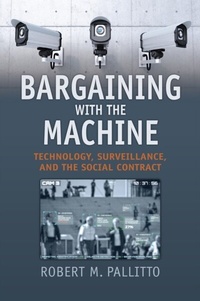
Bargaining with the Machine
Description
Alles über E-Books | Antworten auf Fragen rund um E-Books, Kopierschutz und Dateiformate finden Sie in unserem Info- & Hilfebereich.
Cell phone apps share location information; software companies store user data in the cloud; biometric scanners read fingerprints; employees of some businesses have microchips implanted in their hands. In each of these instances we trade a share of privacy or an aspect of identity for greater convenience or improved security. What Robert M. Pallitto asks in Bargaining with the Machine is whether we are truly making such bargains freely?whether, in fact, such a transaction can be conducted freely or advisedly in our ever more technologically sophisticated world.
Pallitto uses the social theory of bargaining to look at the daily compromises we make with technology. Specifically, he explores whether resisting these ?bargains? is still possible when the technologies in question are backed by persuasive, even coercive, corporate and state power. Who, he asks, is proposing the bargain? What is the balance of bargaining power? What is surrendered and what is gained? And are the perceived and the actual gains and losses the same?that is, what is hidden?
At the center of Pallitto's work is the paradox of bargaining in a world of limited agency. Assurances that we are in control are abundant whether we are consumers, voters, or party to the social contract. But when purchasing goods from a technological behemoth like Amazon, or when choosing a candidate whose image is crafted and shaped by campaign strategists and media outlets, how truly free, let alone informed, are our choices?
The tension between claims of agency and awareness of its limits is the site where we experience our social lives?and nowhere is this tension more pronounced than in the surveillance society. This book offers a cogent analysis of how that complex, contested, and even paradoxical experience arises as well as an unusually clear and troubling view of the consequential compromises we may be making.
All prices
More details
Other editions
Additional editions

Person
Content
Acknowledgments
1. Introduction: Irresistible Bargains
2. Technologies of Convenience and Efficiency
3. Technologies of Ubiquity and Obscurity
4. the Internet of Things and the Smart City
5. Avenues of Resistance
6. Conclusion: Technology, Surveillance, and the Social Contract
Notes
Bibliography
Index

System requirements
File format: ePUB
Copy protection: Adobe-DRM (Digital Rights Management)
System requirements:
- Computer (Windows; MacOS X; Linux): Install the free reader Adobe Digital Editions prior to download (see eBook Help).
- Tablet/smartphone (Android; iOS): Install the free app Adobe Digital Editions or the app PocketBook before downloading (see eBook Help).
- E-reader: Bookeen, Kobo, Pocketbook, Sony, Tolino and many more (not Kindle).
The file format ePub works well for novels and non-fiction books – i.e., „flowing” text without complex layout. On an e-reader or smartphone, line and page breaks automatically adjust to fit the small displays.
This eBook uses Adobe-DRM, a „hard” copy protection. If the necessary requirements are not met, unfortunately you will not be able to open the eBook. You will therefore need to prepare your reading hardware before downloading.
Please note: We strongly recommend that you authorise using your personal Adobe ID after installation of any reading software.
For more information, see our ebook Help page.
File format: PDF
Copy-Protection: Adobe-DRM (Digital Rights Management)
System requirements:
- Computer (Windows; MacOS X; Linux): Install the free reader Adobe Digital Editions prior to download (see eBook Help).
- Tablet/smartphone (Android; iOS): Install the free app Adobe Digital Editions or the app PocketBook before downloading (see eBook Help).
- E-reader: Bookeen, Kobo, Pocketbook, Sony, Tolino and many more (only limited: Kindle).
The file format PDF always displays a book page identically on any hardware. This makes PDF suitable for complex layouts such as those used in textbooks and reference books (images, tables, columns, footnotes). Unfortunately, on the small screens of e-readers or smartphones, PDFs are rather annoying, requiring too much scrolling.
This eBook uses Adobe-DRM, a „hard” copy protection. If the necessary requirements are not met, unfortunately you will not be able to open the eBook. You will therefore need to prepare your reading hardware before downloading.
Please note: We strongly recommend that you authorise using your personal Adobe ID after installation of any reading software.
For more information, see our eBook Help page.
File format: ePUB
Copy protection: Watermark-DRM (Digital Rights Management)
System requirements:
- Computer (Windows; MacOS X; Linux): Use a reading software that can process the file format ePUB: e.g., Adobe Digital Editions or FBReader – both free (see eBook Help).
- Tablet/Smartphone (Android; iOS): Before downloading, install the free app Adobe Digital Editions (see eBook Help).
- E-reader: Bookeen, Kobo, Pocketbook, Sony, Tolino and many more (not Kindle).
The file format ePUB works well for novels and non-fiction books – i.e., „flowing” text without complex layout. On an e-reader or smartphone, line and page breaks automatically adjust to fit the small displays.
This eBook uses Watermark-DRM, a „soft” copy protection. This means that there are no technical restrictions to prevent illegal distribution. However, there is a personalised watermark embedded in the eBook that can be used to identify the purchaser of the eBook in the event of misuse and to provide evidence for legal purposes.
For more information, see our eBook Help page.
